
 El Monte
 Log in
Log in
Log in
Six Dark Rooms Around New York, and the Very Different Buildings Wrapped Around Them
A basement under the Manhattan Bridge where the columns are original factory ironwork and the bar upstairs stops serving to anyone under eighteen after eight on a Thursday. A mall in Glendale where one wristband covers a trampoline park, a foam-ball arena, a bowling alley the size of a hallway and a laser maze, with the laser tag arena tucked in among them like one more ride. A four-thousand-square-foot room on Long Island lit in fuchsia and cerulean, with axe-throwing lanes down the corridor and beer on the menu. A family in Mount Kisco who own a hundred and twenty-five laser rifles, a stack of inflatable barricades and no building whatsoever.
Here is the thing nobody tells you when you start calling around: the arena itself is close to identical everywhere. Dark room, black light, chest-high cover, vests that buzz when you are hit, rounds of ten to fifteen minutes. What actually differs between one club and the next is not the game. It is the building. Almost nobody in the New York area builds a laser tag club; they build an amusement park, a children’s fun center, an axe bar or a converted warehouse, and then they put an arena inside it. That decision determines who else is in the room with you, what you do for the two hours around the game, whether there is a beer at the end, and what the whole thing costs.
Six clubs in the catalog, spread from Brooklyn to Orange County, all verified as operating this autumn. Each one has a different answer to the question of what surrounds the dark room.
Area 53 runs its laser tag site in DUMBO, Brooklyn, a few minutes’ walk from the York Street and High Street subway stations, which makes it the one club here that a group without a car can simply turn up to.
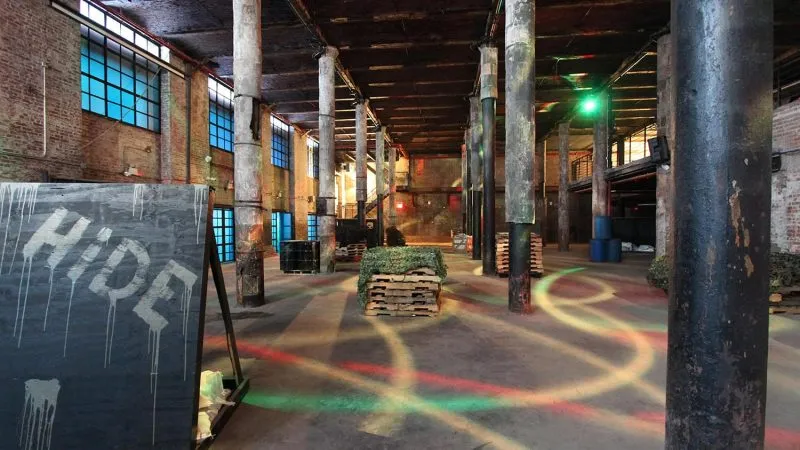
Laser tag “Area 53 Dumbo” in Brooklyn, NY
The arena is a dual-level factory basement, and the operators have kept the bones of it: original columns, low ceilings, sightlines that end abruptly. Cover has been added around the ironwork rather than in place of it, so the map plays as a series of short, sharp encounters rather than long-range trading. Up to twenty-six players fit in a single game. A private session needs ten players on a weekday or fourteen on a weekend, and a full buyout of the venue is available for larger groups.
Beyond the arena there is a four-lane mini-bowling setup with four novelty game modes, and an arcade. Worth knowing before you book: Area 53 runs two further sites in Williamsburg, one an indoor dual-level paintball arena and one an adventure park with rock walls, a ropes course and a roller rink, so a long day can be split across brands under a single operator.
After the game there is a second-floor lounge with seating, game tables and catering. The food comes from the venue’s own menu; outside food and drink are not permitted, which matters if you were planning to carry in a cake.
Sessions run about ninety minutes to two hours and consist of three games across five modes, including Search and Destroy and a flag mode. Thursday evenings after eight are eighteen and over, and Thursday, Friday and Saturday run to midnight, which is unusual in this category and the reason this is the one club on the list that works as an adult night out rather than a daytime party.
The headline number is $39.99 per person on a weekday and $49.99 on a weekend, covering the full three-game session. Walk-ins who want a single game pay $15 on a weekday and $17 on a weekend. Mini bowling is separate, at $30 per booking for up to six players for twenty-five minutes.
Phone: (347) 305-7448
More info about the Area 53 Dumbo
Laser Bounce sits inside the Shops at Atlas Park in Glendale, Queens, with mall parking underneath, which solves the problem that most of the other clubs on this list create.
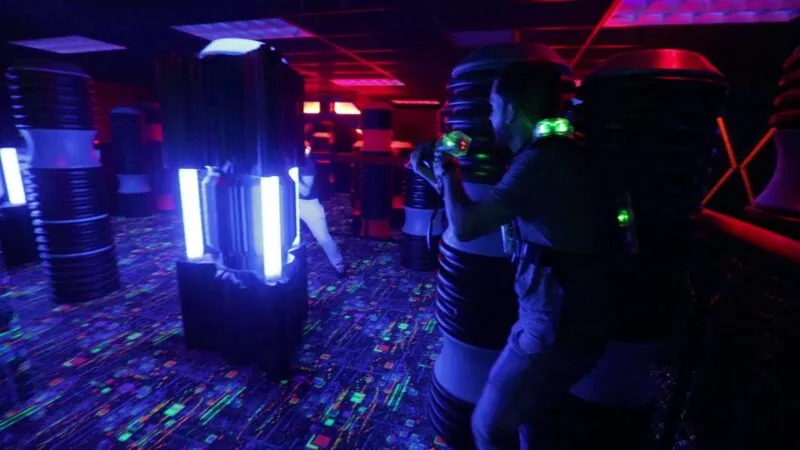
Laser tag “Laser Bounce Queens” in Glendale, NY
The arena is an LED build rather than a black-light one: the cover and the walls are lit from within, so the room reads as futuristic and glowing rather than dim. Up to twenty players go in at once, games run eight to fifteen minutes, and the formats are the familiar ones, capture the flag and free-for-all, around an obstacle course layout. It is a smaller and brighter room than the Brooklyn or Long Island arenas, and it is built with children in mind from age five up.
The surrounding building is where this place makes its case. Six more attractions share the floor: an inflatable trampoline park with ninja courses, Ballocity, a foam-ball arena with cannons and blasters, Highway 66 mini bowling, a Mission Impossible laser beam maze, a VR setup, and an arcade of about a hundred and fifty machines with prize redemption. A family that arrives with two children of very different ages can keep both of them occupied for four hours without leaving the unit.
Food is sold on site, and the venue’s own value bundles pair pizza, drinks and arcade credits with all-day play, which is the clearest signal of how they expect a visit to go.
Programs are built around passes rather than bespoke scenarios, and birthday packages come with a dedicated host and private access to attractions. This is a ready-made-package operation, not a build-it-to-order one.
Pricing follows the passes. A single laser tag session of two games is $25.95 per child. The Extreme Pass, at $44.95, adds all-day laser tag to all-day trampoline and Ballocity; the Ultimate Pass at $49.95 folds in bowling and the laser maze as well. If laser tag is the only thing you came for, $25.95 is the number; if you are there for the afternoon, the pass is better value than paying by attraction.
Phone: (347) 599-1919
More info about the Laser Bounce Queens
Fun Station USA is on Victory Boulevard in the middle of Staten Island, and it is the only laser tag arena in the borough, which is most of what you need to know about why people go there.
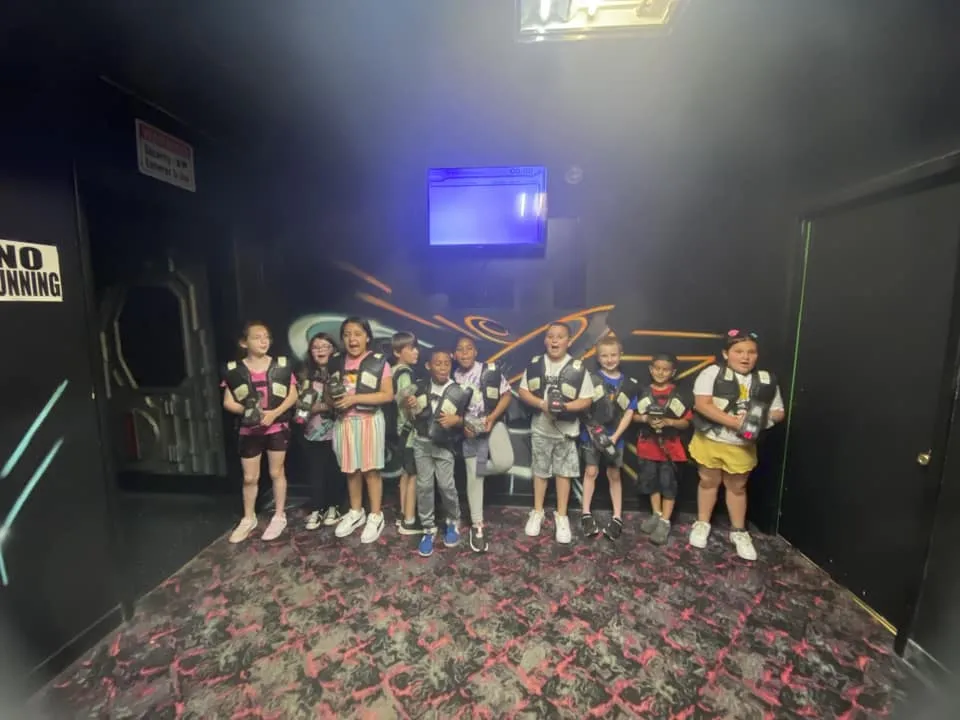
Laser tag “Fun Station USA” in Staten Island, NY
The arena is a darkened room lit by neon, with obstacles and cover arranged for fast missions; players take laser packs and phasers and run rounds built around stealth and teamwork. The venue does not publish arena dimensions or a maximum player count, which is a genuine gap when you are planning for a large group, and worth settling by phone before you commit.
What surrounds it is not a fun center so much as a small indoor amusement park. Bumper cars, a Himalaya, a Mini-Twister, an airplane ride and a train circle the floor; there is a multi-level soft-play maze with slides and hidden routes, a jungle gym, a VR simulator, an arcade, batting cages and basketball courts. It is the only venue here with actual carnival rides under the same roof.
There is a catering menu and party rooms, and party packages arrive with pizza and a Carvel cake, so the food question is answered in-house rather than by what you carry in.
The programs are packages, and they are generous in scope rather than tactical in design. The VIP laser tag package runs two hours and includes a private room, an hour of unlimited rides plus soft play and bounce, a round of laser tag, a t-shirt per child, thirty game-card credits each, pizza, supplies and cake.
On price, this is the one venue on the list that does not publish a walk-in rate card; ride access and laser tag rounds are sold at the counter and appear publicly only through third-party promotions, so treat any figure you see on a deal site with caution. The venue’s own published number is the package: $799.95 covers ten children, which works out at about $80 per child for the full two hours with food, and each additional child is $39.95. That per-head figure falls fast as the group grows, and it is not comparable to the pure game prices elsewhere on this list, because it includes an hour of rides and a meal.
Phone: (718) 370-0077
More info about the Fun Station USA
Q-ZAR sits on Voice Road in Carle Place, Nassau County, a few minutes from Roosevelt Field, which puts it within easy reach of most of western Long Island.
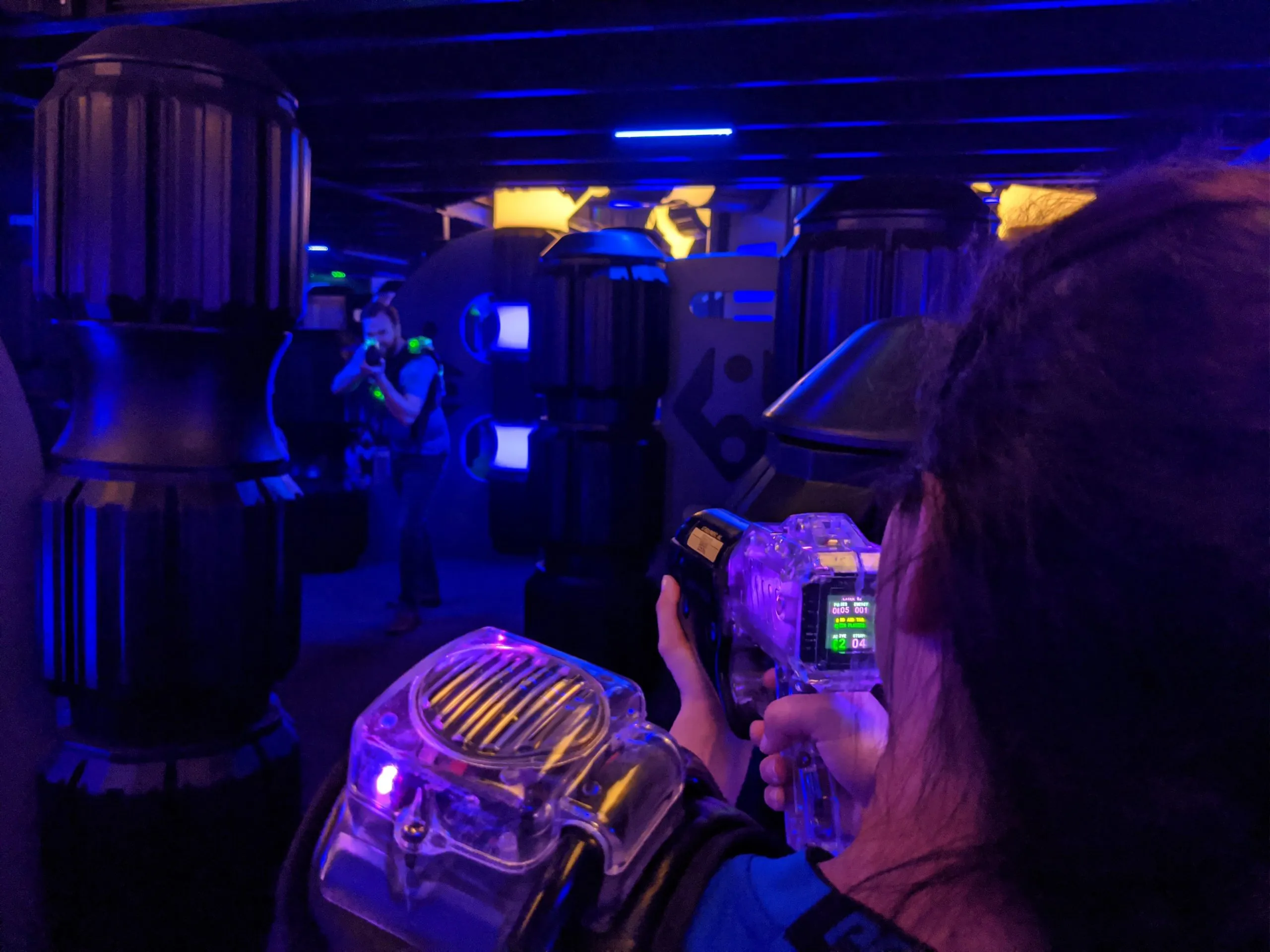
Laser tag “Q-ZAR & Q-AXE” in Carle Place, NY
The arena is four thousand square feet of black-lit battlefield with an elevated second level, painted in fuchsia, cerulean and a shade the venue itself calls radioactive sherbet. It holds up to forty-eight players in a single game, the largest single-game capacity on this list by a wide margin, and the vests and handsets are replaced as the technology moves. A second level changes how the room plays: cover is no longer only lateral, and a team that ignores the upper deck loses.
Alongside the arena are axe-throwing lanes with coaching staff and a large arcade including VR. The two activities are sold together in several packages, which is the point of the building.
There is a food menu and, unusually for this category, beer and wine, along with two party rooms that can be booked separately or together. That combination is the reason the place works for a company team-building afternoon as readily as for a twelve-year-old’s birthday.
Packages are the structure here, and there are many of them: standard, deluxe and mega laser tag parties, a smaller Q-Blast built around public games, dedicated axe parties, teen parties and kosher parties. Axe throwing has an age floor of twelve with a guardian present, one adult per two minors.
The clearest per-head figure comes from the standard laser tag party: $499.95 covers ten children with the birthday child free, which is roughly $50 each for three games, game cards, forty-five minutes of room time, pizza and drinks, with additional children at $39.99. That price reflects a $200 promotional discount off a list price of $699.95, so verify it is still running before you budget around it. The Q-Blast, at $399.95 for six guests, is about $67 a head and the cheapest way in for a small group. The Mega package at $1,299.95 for fifteen children adds two private axe lanes for ninety minutes.
Phone: (516) 877-7200
More info about the Q-ZAR & Q-AXE
The Castle Fun Center is in Chester, Orange County, about an hour up the Thruway from the George Washington Bridge and the furthest point on this list from the city.
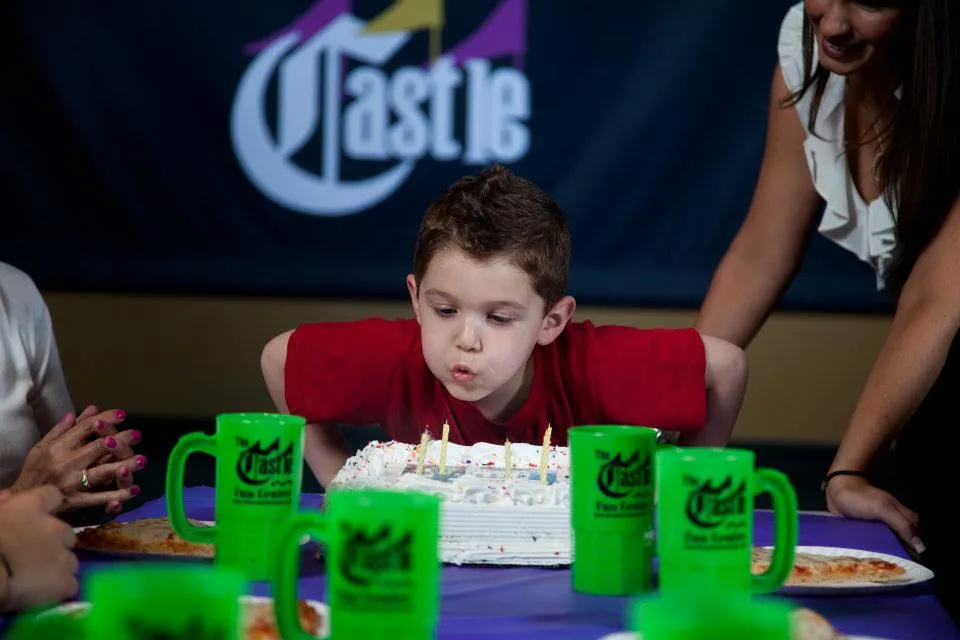
Laser tag “The Castle Fun Center” in Chester, NY
The arena is roughly thirty-five hundred square feet across two levels, lit entirely by black light, with castle-themed painted artwork, a heavy sound system and theatrical fog. Play runs along dungeon walls, over bridges and around corners; games last ten minutes and the recommended floor is age seven. The venue publishes no maximum player count for a single game, so a large group should call ahead.
The building around it is the largest on this list and the only one that goes outdoors. Indoors: bowling, roller skating, axe throwing, a two-level foam-ball arena, an inflatable park, a rock wall and an arcade. Outdoors and seasonal: four separate go-kart tracks, a dragon coaster, a swing ride, a zip line, mini golf, batting cages, a driving range and a free-fall tower. Laser tag here is one line item on a menu of about twenty.
Food comes from Jesters Restaurant and Pub on site, and there is a separate event centre for private functions, school trips and corporate days.
The structural difference is that there are no packages to buy into for a casual visit and no advance booking. You load money onto a Castle Card at a kiosk and pay per attraction, with no admission charge and no parking fee. Birthday and group packages exist if you want them, but they are optional rather than the only door in. Note the opening pattern: closed Monday and Tuesday, limited attractions Wednesday and Thursday.
That pay-as-you-go structure produces the lowest entry price here by a distance. A ten-minute laser tag game is $9.50 per person. Two games and a go-kart ride puts a visitor at about $32; bowling is $45 on weekdays or $48 on weekends per lane per hour for up to six, plus $5 for shoes, and the zip line is $10 a ride. The catch is the drive, and the fact that the outdoor attractions are seasonal.
Phone: (845) 469-2116
More info about the The Castle Fun Center
Outdoor Laser Tag USA is based in Mount Kisco, Westchester County, and works across Westchester, the rest of New York, Connecticut and New Jersey. The address in the catalog is an office, not a venue.
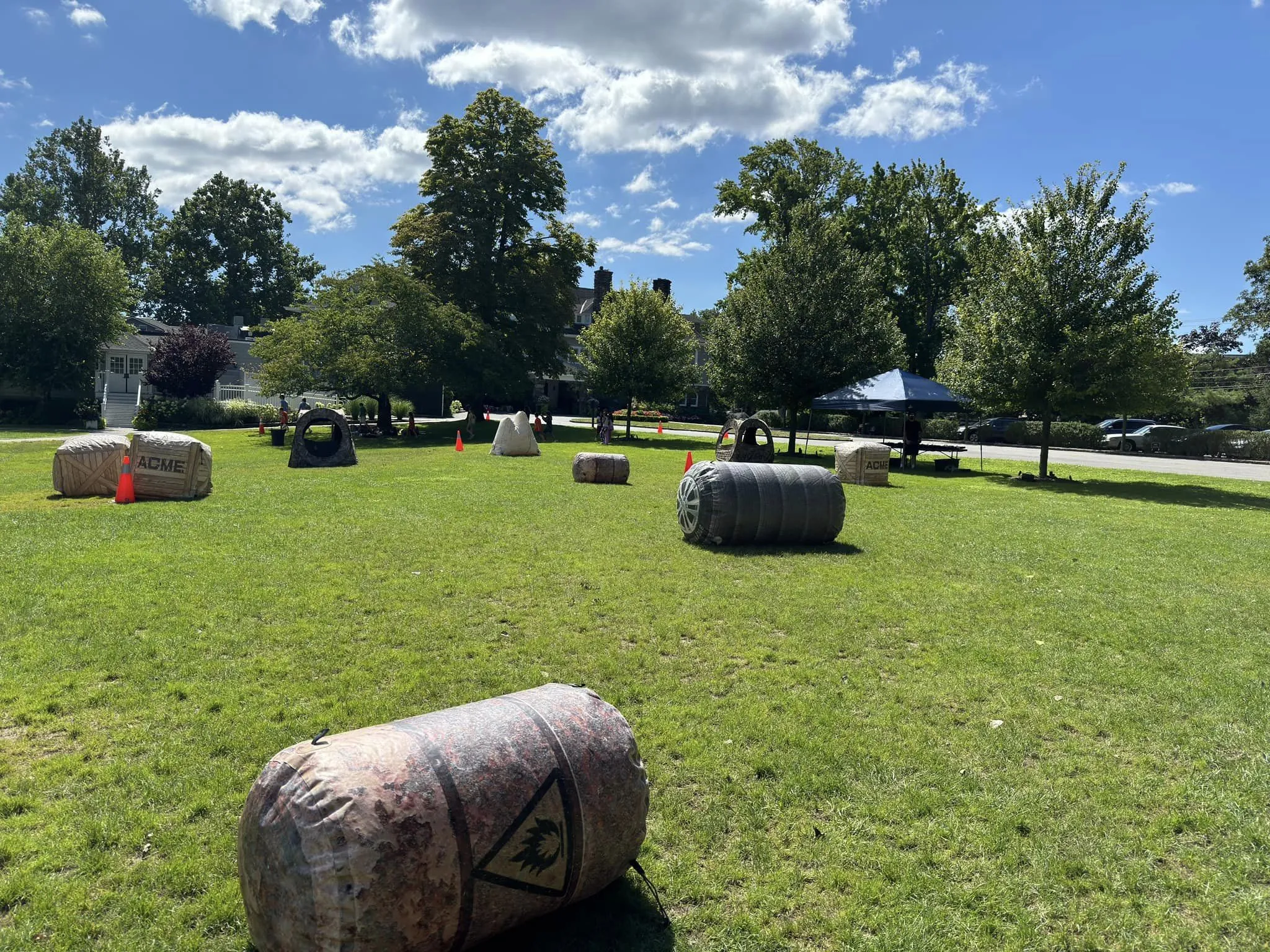
Laser tag “Outdoor Laser Tag USA” in Mount Kisco, NY
This is a family-run mobile operation, and the arena is whatever you have: a back garden, a school field, a camp clearing, a corporate lawn. The equipment is long-range outdoor gear that works in daylight or after dark, and inflatable barricades and camouflage pop-up tents are brought in to build cover on open ground. They hold over a hundred and twenty-five rifles, which is why the maths at the top end of this list looks nothing like the others: a group of four hundred is a normal booking, not an emergency.
There are no additional attractions, because there is no building. What that buys instead is scale and setting, and the freedom to hold the game where the rest of the party already is.
Rest and food are your problem and your advantage: it is your venue, so your catering, your cake, your alcohol policy. None of the indoor clubs on this list will let you bring in outside food; this one has no opinion on the matter.
Programs are mission scenarios with supervised staff, sold as event packages for birthdays, camps, schools, Bar and Bat Mitzvahs and corporate days. A $250 deposit, non-refundable, secures the date.
Pricing starts at $595 for the first eight players on the Boot Camp package, with each additional player at $50, so eight players is about $74 each and twenty players works out at roughly $60 each. The Special Ops package is $695 for eight with additional players at $60. Inflatable obstacles and camouflage tents add $125 to $350 depending on group size. At the far end of the scale, an event of four hundred players over five or six hours brings the cost down to around $9 a head, a figure no fixed arena on this list can approach.
Phone: (914) 413-7138
More info about the Outdoor Laser Tag USA
The simplest game across these six clubs runs from $9.50 to about $80 a head, and that spread explains almost nothing on its own, because the six numbers do not buy the same thing. Chester’s $9.50 is ten minutes of game time and nothing else. Brooklyn’s $15 walk-in buys one game; its $39.99 buys three. Glendale’s $25.95 covers two games, and $44.95 covers those plus a full day of six other attractions. Carle Place’s $50 a child and Staten Island’s $80 a child are party packages with pizza, room time and a host folded in. Mount Kisco’s $74 falls to about $60 once twenty people are playing and keeps falling after that. Sorting by price tells you very little. Sorting by what each building is built to do decides it in a sentence.
Six arenas, six exclusive arguments, and each one is true of exactly one club on this list.
Area 53 Dumbo is the only one you can reach without a car, and the only one that clears the children off the floor: Thursday nights after eight are eighteen and over, with the bar and the lounge open until midnight. Nothing else here is designed for adults after work.
Laser Bounce Queens is the only one that folds laser tag into an all-day wristband alongside six other attractions, so the arena costs nothing extra once you are inside. It is also the only one with a mall car park under it.
Fun Station USA is the only arena on Staten Island, and the only venue anywhere on this list with genuine carnival rides, bumper cars and a Himalaya, sharing the floor with the game.
Q-ZAR is the only one that puts forty-eight players into a single game, and the only one that will sell the adults in the group a glass of wine while the axe lanes are being reset.
The Castle Fun Center is the only one you can walk into without booking anything and pay ten-minute game by ten-minute game, at $9.50 a time; it is also the only one where the game is followed by go-karts, a zip line and a dragon coaster in the open air.
Outdoor Laser Tag USA is the only one with no building at all, which makes it the only option when the party is already happening somewhere else, and the only one whose price per player keeps falling as the group grows into the hundreds.
If the deciding factor is transit, it is Brooklyn. If it is a mixed-age family afternoon, Queens or Staten Island. If it is a corporate group of forty who would like a drink, Carle Place. If it is a full day out and a willingness to drive, Chester. If the venue is your own field, Mount Kisco.
6 Questions to Ask a Party Venue Before You Send the Deposit
A deposit on a New York party room runs $150 to $250, it is non-refundable, and at some venues you can only move the date if you ask more than three weeks out. Which means the window where your questions still change anything closes the moment you hit send. Most people start asking the day after.
The questions that actually decide how a birthday or a team outing goes — and what a straight answer sounds like versus a dodge.
The call almost always runs the same way. A parent asks the price and whether a Saturday is open. The manager gives the price and says the Saturday is open. Everyone hangs up satisfied, the deposit clears, and not one thing that will determine how the party actually goes has been mentioned. Dana Ruiz, who has been running kids’ parties on contract for about a decade, puts it bluntly: venues don’t lie, they just don’t volunteer. “Nobody is going to tell you on their own that a second group walks into your room at 4 p.m. That isn’t dishonesty. You didn’t ask.” Marcus Bell, a floor manager at a family entertainment center, thinks the problem runs the other direction. Fifteen minutes on the phone is not enough to explain how a building works, and the person calling has a picture in their head from somebody’s TikTok. “Ask me anything and I’ll tell you. But you only ask what it costs.” They’re both right, which is the whole problem. Here are the six questions that close the gap.
Ruiz lives in Ridgewood and works almost entirely in central and eastern Queens — Glendale, Middle Village, Maspeth, Forest Hills, and over the line into Bushwick. That isn’t loyalty, it’s logistics. A planner hauls decorations, a folding table and sometimes a cake, and on a good Saturday there are two parties back to back. Ninety minutes on the BQE between them turns the job into something else entirely. Party planners in this city are neighborhood animals: each one has four or five venues they know cold. There’s a useful takeaway in that for anyone reading. If you’re hiring help, hire someone who works your slice of the map. They’re not better than the rest — they’ve just been inside your venues a dozen times and know which manager calls back. The flip side is that every planner like this has a favorite, and the favorite is always the place fifteen minutes from home. Ruiz’s is Laser Bounce in Glendale, and she says so before you can point it out: “Sure I’m biased. I’m in that building more than anywhere else, which is exactly why I know more about it than about anywhere else.” Bell’s reply is worth keeping in mind: “Every planner has a house venue. It’s not always the best one. It’s the closest one.”
What follows is her reasoning on each question. Read it with that discount applied.
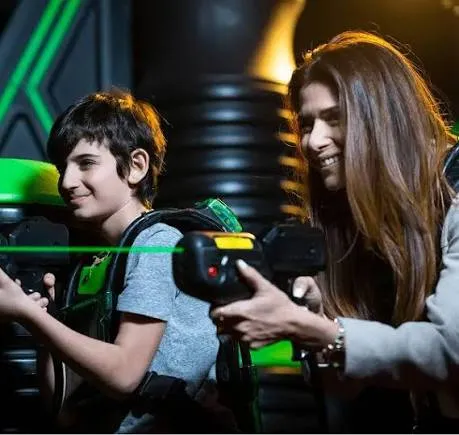
An arena photo tells you almost nothing about the thing that matters most: how many separate groups move through it in a day.
This is the one that surprises New York parents most, and it’s specific to how American entertainment centers are built. Most of them run open play all day — anyone can buy a ticket and walk into the arena. So “we booked laser tag for the party” can easily mean your ten nine-year-olds plus six teenagers who happened to be there, which is a different afternoon than the one you were picturing. The word to use is private, and the follow-up is which tier buys it. At Laser Bounce the answer changes by package: the higher tiers include private games, while the entry tier puts you into public play or gives you a choice between that and private laser tag. Same building, same afternoon, completely different experience — and the difference is a line item, not a favor. Worth asking in the same breath: how many players fit in one game. Twenty is a common ceiling, which means a party of thirty is two waves whether anyone said so or not.
Red flag: “You’ll basically have it to yourselves.” Basically is doing a lot of work in that sentence.
Party rooms in this format are timed, and the number is usually printed somewhere nobody reads. Forty-five minutes and ninety minutes are both normal, and they are not remotely the same party: at forty-five you are herding kids through pizza and cake against a clock, and the moment the candles are out somebody is stacking your chairs. A straight answer is boring and specific — “the room is yours 2:00 to 2:45, next party comes in at 3:15.” A dodge sounds smooth: “there’s usually plenty of time.” Ruiz says the room clock is the only upgrade she argues for with clients: “Ninety minutes instead of forty-five is the difference between a party and a fire drill. At my place that’s a package tier, and it’s the one line I tell people not to cheap out on.”
“Everything else you can fix on the day. You cannot fix not having the room.”
Dana Ruiz, party planner
American party packages are almost always priced for a fixed headcount — ten is the industry default — and that price holds whether ten kids come or six. Additional guests run somewhere around $40 to $50 each. So there are really three questions stacked inside this one: what headcount is baked into the package, what does each extra guest cost, and does anybody credit you for no-shows. The honest answer to the third is usually no, and a venue that says so plainly is telling you the truth about everything else too. Then ask about the adults, which people forget entirely. Twenty parents will show up with your ten kids. Do they count against anything? Is there food for them, and is it included, and can they buy a beer? At a venue where nobody may drop their child off — and that rule is more common than parents expect — you are not hosting ten guests, you are hosting thirty. Ruiz builds her headcounts on that assumption: “I plan for every kid arriving with one adult, because in this city that’s what happens. The train is not a place people send a seven-year-old alone.”
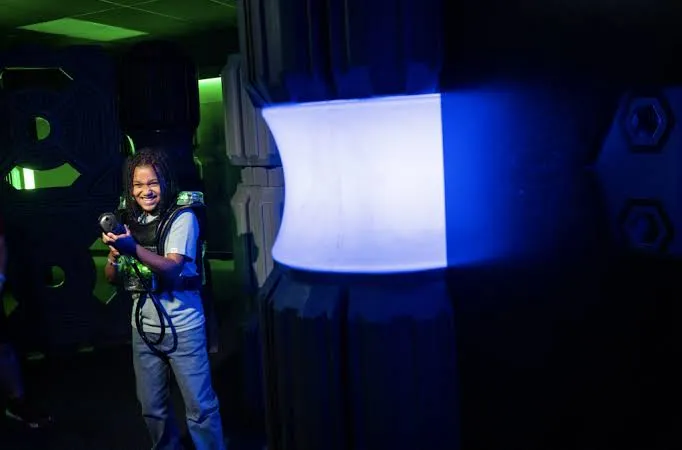
Gear on the charging rack. How many sets a venue owns is the real ceiling on how big one game can be — no matter what the party page says about capacity.
The quoted package price is not what you pay, and this is where New York budgets go sideways. Sales tax in the city is 8.875% and it lands on the whole thing. Gratuity for the party host may or may not be added automatically — plenty of places tack on 18 to 20%, plenty of others leave it entirely to you, and both are normal. Then there are setup fees, add-on food, arcade cards, and the fact that food orders often have to be locked in a couple of days ahead, which quietly removes your ability to adjust once you see the RSVP list. The move here is simple and almost nobody makes it: give them your real headcount and ask them to walk you through the full invoice, line by line, out loud. Any venue worth booking will do it without hesitating. Ruiz notes that gratuity policy in particular is worth pinning down rather than assuming: at her home venue it isn’t added to the bill at all and is left to the host’s judgment, which is generous and also means first-time parents budget nothing for it and then feel terrible at the end.
Red flag: a quote given as a round number with no mention of tax. It is never a round number.
The near-universal American policy is that you may bring a birthday cake or cupcakes and nothing else. That’s reasonable — the venue sells food, and it’s part of how the room stays cheap — but it has edges you want to find early rather than at the door. Ask about allergies specifically, because a nut-free classroom does not become a nut-free party by itself and the venue’s pizza vendor is not thinking about your guest list. Ask whether you can bring your own drinks, whether there’s a fridge for a cake that has to survive a July afternoon, and whether they supply candles, a lighter, plates and a knife — three separate parties a year are rescued by a manager with a lighter in a drawer, and it’s better not to be the fourth. “At my place it’s cake and cupcakes, full stop, nothing else comes through the door,” Ruiz says. “I like that better than the ones that say sure, bring whatever, and then hand you a fee at checkout for the privilege.”
In most of this country this is a small question. In New York it is the one that decides whether half your guest list shows up on time, because your guests are arriving by three different methods and only one of them is predictable. “There’s parking” is not an answer. The answers you need are whether it’s free, whether it’s a garage or a surface lot, and what it actually costs for the length of a party — and those can differ inside a single property. At the mall where Laser Bounce sits, the indoor garage runs about $4 for up to two hours while the outdoor lot runs $10 for the same stretch, with only the first fifteen minutes free either way. Nobody tells arriving guests this. A line in the invitation saying use the garage, not the lot saves twelve families six dollars each and takes you four seconds to write. Then the transit half, which in Queens is where the honest weakness usually lives. This is Ruiz’s one complaint about her own favorite: the nearest subway, Middle Village–Metropolitan Avenue on the M, is over a mile off, and the practical options are the Q29, Q47 and Q54 buses or a car service. “For families driving in from Glendale or Middle Village it’s a non-issue, that’s the whole neighborhood. But if a guest is coming from Manhattan I tell the host to say so in the invite, because that person is going to look at the map, see a mile of walking, and either be late or not come.”
Red flag: “It’s right by the train.” Ask which train, which station, and how many minutes on foot.
None of these 6 requires any expertise and none takes more than a minute. Together they fit inside the same phone call where you were going to confirm the date anyway, and they change its character from what does it cost to how does this actually work. Ruiz’s own advice is simpler than any of it: go look at the place. Most venues will show you the room if you call ahead, and ten minutes inside answers four of these 6 on its own — the rooms, the parking, the food setup, and what the staff are like when nobody’s performing. “And don’t book my venue because I talked about it for twenty minutes,” she adds. “Book the one that’s twenty minutes from your apartment, and ask it these 6 questions. If the answers come back specific, that’s your place.” Bell, predictably, agrees with her on that one point: “My favorite customer is the one who came by on a Tuesday and looked around. I never have an argument with that person later.” What the two of them can’t settle is whose job it is to raise all this in the first place — which is exactly why it lands on you. Packages, policies and prices change without notice; confirm the details that matter to you directly with the venue before you book.
More laser tag venues around New York are listed in the Battleonix catalog.
167+ Laser Tag Puns
Laser tag isn’t just about adrenaline-fueled battles in a neon-lit arena where everyone hides behind barriers and takes aim at opponents. It’s also an endless source of witty jokes and clever wordplay. And if you thought laser tag was only about strategy and accuracy, get ready to smile: it turns out a good joke can be just as powerful a weapon as a laser blaster.
The website Punsify has published an impressive collection — over 167 laser tag puns, compiled by an author going by the pen name Pun Prince. This is a true encyclopedia of verbal shots that hit the funny bone. Just consider the classics: “That joke really hit the target” or the iconic “Keep calm and laser on” — a variation on the famous British wartime poster, but with a laser twist.
Here’s an interesting fact from the article: laser tag was invented in 1979, inspired by the movie Star Wars. That’s right — those very galactic battles between Jedi and Imperial stormtroopers inspired the creators to develop a game that still gathers millions of fans worldwide. No wonder the puns about laser tag are just as bright and luminous.
The Punsify collection isn’t just a list of jokes — it’s a well-structured compilation organized into categories:
Special mention goes to the Pun-tastic Names section — team name ideas like Laser Quest, Tag You’re It!, Beam Team, Photon Fury, Glow Getters — something for every taste.
Humor in laser tag is more than just entertainment. As the author notes, laughter is the best strategy in any game. A well-aimed joke can relax your opponent, boost your team’s morale, and make the game unforgettable. And if you’re planning a birthday party or corporate event at a laser tag arena, these puns are perfect for invitations, social media posts, or simply creating a fun atmosphere.
The full collection of 167+ puns is available at the source link below. It also includes an FAQ with answers to questions like “How do I come up with my own laser tag puns?” and a glossary of terms with humorous definitions.
🔗 Source: https://punsify.com/laser-tag-puns/


