El Monte
6 Questions to Ask a Party Venue Before You Send the Deposit
A deposit on a New York party room runs $150 to $250, it is non-refundable, and at some venues you can only move the date if you ask more than three weeks out. Which means the window where your questions still change anything closes the moment you hit send. Most people start asking the day after.
- A quick word on who’s advising you
- 1. Is the arena actually ours, or are we playing with strangers?
- 2. Is the room ours for the whole time, or is it a slot?
- 3. Does the price cover the kids who actually show up?
- 4. What is the number at the bottom of the invoice?
- 5. Cake yes, food no — so what exactly can we bring?
- 6. How are twenty people actually getting there, and what does parking cost?
- What this actually adds up to
The questions that actually decide how a birthday or a team outing goes — and what a straight answer sounds like versus a dodge.
The call almost always runs the same way. A parent asks the price and whether a Saturday is open. The manager gives the price and says the Saturday is open. Everyone hangs up satisfied, the deposit clears, and not one thing that will determine how the party actually goes has been mentioned. Dana Ruiz, who has been running kids’ parties on contract for about a decade, puts it bluntly: venues don’t lie, they just don’t volunteer. “Nobody is going to tell you on their own that a second group walks into your room at 4 p.m. That isn’t dishonesty. You didn’t ask.” Marcus Bell, a floor manager at a family entertainment center, thinks the problem runs the other direction. Fifteen minutes on the phone is not enough to explain how a building works, and the person calling has a picture in their head from somebody’s TikTok. “Ask me anything and I’ll tell you. But you only ask what it costs.” They’re both right, which is the whole problem. Here are the six questions that close the gap.
A quick word on who’s advising you
Ruiz lives in Ridgewood and works almost entirely in central and eastern Queens — Glendale, Middle Village, Maspeth, Forest Hills, and over the line into Bushwick. That isn’t loyalty, it’s logistics. A planner hauls decorations, a folding table and sometimes a cake, and on a good Saturday there are two parties back to back. Ninety minutes on the BQE between them turns the job into something else entirely. Party planners in this city are neighborhood animals: each one has four or five venues they know cold. There’s a useful takeaway in that for anyone reading. If you’re hiring help, hire someone who works your slice of the map. They’re not better than the rest — they’ve just been inside your venues a dozen times and know which manager calls back. The flip side is that every planner like this has a favorite, and the favorite is always the place fifteen minutes from home. Ruiz’s is Laser Bounce in Glendale, and she says so before you can point it out: “Sure I’m biased. I’m in that building more than anywhere else, which is exactly why I know more about it than about anywhere else.” Bell’s reply is worth keeping in mind: “Every planner has a house venue. It’s not always the best one. It’s the closest one.”
What follows is her reasoning on each question. Read it with that discount applied.

An arena photo tells you almost nothing about the thing that matters most: how many separate groups move through it in a day.
1. Is the arena actually ours, or are we playing with strangers?
This is the one that surprises New York parents most, and it’s specific to how American entertainment centers are built. Most of them run open play all day — anyone can buy a ticket and walk into the arena. So “we booked laser tag for the party” can easily mean your ten nine-year-olds plus six teenagers who happened to be there, which is a different afternoon than the one you were picturing. The word to use is private, and the follow-up is which tier buys it. At Laser Bounce the answer changes by package: the higher tiers include private games, while the entry tier puts you into public play or gives you a choice between that and private laser tag. Same building, same afternoon, completely different experience — and the difference is a line item, not a favor. Worth asking in the same breath: how many players fit in one game. Twenty is a common ceiling, which means a party of thirty is two waves whether anyone said so or not.
Red flag: “You’ll basically have it to yourselves.” Basically is doing a lot of work in that sentence.
2. Is the room ours for the whole time, or is it a slot?
Party rooms in this format are timed, and the number is usually printed somewhere nobody reads. Forty-five minutes and ninety minutes are both normal, and they are not remotely the same party: at forty-five you are herding kids through pizza and cake against a clock, and the moment the candles are out somebody is stacking your chairs. A straight answer is boring and specific — “the room is yours 2:00 to 2:45, next party comes in at 3:15.” A dodge sounds smooth: “there’s usually plenty of time.” Ruiz says the room clock is the only upgrade she argues for with clients: “Ninety minutes instead of forty-five is the difference between a party and a fire drill. At my place that’s a package tier, and it’s the one line I tell people not to cheap out on.”
“Everything else you can fix on the day. You cannot fix not having the room.”
Dana Ruiz, party planner
3. Does the price cover the kids who actually show up?
American party packages are almost always priced for a fixed headcount — ten is the industry default — and that price holds whether ten kids come or six. Additional guests run somewhere around $40 to $50 each. So there are really three questions stacked inside this one: what headcount is baked into the package, what does each extra guest cost, and does anybody credit you for no-shows. The honest answer to the third is usually no, and a venue that says so plainly is telling you the truth about everything else too. Then ask about the adults, which people forget entirely. Twenty parents will show up with your ten kids. Do they count against anything? Is there food for them, and is it included, and can they buy a beer? At a venue where nobody may drop their child off — and that rule is more common than parents expect — you are not hosting ten guests, you are hosting thirty. Ruiz builds her headcounts on that assumption: “I plan for every kid arriving with one adult, because in this city that’s what happens. The train is not a place people send a seven-year-old alone.”
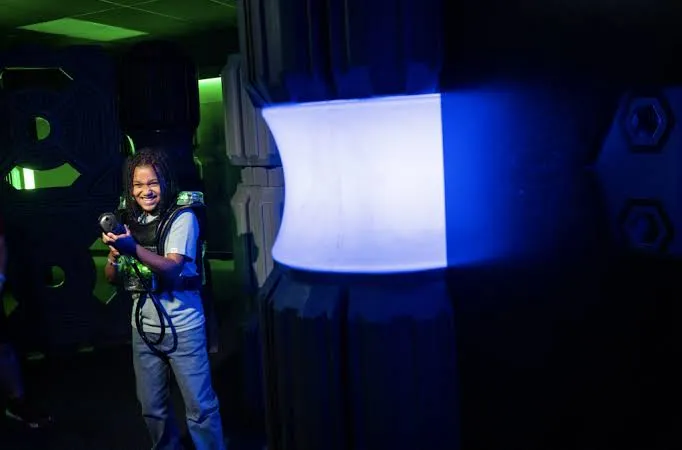
Gear on the charging rack. How many sets a venue owns is the real ceiling on how big one game can be — no matter what the party page says about capacity.
4. What is the number at the bottom of the invoice?
The quoted package price is not what you pay, and this is where New York budgets go sideways. Sales tax in the city is 8.875% and it lands on the whole thing. Gratuity for the party host may or may not be added automatically — plenty of places tack on 18 to 20%, plenty of others leave it entirely to you, and both are normal. Then there are setup fees, add-on food, arcade cards, and the fact that food orders often have to be locked in a couple of days ahead, which quietly removes your ability to adjust once you see the RSVP list. The move here is simple and almost nobody makes it: give them your real headcount and ask them to walk you through the full invoice, line by line, out loud. Any venue worth booking will do it without hesitating. Ruiz notes that gratuity policy in particular is worth pinning down rather than assuming: at her home venue it isn’t added to the bill at all and is left to the host’s judgment, which is generous and also means first-time parents budget nothing for it and then feel terrible at the end.
Red flag: a quote given as a round number with no mention of tax. It is never a round number.
5. Cake yes, food no — so what exactly can we bring?
The near-universal American policy is that you may bring a birthday cake or cupcakes and nothing else. That’s reasonable — the venue sells food, and it’s part of how the room stays cheap — but it has edges you want to find early rather than at the door. Ask about allergies specifically, because a nut-free classroom does not become a nut-free party by itself and the venue’s pizza vendor is not thinking about your guest list. Ask whether you can bring your own drinks, whether there’s a fridge for a cake that has to survive a July afternoon, and whether they supply candles, a lighter, plates and a knife — three separate parties a year are rescued by a manager with a lighter in a drawer, and it’s better not to be the fourth. “At my place it’s cake and cupcakes, full stop, nothing else comes through the door,” Ruiz says. “I like that better than the ones that say sure, bring whatever, and then hand you a fee at checkout for the privilege.”
6. How are twenty people actually getting there, and what does parking cost?
In most of this country this is a small question. In New York it is the one that decides whether half your guest list shows up on time, because your guests are arriving by three different methods and only one of them is predictable. “There’s parking” is not an answer. The answers you need are whether it’s free, whether it’s a garage or a surface lot, and what it actually costs for the length of a party — and those can differ inside a single property. At the mall where Laser Bounce sits, the indoor garage runs about $4 for up to two hours while the outdoor lot runs $10 for the same stretch, with only the first fifteen minutes free either way. Nobody tells arriving guests this. A line in the invitation saying use the garage, not the lot saves twelve families six dollars each and takes you four seconds to write. Then the transit half, which in Queens is where the honest weakness usually lives. This is Ruiz’s one complaint about her own favorite: the nearest subway, Middle Village–Metropolitan Avenue on the M, is over a mile off, and the practical options are the Q29, Q47 and Q54 buses or a car service. “For families driving in from Glendale or Middle Village it’s a non-issue, that’s the whole neighborhood. But if a guest is coming from Manhattan I tell the host to say so in the invite, because that person is going to look at the map, see a mile of walking, and either be late or not come.”
Red flag: “It’s right by the train.” Ask which train, which station, and how many minutes on foot.
What this actually adds up to
None of these 6 requires any expertise and none takes more than a minute. Together they fit inside the same phone call where you were going to confirm the date anyway, and they change its character from what does it cost to how does this actually work. Ruiz’s own advice is simpler than any of it: go look at the place. Most venues will show you the room if you call ahead, and ten minutes inside answers four of these 6 on its own — the rooms, the parking, the food setup, and what the staff are like when nobody’s performing. “And don’t book my venue because I talked about it for twenty minutes,” she adds. “Book the one that’s twenty minutes from your apartment, and ask it these 6 questions. If the answers come back specific, that’s your place.” Bell, predictably, agrees with her on that one point: “My favorite customer is the one who came by on a Tuesday and looked around. I never have an argument with that person later.” What the two of them can’t settle is whose job it is to raise all this in the first place — which is exactly why it lands on you. Packages, policies and prices change without notice; confirm the details that matter to you directly with the venue before you book.
More laser tag venues around New York are listed in the Battleonix catalog.