El Monte
 Log in
Log in
Log in

Main Event Fayetteville sits in the Cross Creek Mall area of Fayetteville, North Carolina, a convenient stop along the city’s main shopping corridor and an easy drive from downtown and surrounding neighborhoods.
At its heart is a multi-level laser tag arena with elevated positions and hiding spots, complemented by professional bowling lanes, a gravity ropes course, rock climbing walls, and an arcade with more than a hundred games. Birthday packages come with dedicated party hosts, reserved space, and food, while the same venue handles corporate events, school outings, and lock-ins.
The on-site Family Kitchen restaurant and bar serve pizza, burgers, wings, and cocktails, with lounge seating for relaxing between games. The staff is frequently praised for going out of their way to make events feel special, and the venue’s variety makes it a natural fit for birthdays, team building, and family outings.
 Indoors
Battle House Laser Tag sits in the Westwood Shopping Center on the western side of Fayetteville, North Carolina, a short drive from Fort Bragg. It is an indoor tactical laser tag arena built around mission-based gameplay, with separate two-story buildings, abandoned vehicles, and a crashed helicopter creating an immersive urban battlefield. Sessions run 1 to 3.5 hours, led by Field Marshals, with a rotating lineup of modes including Bank Heist, VIP protection, Rescue the Hostage, bomb missions, and domination games. Players choose from realistic weapons like the MP5, M4, AK-47, FAL Sniper, SAW, and Shotgun, each with its own stats.
The venue hosts birthday parties, military unit events, corporate team building, school and church groups, and family outings, accommodating up to 50 players per game time. After the battle, groups can use a party room for food and celebration, with guests welcome to bring in their own catering and beverages available for purchase, including beer. The veteran-owned facility is praised for its friendly, professional staff and is a popular rainy-day and weekend destination for families and groups across the Fort Bragg area.
IndoorsPutt-Putt Fun Center sits in the southern part of Fayetteville, North Carolina, in the Hope Mills neighborhood along Footbridge Lane, part of a family entertainment chain founded in 1954.
The center is a complete family destination featuring a two-story laser tag arena where players battle each other and a 10-foot battle droid, two authentic 18-hole par-2 Putt-Putt golf courses, the area’s only go-kart track, seasonal bumper boats, and a large arcade with more than 40 games. Structured birthday packages and group programs bundle attractions, game cards, and prize points for gatherings of all sizes.
Three private party rooms, an open indoor event space, and ample outdoor area make it a natural fit for birthdays, corporate team-building, school groups, church lock-ins, and family reunions. A friendly staff, an on-site café, and a redemption counter round out the experience, with regular specials including military and student discounts, first responder days, and a summer unlimited pass.
Indoors Outdoors
The evolution of recreational gaming has witnessed many trends, but few have maintained the enduring popularity and technological sophistication of laser tag. Since its inception as a high-tech alternative to traditional games like hide-and-seek or tag, laser tag has transformed into a global phenomenon. It blends physical activity, strategic thinking, and cutting-edge infrared technology to create an immersive experience that transcends simple entertainment. Today, the sport is recognized not just as a pastime for children, but as a legitimate tool for team building, fitness, and tactical training.
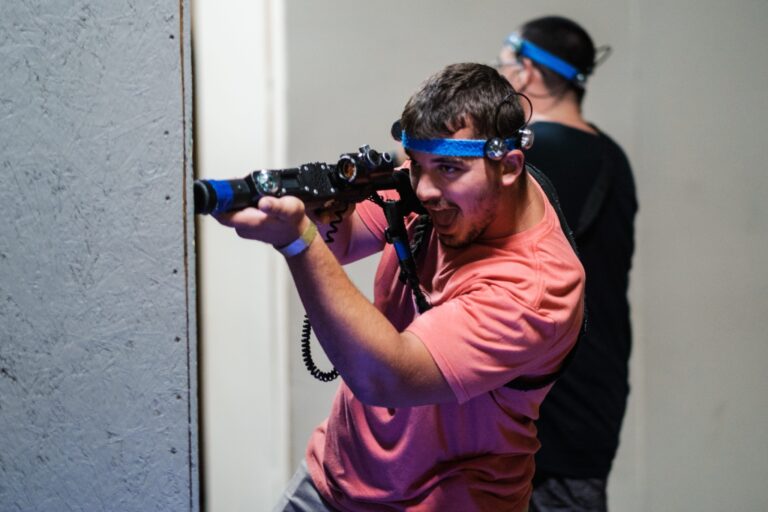
At its most fundamental level, laser tag is a non-contact shooting sport where players use electronic devices—often referred to as taggers—to emit infrared signals toward sensors worn by their opponents. Despite the name “laser” tag, the vast majority of systems utilize infrared light, the same safe technology found in television remote controls. When a beam of infrared light strikes a sensor on a player’s vest or headband, the system registers a “tag,” which is then processed by a central computer or the onboard hardware of the equipment.
The equipment has evolved significantly since the early 1980s. Modern taggers are equipped with sophisticated software capable of tracking real-time statistics, such as accuracy, number of tags, and health points. High-end systems include liquid crystal displays (LCDs) that provide players with live feedback, haptic sensors that vibrate when a player is hit, and synchronized sound effects that enhance the immersion of the battlefield. Because there are no physical projectiles involved—unlike paintball or airsoft—laser tag is entirely painless and clean, making it accessible to a wide variety of age groups and environments.
While the simplest form of laser tag involves a “free-for-all” where every player competes against everyone else, the depth of the sport lies in its complex scenarios. These mission-based games require cooperation and tactical planning. One of the most popular formats is Team Deathmatch, where two or more squads compete to reach a specific score or eliminate the opposing team within a set timeframe.
More advanced scenarios include “Capture the Flag,” where teams must infiltrate enemy territory to retrieve an object while defending their own base. “Domination” involves controlling specific electronic “bases” or “control points” scattered across the arena; the longer a team holds a point, the more points they accrue. For those seeking a narrative experience, “Infection” or “Zombie” modes pits a small group of survivors against a growing horde of “infected” players. There are also “VIP” or “Escort” missions, where one team must protect a specific player while moving across the field, and the opposing team must stop them. These varied formats ensure that the game remains fresh and intellectually stimulating for regular players.
The benefits of participating in laser tag extend far beyond simple enjoyment. From a physical perspective, it is a high-intensity cardiovascular workout. Players spend the duration of a match running, crouching, and navigating obstacles, which improves endurance, agility, and overall physical coordination. Unlike sedentary video games, laser tag requires active physical engagement, making it an excellent tool for combating a stationary lifestyle.
Mentally, the game is a rigorous exercise in problem-solving and spatial awareness. Players must constantly analyze their surroundings, predict opponent movements, and adapt their strategies on the fly. It encourages the development of quick reflexes and focus under pressure. Furthermore, the social benefits are substantial. Laser tag fosters communication and collaboration. Success in a team-based scenario is impossible without clear instructions, trust in teammates, and the ability to work toward a common goal. This makes it a powerful venue for building self-confidence and improving interpersonal relationships.
Specialists in various fields have analyzed laser tag through the lenses of technology, psychology, and physical health. Industry experts often highlight the precision of the optics involved. They note that the sophisticated lenses in high-quality taggers allow for accuracy at distances exceeding several hundred feet, even in broad daylight. This technological reliability has allowed the industry to expand into “Milsim” (Military Simulation), where high-fidelity equipment is used for professional training and hobbyist competitions.
From a psychological standpoint, behavioral experts view laser tag as a form of “gamification” for physical exercise. It leverages the reward systems of the brain—scoring points and completing objectives—to motivate players to push their physical limits. Unlike traditional sports that can sometimes be exclusionary based on skill level, experts note that laser tag provides an “even playing field” where strategic thinking and teamwork can often overcome raw athleticism. Furthermore, safety experts frequently praise the sport for its zero-impact nature, noting that the absence of physical projectiles minimizes the risk of injury while still providing the adrenaline rush associated with combat-style games.
While laser tag is enjoyed by adults and competitive enthusiasts, it holds a special place in the world of activities for children. Because the equipment can be scaled in size and complexity, it is suitable for children as young as six or seven years old. For younger players, the game focuses on the thrill of the lights and sounds, and the simple joy of tagging a target. It provides a safe environment for kids to release energy and engage in imaginative play.
Parents and educators often prefer laser tag for kids because it promotes active play without the aggression sometimes associated with other competitive sports. It teaches children the importance of following rules and functioning as part of a group. Most facilities offer lightweight vests and taggers specifically designed for smaller frames, ensuring that the equipment is not cumbersome. As children grow into their teenage years, the game evolves with them, becoming more about tactical skill and coordination, providing a consistent outlet for social interaction throughout their development.
The versatility of laser tag makes it a premier choice for celebratory events and professional gatherings. For a birthday party, it offers an “all-in-one” entertainment solution. It keeps large groups of children or teenagers occupied and excited, often within a structured environment that provides supervision and safety. The competitive but friendly nature of the game ensures that everyone feels included in the festivities.
Graduation parties also benefit from the high-energy atmosphere of a laser tag arena. It serves as a symbolic “final battle” for classmates before they head off to different paths, providing a memorable bonding experience that bridges the gap between childhood play and adult recreation.
In the corporate world, laser tag has emerged as a favorite for team-building retreats. High-level executives and entry-level employees are placed on equal footing within the arena, breaking down traditional workplace hierarchies. To win, a corporate team must demonstrate leadership, delegate tasks, and communicate effectively under time constraints. It is an effective way to relieve workplace stress while reinforcing the fundamental principles of a successful organization through a fun and engaging medium.
The choice of venue significantly alters the laser tag experience, and both indoor and outdoor options have unique appeals. Indoor arenas are the traditional home of the sport. These environments are typically characterized by neon lights, fog machines, and labyrinthine corridors. The controlled lighting allows for the spectacular use of UV-reactive paint and glowing sensors, creating a futuristic, arcade-like atmosphere. Indoor play is typically close-quarters, focusing on fast-paced movement and quick reflexes.
Outdoor laser tag, often referred to as “Tactical Laser Tag,” offers a completely different dynamic. Played in parks, forests, or specially designed urban ruins, outdoor venues utilize the natural environment as cover. Because natural light is present, outdoor equipment is engineered with powerful infrared emitters and sun-readable screens. The vastness of outdoor fields allows for long-range engagements, sometimes spanning several hundred yards. This style of play is more methodical, emphasizing stealth, camouflage, and long-term strategy. Many mobile laser tag companies now offer the ability to bring the equipment to a client’s specific location, turning a backyard or a local park into a temporary combat zone.
Whether played in a high-tech indoor maze or across a rugged outdoor terrain, laser tag continues to be a pinnacle of interactive entertainment. By combining the thrill of competition with the safety of modern technology, it remains one of the few activities that can truly claim to offer something for everyone.


 580 Cross Creek Mall, Fayetteville, NC 28303, United States