Log in
Tilt Studio Magnolia Indoor Center is located in Florence, SC.
Tilt Studio Magnolia, located in Florence, SC, is a family-friendly entertainment center that offers a variety of activities for all ages. The studio features state-of-the-art bowling lanes, arcade games, laser tag arenas, and a full-service restaurant and bar. With its modern decor and comfortable seating, Tilt Studio Magnolia provides a fun and enjoyable experience for both adults and children. Whether you’re looking to host a birthday party, corporate event, or just enjoy a night out with friends or family, Tilt Studio Magnolia is the perfect destination for entertainment and fun.
Indoors
In the landscape of recreational activities, few games have successfully bridged the gap between physical exertion, tactical strategy, and high-tech immersion quite like laser tag. Once considered a niche hobby relegated to dark, neon-lit basements during the 1980s, the sport has evolved into a global phenomenon that caters to everyone from adventurous children to corporate executives seeking team-building solutions.
At its core, laser tag is a recreational shooting sport where players compete to score points by tagging opponents with infrared-emitting light guns. Unlike paintball or airsoft, which utilize physical projectiles, laser tag is entirely non-contact and “pain-free,” relying on sophisticated infrared technology.
Players typically wear a vest equipped with sensors or carry a specialized phaser that registers “hits.” When a beam of light strikes a sensor, the equipment records the hit, often providing immediate auditory and visual feedback. Modern systems use advanced software to track accuracy, kill-death ratios, and objective completions in real-time, making it an incredibly data-driven experience compared to its primitive predecessors.
The variety of play modes—often referred to as scenarios—is what keeps the sport fresh and engaging. While “Team Deathmatch” remains the classic standard, modern arenas offer complex objectives that require deeper strategy.
Beyond the thrill of the chase, laser tag offers substantial physical and mental health advantages. It is a high-intensity cardiovascular workout that encourages players to sprint, duck, crawl, and maneuver through an environment, often without the player realizing how much exercise they are getting.
Mentally, the game demands rapid decision-making and spatial awareness. Players must constantly analyze their surroundings, predict enemy movements, and communicate with teammates. For children, this fosters the development of secondary skills such as cooperation, leadership, and conflict resolution, while adults often find it to be an effective stress-relief mechanism that requires complete “unplugged” focus.
Research into play-based learning and sports science suggests that games like laser tag occupy a vital space in human social interaction. Experts in the field of gamification highlight that the “flow state”—the mental state where a person is fully immersed in an activity—is easily triggered by the high-stakes, fast-paced nature of laser tag.
Industry experts note that the technology has moved far beyond simple toys. With the integration of augmented reality (AR) and smartphone-connected scoring apps, the industry is transitioning into a “phygital” space (physical plus digital). Experts emphasize that the social component is the industry’s greatest strength; it provides a communal experience that cannot be replicated by home video games or solitary fitness routines.
While the technology is sophisticated enough to satisfy tactical enthusiasts, it remains uniquely accessible for children. Laser tag is often the preferred choice for youth sports because it eliminates the risk of bruising or safety gear complications associated with projectile sports.
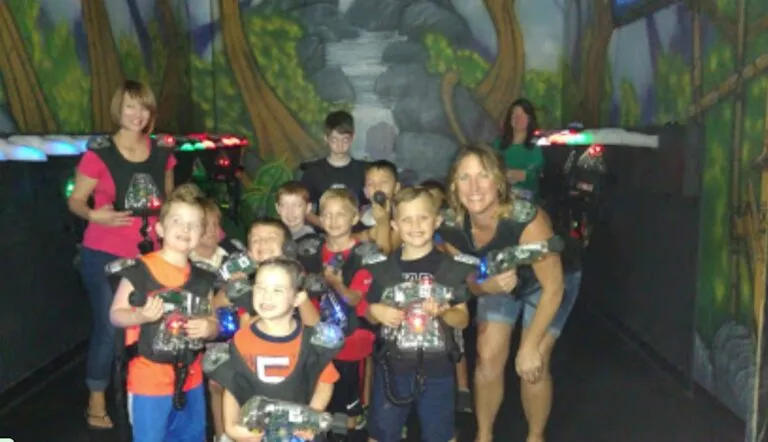
For kids, laser tag acts as a real-world version of the digital games they play at home. It gets them off the couch and encourages face-to-face social interaction. Many venues offer “low-impact” settings for younger children, ensuring that the equipment is lightweight and the game modes are simplified, making it an inclusive activity for birthday parties and youth groups.
The versatility of laser tag makes it a premier option for event planning.
The playing field significantly alters the experience.
Indoor Venues are the staple of the industry. These arenas are typically climate-controlled and feature labyrinthine designs with blacklights, fog machines, and booming soundtracks. The controlled environment allows for precise lighting effects and consistent, high-tech gameplay regardless of the weather.
Outdoor Venues, conversely, offer a more “mil-sim” (military simulation) experience. These are often played in woods, parks, or specifically constructed “urban” tactical courses. Outdoor laser tag captures the essence of exploration and natural obstacles, allowing for longer-range engagements and a more rugged, nature-integrated adventure.
Whether one prefers the neon, high-tech intensity of an indoor maze or the tactical, wide-open challenge of an outdoor forest, the sport of laser tag continues to be a dominant force in recreational entertainment. By blending physical activity with strategic teamwork and cutting-edge technology, it remains a timeless way to foster competition, camaraderie, and excitement.