
 El Monte
 Log in
Log in
Log in

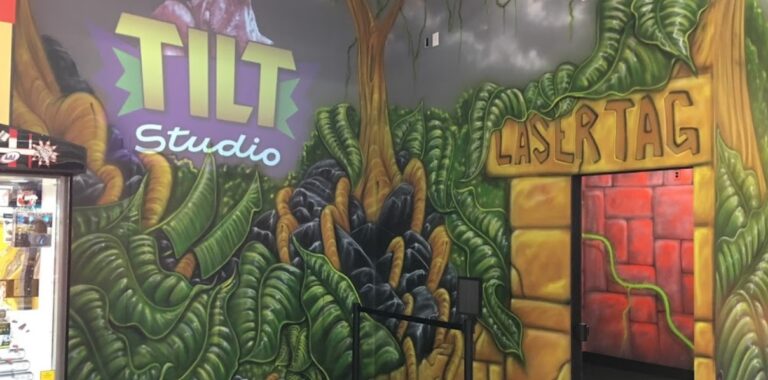
Tilt Studio Valley Mall is located inside the Valley Mall in Hagerstown, Maryland.
This 48,000-square-foot family entertainment center offers a wide range of active and interactive attractions including a black light jungle-themed laser tag arena, two miniature golf courses (Putter Pirates and White Shark), bumper cars, a Himalaya Bobsled ride, mini bowling, and over 150 arcade and video games with virtual reality and pinball options. The venue operates on a free-admission Play Card system and offers birthday party packages with private rooms, dedicated hosts, food, and cleanup included.
Beyond the main attractions, Tilt Studio provides flexible event spaces for corporate team-building, fundraisers, group gatherings, and special celebrations of all kinds. An on-site restaurant and bar serves pizza, chicken bites, pretzels, hot dogs, soft drinks, beer, and wine. The staff includes trained party hosts and coordinators who assist with planning and execution, while the venue’s location inside Valley Mall offers additional dining and shopping options for visitors looking to extend their outing.
 Indoors
In an era dominated by digital screens and sedentary entertainment, laser tag has emerged as a powerhouse of active social engagement. It is more than just a game; it is a high-tech immersive experience that blends physical exertion, strategic thinking, and adrenaline-pumping fun. By transforming ordinary participants into tactical players within a simulated environment, laser tag has cemented its place as a staple of modern recreational culture.
At its core, laser tag is a recreational shooting sport where players compete to score points by tagging opponents with infrared-emitting light guns. Unlike paintball or airsoft, which use physical projectiles, laser tag utilizes infrared beams, making it a safe, non-contact, and mess-free activity.
Each player typically wears a vest or a series of sensors that detect when an infrared beam strikes them. When a player is “tagged,” their sensors register the hit, often resulting in temporary deactivation or a deduction of points. The game is managed by sophisticated computer systems that track scores, accuracy, and team statistics in real-time. This technological backbone ensures that game modes can be customized, providing a level of precision and fairness that traditional tag games simply cannot match.
The versatility of laser tag lies in its modular scenarios. While the classic “Team Deathmatch” remains a crowd favorite, modern facilities offer a wide array of mission-based gameplay.
“Capture the Flag” remains a primary staple, requiring teams to coordinate offensive strikes and defensive perimeters. “VIP Protection” scenarios force players to defend a single teammate designated as the leader while moving through the arena, fostering high levels of cooperation. For those seeking a challenge, “Zombie Infestation” modes pit a small group of highly mobile infected players against a larger team of survivors, creating a high-pressure environment that changes the pace of the game. Other popular modes include “Domination,” where teams fight to control specific zones within the arena to accumulate points, or “Base Siege,” where teams must infiltrate an enemy stronghold to deactivate a central target.
Beyond the excitement, laser tag offers substantial health and developmental benefits. Physically, it serves as a form of high-intensity interval training. Players are constantly moving, ducking, crawling, and sprinting, which improves cardiovascular health, agility, and stamina.
On a cognitive level, the game demands rapid decision-making. Players must process spatial information, anticipate enemy movements, and communicate effectively under pressure. This enhances problem-solving skills and hand-eye coordination. Furthermore, the social component is invaluable; because the game requires teamwork, it forces individuals to rely on their peers, fostering better communication, trust, and interpersonal bonds. For many, it acts as a healthy outlet for stress, replacing the daily grind with a focused, goal-oriented hobby.
Research into recreational play suggests that laser tag occupies a unique space in child development and adult cognitive maintenance. Experts often highlight “gamification” as a tool for learning; by introducing game mechanics into physical activity, players are more likely to stay engaged.
Industry professionals emphasize the “flow state”—a psychological concept where an individual becomes fully immersed in a task. Laser tag naturally induces this state, as the rapid pace of play demands total concentration, helping players temporarily disconnect from academic or work-related anxieties. Additionally, experts note that the non-contact nature of the sport makes it an inclusive environment for a wide demographic, allowing individuals of varying athletic abilities to contribute to their team’s success through strategy rather than raw physical power alone.
Laser tag is frequently mischaracterized as a game solely for children, yet its demographic is remarkably diverse. While it is undeniably a favorite among younger audiences—often serving as a child’s first introduction to competitive team sports—the game’s appeal extends into adulthood.
For kids, laser tag is a rite of passage. It offers an environment where they can safely explore “heroic” narratives and learn the foundations of sportsmanship. Unlike sports that may emphasize aggressive physicality, laser tag rewards intelligence and positioning. It allows children to build confidence as they navigate complex environments, teaching them that victory is usually the result of a collective effort rather than individual talent.
As a customizable event venue, laser tag is unparalleled for celebrations of all kinds. For birthday parties, it provides an all-inclusive entertainment package that relieves parents of the burden of organizing complex activities. The structure of the game ensures that participants remain occupied, active, and safe for multiple hours.
For graduations, laser tag serves as a nostalgic and high-energy way for classmates to celebrate their shared journey. However, the most significant growth in the industry has been in the corporate sector. Companies are increasingly moving away from traditional “trust falls” and toward laser tag for team-building retreats. The game exposes the strengths and weaknesses of employees in a low-stakes environment, revealing natural leaders, creative strategists, and supportive team players. It creates a level playing field where a CEO and an intern must communicate as equals to achieve a common objective, effectively breaking down corporate hierarchies.
The experience of laser tag varies significantly depending on the venue. Indoor arenas are typically highly controlled, climate-controlled environments featuring elaborate neon lighting, fog machines, and multi-level structures. These venues are ideal for those who enjoy the “sci-fi” aesthetic and precision gameplay. The confined space of indoor arenas forces constant interaction, making it perfect for smaller groups looking for intense, fast-paced action.
Conversely, outdoor laser tag provides a completely different atmosphere. Often played in forested areas, abandoned industrial zones, or custom-built tactical fields, outdoor laser tag relies on natural terrain. The increased range of outdoor equipment allows for long-distance sniping and wide-flanking maneuvers. These sessions often feel more akin to a military simulation, appealing to those who prefer endurance and stealth over the high-speed chaos of indoor facilities. Whether one prefers the high-tech, futuristic feel of an indoor labyrinth or the rugged, tactical challenges of an outdoor mission, the game is adaptable enough to satisfy any preference.
In conclusion, laser tag has evolved into a sophisticated recreational phenomenon. By balancing technology with human movement and social interaction, it provides a unique platform for development, celebration, and professional growth. As the industry continues to integrate augmented reality and even more precise tracking sensors, the future of the sport promises to be even more immersive, ensuring that laser tag remains a premier choice for those seeking to challenge their bodies and minds in the spirit of play.


 17301 Valley Mall Rd #725, Hagerstown, MD 21740, United States