
 El Monte
 Log in
Log in
Log in

Tilt Studio Pecanland is located inside the Pecanland Mall in Monroe, Louisiana, offering a spacious indoor destination for family fun.
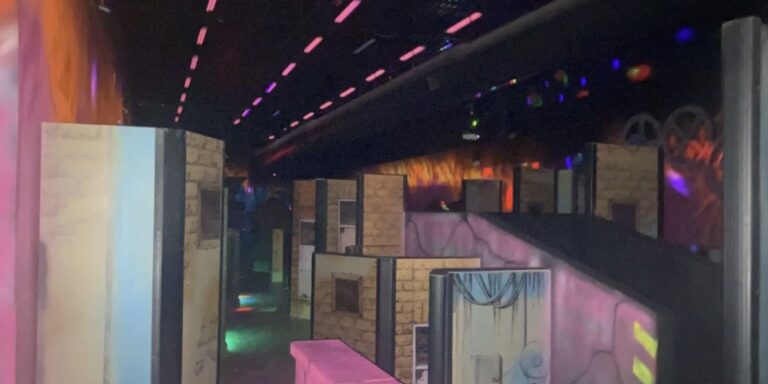
This 60,000-square-foot center features a jungle-themed black light laser tag arena, an 18-hole underwater-themed black light mini golf course, mini bowling lanes, bumper cars, virtual reality, and over 150 arcade and video games. Birthday party packages include Ultimate, Deluxe, and Premier options with Play Cards, attractions, pizza, drinks, cupcakes, goodie bags, and dedicated party hosts who handle setup and cleanup. The venue also hosts corporate events, team-building activities, fundraisers, and group gatherings of all sizes.
A pizza snack bar and restaurant is available on-site for dining between activities. Private party rooms accommodate up to 25 guests, with larger event spaces for bigger celebrations. The Play Card system allows guests to pay only for what they play, with a VIP rewards program offering 10% off after accumulating points. Admission is free, making it easy to visit for any length of time.
 Indoors
Laser tag has evolved from a futuristic novelty in the 1980s into a sophisticated, high-energy activity enjoyed by millions globally. By blending physical movement, tactical decision-making, and immersive technology, it creates an experience that feels like stepping directly into a video game. Whether you are navigating a dark, fog-filled arena or running through a sun-drenched outdoor forest, laser tag offers a unique intersection of leisure and adrenaline.
At its core, laser tag is a recreational shooting game where players use infrared-emitting light guns to tag designated targets, usually worn on vests or the guns themselves. Unlike paintball or airsoft, which involve physical projectiles, laser tag is entirely contactless and pain-free, utilizing harmless infrared beams that are tracked by sophisticated sensors.
The equipment consists of a phaser (the blaster) and sensors. When an infrared beam hits a sensor, the system records a “hit,” providing instant feedback through sounds, lights, or vibrations. This instantaneous scoring system allows for complex gaming modes, detailed statistics, and fair play, as the technology removes any ambiguity regarding whether a player was hit.
The variety in laser tag is limited only by imagination. Traditional “Team Deathmatch” modes—where two teams compete to score the most hits—remain the most popular, but modern venues have introduced immersive, objective-based scenarios that require deeper strategy:
These scenarios shift the focus from simple accuracy to tactical cooperation, requiring squads to communicate and execute maneuvers to win.
Beyond the excitement, laser tag offers substantial health and psychological benefits. It is a high-intensity cardiovascular workout that forces players to sprint, duck, crouch, and move laterally for long periods. Because the adrenaline keeps the heart rate elevated, players often burn hundreds of calories without even realizing they are exercising.
Psychologically, the game promotes problem-solving and rapid decision-making. Players must process spatial information, anticipate enemy movements, and adapt their strategies in real-time. Furthermore, it serves as a powerful social bridge. It requires players to rely on their teammates, fostering trust and communication in a high-stakes, yet safe, environment.
Research into human-computer interaction and pedagogical gaming suggests that laser tag serves as an excellent “gamified” form of soft-skill development. Experts in developmental psychology often highlight how laser tag helps children and adults alike refine their hand-eye coordination and spatial reasoning.
Industry experts observe that the shift toward “Tactical Laser Tag”—which uses realistic-looking equipment and advanced software—is bridging the gap between professional training simulations and recreational gaming. Many organizations utilize these systems for team-building exercises, noting that the intensity of the game strips away professional hierarchies, allowing employees to collaborate on an equal playing field. The consensus is that laser tag is more than just a game; it is an accessible simulator for leadership, situational awareness, and group cohesion.
Laser tag is remarkably inclusive. Because there is no impact, it is arguably the safest combat-style sport for children, allowing them to participate in high-energy play without the risks associated with bruised skin or projectiles. For kids, it is a masterclass in social interaction. They learn to follow rules, respect boundaries, and work within the structures of a team.
However, the appeal extends far beyond childhood. Adults, teenagers, and even older generations frequently flock to laser tag venues. It offers a rare space where adults can engage in “play” with the same intensity as children, providing a necessary mental break from the stresses of professional life.
The versatility of laser tag makes it an ideal choice for event planning.
Where you play drastically changes the feel of the experience:
Indoor Venues: Usually found in specialized arenas or multi-entertainment centers, these are climate-controlled and feature complex mazes, glowing neon lights, fog machines, and booming soundtracks. They provide a “sci-fi” atmosphere that feels like stepping into a cinematic space station or a futuristic labyrinth. They are consistent, reliable, and available year-round regardless of the weather.
Outdoor Venues: Often set in forests, abandoned industrial sites, or structured fields with bunkers and inflatable obstacles, outdoor laser tag feels more like a military simulation. The terrain adds another layer of challenge—players must deal with uneven ground, natural cover, and the shifting daylight. For those who enjoy nature and want a more “realistic” tactical experience, outdoor venues offer a sense of scale and freedom that tight indoor arenas cannot match.
In conclusion, laser tag is a multifaceted activity that manages to balance high-tech innovation with primal, physical fun. As technology continues to bridge the gap between virtual and real-world play, the sport is likely to become even more immersive. Whether for a child’s first birthday or a high-stakes corporate retreat, laser tag provides a platform for connection, competition, and immense enjoyment.


 4700 Millhaven Rd Space 6702, Monroe, LA 71203, United States