El Monte
 Log in
Log in
Log in

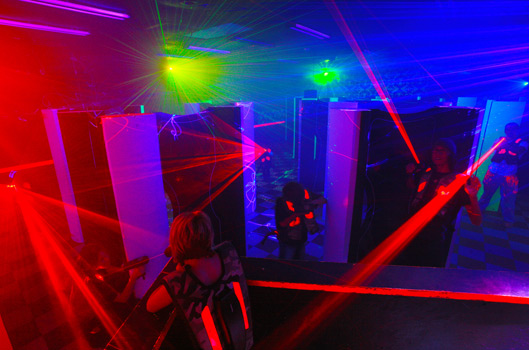
LASERTRON sits in the Henrietta section of Rochester, New York, at 1175 Marketplace Drive, a short drive from the Marketplace Mall and the city’s southern suburbs. The venue centers on a massive, multi-level, 100% LED-illuminated laser tag arena that is three to four times larger than most in the country, holding up to 40 players across five game modes including Headquarters, Team Base, and Battle Royale Squads. Games run as 30-minute sessions with six to seven back-to-back matches, supported by automated team rebalancing that keeps every round competitive.
Beyond laser tag, the facility offers Krazy Axes axe throwing, Krazy Darts, the Rochester-exclusive Krazy Arrowz archery arena, Cyber Sport, billiards, foosball, table tennis, cornhole, and a large arcade. A sports bar and restaurant with craft beers, a cafe, and a Rec Room provide space to relax, while dedicated event packages, team building programs, and private room rentals make it a popular choice for birthdays, corporate outings, and group gatherings.
 Indoors
Horizon Fun FX sits in the northwest corner of Rochester, New York, on Ling Road, a short drive from the Lake Ontario shoreline and the Port of Rochester.
It is a family entertainment center spanning more than 32,000 square feet, built around roller skating and rollerblading, with rental skates from toddler to adult sizes. The venue also features X-Treme Laser Tag in a multi-level arena themed like Gotham City, Jungle Jim’s three-story playland, the King of the Hill inflatable, and a state-of-the-art Game Zone arcade.
Beyond the attractions, Bamboozles Café offers a place to refuel, with free WiFi, plenty of seating and monitors airing sporting events. Spectating parents and children two and under get in free. The venue hosts birthday parties with bundled packages, school field trips, family skate nights, sports banquets and corporate team-building events, making it a flexible destination for families and groups alike.
IndoorsLaser tag has evolved far beyond its humble origins as a simple futuristic toy. Today, it stands as a sophisticated fusion of cutting-edge technology, physical exercise, and tactical gameplay. Whether played in a dimly lit indoor arena with neon strobes or on a sprawling outdoor field with natural obstacles, laser tag offers an immersive experience that transitions players from the couch to a battlefield of their own making.
At its core, laser tag is a recreational shooting game where players use infrared-emitting light guns to tag designated targets on their opponents—usually sensors worn on vests or integrated into headgear. Unlike paintball or airsoft, which utilize physical projectiles, laser tag is entirely non-contact and “painless.”
The technology behind modern systems is remarkably advanced. Infrared signals work similarly to television remote controls, transmitting coded data that the receiving sensor decodes to register a “hit.” When a player is tagged, the vest or gun usually vibrates, flashes, or produces an audio cue, providing immediate feedback. Because there are no messy projectiles, the game is clean, safe, and easily accessible for a wide range of ages, making it a staple of recreational play globally.
The variety of game modes is what keeps laser tag endlessly replayable. Beyond the basic “Free-For-All” where everyone competes against one another, game designers have introduced complex scenarios that require genuine teamwork.
These scenarios shift the focus from simple accuracy to tactical communication, spatial awareness, and resource management.
While often viewed merely as entertainment, laser tag provides significant physiological and psychological benefits. It is a high-intensity interval training (HIIT) workout hidden in plain sight. Players constantly sprint, crouch, dodge, and pivot, leading to improved cardiovascular health and muscular endurance.
Beyond the physical, laser tag is a masterclass in social development. It forces players to communicate under pressure, build trust with teammates, and exercise strategic thinking. For younger players, it encourages fair play and sportsmanship. For adults, it provides a much-needed mental break from sedentary office environments, forcing them to engage their reflexes and cognitive problem-solving skills in a high-adrenaline setting.
Research into human behavior and gaming suggests that laser tag serves as an excellent “flow state” inducer. Experts in recreational psychology note that because laser tag requires a mix of athletic exertion and mental focus, it helps players achieve a state of deep concentration where time seems to slow down.
Industry experts also point to the evolution of the hardware as a key driver of the sport’s longevity. The integration of Bluetooth, smartphone-compatible apps, and real-time score tracking has bridged the gap between traditional physical sports and e-sports. By digitizing the experience, operators can provide players with post-game statistics—accuracy percentages, most-tagged players, and total distance covered—which adds a layer of competitive depth that appeals to data-driven gamers.
Laser tag is remarkably inclusive. For children, it is often their first introduction to competitive team sports. It teaches them how to follow rules, respect opponents, and operate as part of a collective unit. Because the gear is lightweight and the game is non-violent in nature, it is a safe outlet for the high energy typical of school-aged children.
Many facilities offer “Young Cadets” sessions specifically tailored for younger demographics, with lower intensity modes and longer respawn times to ensure that the game remains fun rather than frustrating. It helps children develop spatial intelligence and improves hand-eye coordination in a way that static screen-based games simply cannot.
The versatility of laser tag makes it an ideal choice for social events.
The playing field significantly influences the style of the game.
Indoor Arenas: These are often set in sprawling, climate-controlled environments. They frequently feature “blackout” conditions with UV lighting, fog machines, and elaborate, multi-level structures. Indoor laser tag relies on close-quarters combat, swift movement, and mastery of tight corners. The environment is predictable and consistent, making it perfect for leagues and tournament play.
Outdoor Arenas: Outdoor laser tag typically takes place in wooded areas, parks, or designated tactical courses. These venues incorporate natural obstacles like trees, bunkers, and trenches. Outdoor play focuses on long-range accuracy and camouflage. Because the playing field is significantly larger, the game becomes more of a grueling endurance test. Tactical communication is even more vital outdoors, as teammates must coordinate over longer distances while navigating variable terrain.
Whether one prefers the neon-soaked thrill of an indoor maze or the tactical, grounded challenge of an outdoor woodland, laser tag remains one of the few activities that successfully blends fitness, technology, and pure, unadulterated fun. As technology continues to advance, the gap between virtual gaming and real-world action will only continue to shrink, ensuring that laser tag remains a cornerstone of the modern recreational landscape for years to come.


 1175 Marketplace Dr, Rochester, NY 14623, United States