TOP 10 best of the best Free-roam VR in Beaumont, TX – Battleonix
El Monte
Log in
0

Advanced Search:

City

Rating

Playground


Price:

Main / Catalog / VR / Texas, US / Beaumont, TX

The best Free-roam VR near me in Beaumont, TX

img
from $16
Laser tagVR

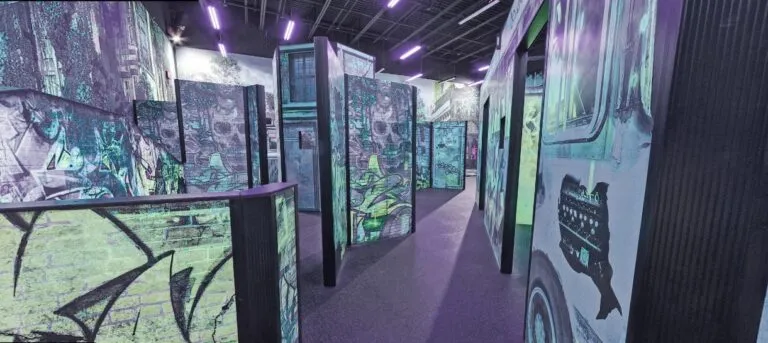
Main Event Indoor Laser Tag arena is located in Beaumont, TX.


Main Event is a huge entertainment hub where you can spend your weekend or throw a birthday party. These laser-tag battles take place in a multi-story arena with fantasy-like decorations, neon lights, and laborious obstacles. Climb up the towers and rain fire on unsuspecting enemies. 


There is also a large recreation area with snacks and drinks to chill after the game. There’s also bowling, pool, VR, mini-golf, a story room, and a ropes course – all available at one single place!

Indoors

Best of the best Free-roam VR in Beaumont, TX


Beyond the Screen: The Immersive Revolution of Free-Roam VR Arenas

The evolution of digital entertainment has long been constrained by the limitations of the “couch experience.” For decades, gamers sat tethered to monitors or televisions, their physical movement restricted to a controller or a keyboard. Today, that paradigm has been shattered by the advent of free-roam virtual reality (VR) arenas. Moving beyond the static simulation of a home headset, these expansive, dedicated spaces allow individuals to walk, run, and collaborate in a physical environment that mirrors a limitless digital landscape.


What is a free-roam VR arena?

A free-roam VR arena is an industrial-scale physical space—often ranging from a few hundred square feet to several thousand—designed specifically for untethered, full-body immersion. Unlike traditional VR setups that require a user to stand in a small, static circle to avoid tripping over wires, a free-roam arena is optimized for movement.

The technology relies on a sophisticated combination of high-precision spatial tracking, wearable VR headsets, and specialized haptic gear. Players are equipped with a lightweight, high-performance backpack computer or a cloud-streamed headset, effectively removing the physical “leash” that has historically limited the VR experience. These arenas use advanced optical sensors (often mounted on the ceiling) to track the precise position of every player in real-time. As the player walks across the physical floor, their avatar mirrors that movement in the virtual world. If a player approaches a wall in the arena, the game design subtly redirects them or incorporates it into the virtual environment, ensuring that the physical and digital boundaries remain seamless and safe.


Free-roam VR scenarios

The true power of free-roam VR lies in the diversity of its scenarios. Because the environment is entirely digital, creators can transport players from the depths of a futuristic space station to the ruins of an ancient civilization in the blink of an eye.

In competitive gaming scenarios, players often engage in team-based tactical combat. Unlike traditional first-person shooters, these games require real-world communication: team members must physically hide behind virtual cover, lean around corners using their own bodies, and coordinate movement with teammates standing right beside them.

Beyond gaming, there are “narrative-driven” experiences that prioritize exploration and puzzles. In these scenarios, groups might work collectively to escape a haunted mansion, navigate a zero-gravity environment, or solve complex riddles within an interactive exhibit. The key difference here is the “presence” factor; because users move their entire bodies, the brain begins to accept the virtual world as a physical reality. This creates a level of emotional engagement that traditional cinema or gaming simply cannot replicate, turning the participant from a spectator into a protagonist.


Who plays on free-roam VR arenas? VR for kids

The demographic for free-roam VR is surprisingly broad, though it has seen a massive surge in popularity among younger generations. For the “digital native” generation—kids and teenagers who have grown up with iPads and consoles—VR is the next logical step in play.

For children, these arenas provide a unique form of active entertainment. Unlike sedentary screen time, free-roam VR encourages physical exertion, coordination, and team collaboration. Parents are increasingly looking toward these arenas as a way to combine the lure of gaming with the physical activity usually reserved for sports. However, safety remains paramount. Responsible venues utilize age-appropriate content filters and carefully supervised sessions, ensuring that younger players are comfortable with the hardware and that the virtual scenarios are curated for their developmental stage.

Beyond children, the technology attracts young adults, gaming enthusiasts, and even curious seniors looking to experience cutting-edge technology. The beauty of free-roam VR is that it flattens the playing field; physical athleticism is less important than spatial awareness and collaborative communication, making it an inclusive pastime for a wide variety of skill sets.


Free-roam VR for a birthday party, graduation, corporate party

The rise of the “experience economy” has positioned free-roam VR as a premium choice for social gatherings. Traditional parties often rely on passive entertainment, such as renting a hall or going to a movie. Free-roam VR, by contrast, transforms an event into a shared, high-octane memory.

For a birthday party, it provides an unparalleled “wow” factor. It replaces the traditional arcade trip with an immersive adventure where the guest of honor and their friends become the heroes of their own digital story. Graduation parties benefit from the competitive team-building aspect, allowing classmates to celebrate their achievements by facing a common virtual challenge.

Perhaps the most significant shift is in the corporate world. Corporate parties and team-building retreats often struggle with the “awkwardness” of professional socialization. Free-roam VR breaks the ice instantly. When a group of colleagues is tasked with neutralizing a virtual threat or solving a complex engineering problem in an alien landscape, professional hierarchies take a backseat to effective communication and mutual reliance. It is a powerful tool for revealing leadership styles, encouraging cooperation, and providing a memorable, low-stress environment that helps employees bond in ways that a standard office happy hour never could.


Scientists and industry experts view on Free-roam VR

The academic and professional consensus on free-roam VR is trending toward deep optimism. Scientists studying human-computer interaction (HCI) are particularly interested in the concepts of “proprioceptive fidelity”—the alignment of what the body feels and what the eyes see. Because free-roam VR allows the body to move through physical space, it reduces the “simulator sickness” often experienced in static VR, where the eyes perceive motion while the inner ear senses stillness.

Industry experts view free-roam VR as a critical milestone in the development of the “Metaverse.” While early iterations of VR struggled with isolation, free-roam arenas prove that social, physical, and virtual interactions can coexist. Experts suggest that as technology becomes more miniaturized—moving toward lighter headsets and better haptic feedback suits—these arenas will move beyond just entertainment.

Many predict that the future of education and industrial training lies in this format. Engineers could walk through a digital twin of a factory floor, surgeons could practice complex procedures with physical tools tracked in a virtual space, and students could walk through the halls of history. The current generation of gaming arenas is, in effect, the “proof of concept” for a future where our physical environment is no longer the limit of our experience. By merging the tactile world with the infinite potential of digital design, free-roam VR is successfully transitioning from a niche technological experiment into a staple of modern social and professional life. As the hardware becomes more accessible and the software more sophisticated, these arenas will continue to redefine how we interact with technology, each other, and ourselves.