TOP 10 best of the best Free-roam VR in Billings, MT – Battleonix
El Monte
Log in
0

Advanced Search:

City

Rating

Playground


Price:

Main / Catalog / VR / Montana, US / Billings, MT

The best Free-roam VR near me in Billings, MT

img
from $15
VR

V-Rex VR Escape Rooms and Games is a virtual reality entertainment center located in Billings, Montana. It offers a unique and immersive gaming experience for individuals and groups.


At V-Rex, you can step into a virtual world and participate in thrilling escape room challenges. These escape rooms are designed to test your problem-solving skills, teamwork, and ability to think under pressure. You’ll be transported to different scenarios, such as solving a mystery in a haunted mansion or escaping from a high-security prison.


The VR technology used at V-Rex provides a realistic and interactive experience. You’ll wear a VR headset and use handheld controllers to navigate and interact with the virtual environment. The graphics and audio are top-notch, creating a truly immersive adventure.

Indoors

Best of the best Free-roam VR in Billings, MT


Stepping Into the Infinite: The Rise of Free-Roam VR Arenas

Virtual Reality has long been associated with the image of a person standing awkwardly in their living room, tethered by cables and afraid of tripping over the coffee table. But a new frontier has emerged that shatters these physical boundaries. Enter the Free-Roam VR Arena—a transformative experience that replaces the confines of a couch with a wide-open, warehouse-scale space, allowing you to walk, run, and collaborate in digital worlds without a single wire holding you back.


What is a Free-Roam VR Arena?

At its core, a free-roam VR arena (often called “Location-Based VR” or LBVR) is a high-tech facility designed to translate your physical movements into a digital environment with 1:1 precision. Unlike home VR systems, which rely on stationary sensors or limited “guardian” boundaries, a free-roam arena utilizes sophisticated optical tracking systems—often mounted on ceilings or integrated into the hardware—to map an expansive floor space.

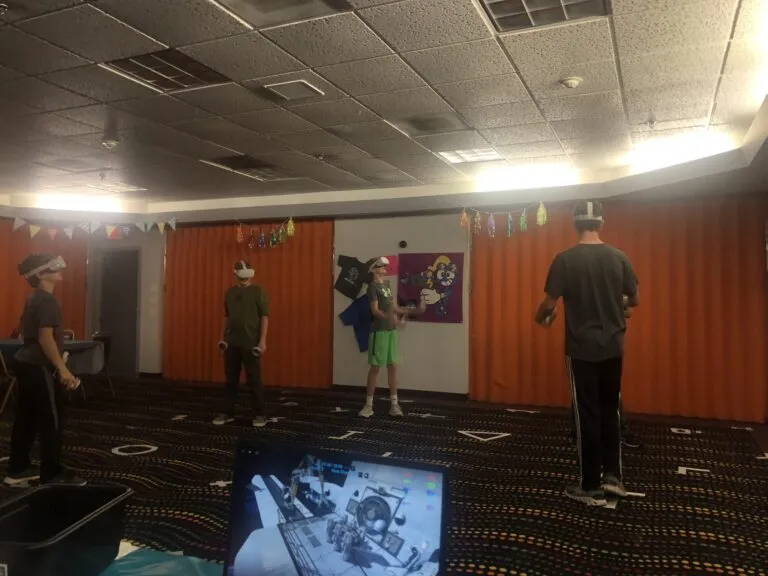
Participants put on lightweight, untethered headsets and often carry haptic gear or mock props. Because the digital world is perfectly mapped to the physical arena, players can walk freely across a room, duck behind physical barriers that appear as digital pillars, and interact with friends in real-time. It is the closest humanity has come to the “Holodeck” experience seen in science fiction.


Free-Roam VR Scenarios: From Zombies to Space Stations

The magic of free-roam VR lies in its ability to transport you anywhere. Because the environment is software-driven, the same 2,000-square-foot room can become a dozen different realities in the span of an hour.

  • Survival Horror: One of the most popular genres sees teams fighting off waves of zombies or alien invaders. The addition of haptic vests—which vibrate when you are “hit”—turns an adrenaline-fueled game into a visceral, full-body experience.
  • Tactical Shooters: Using motion-tracked peripheral props, players can engage in high-stakes competitive matches, leaning around real-world corners to peek at digital opponents.
  • Exploration and Puzzle-Solving: Not every scenario is about combat. Many arenas offer “escape room” style experiences where teams must work together to bypass complex mechanical puzzles, navigate floating platforms, or explore deep-sea ruins that would be impossible to replicate in the real world.


Who Plays in Free-Roam VR? The Case for VR for Kids

While early VR was marketed primarily to tech-savvy adults, the free-roam landscape has become a major destination for younger generations. VR for kids has evolved into a safe, controlled way to engage in “active gaming.”

Parents are increasingly turning to free-roam VR as a healthy alternative to sedentary screen time. It encourages communication, spatial awareness, and problem-solving. Because the arenas are physically monitored by staff, it provides a “gated” digital playground where kids can interact with friends in a moderated environment. Whether it’s a team of 10-year-olds working together to defend a castle or a family bonding over a space adventure, the technology bridges the gap between physical play and digital imagination.


Leveling Up Your Event: Birthdays, Graduations, and Corporate Parties

The traditional event model—bowling alleys or movie theaters—is being challenged by the immersive nature of free-roam VR.

  • Birthday Parties: Kids and teens are moving away from traditional party venues in favor of VR arcades. It offers a “wow” factor that guests will talk about for weeks, providing a high-octane experience that feels exclusive and futuristic.
  • Graduations: For older students, a free-roam VR experience serves as a memorable bonding event, offering a competitive edge for class reunions or post-commencement celebrations.
  • Corporate Parties: This is where free-roam VR truly shines as a team-building tool. Unlike “trust falls” or awkward office lunches, VR forces employees to communicate under pressure. Whether it’s a high-stakes mission or a collaborative puzzle, the experience breaks down professional hierarchies and encourages cooperation in an environment that is genuinely fun.


Scientists and Industry Experts: The Future of Free-Roam VR

The consensus among scientists and tech analysts is that free-roam VR is more than just a passing entertainment trend; it is a preview of the future of human-computer interaction (HCI).

Experts point to the “Presence” factor—the psychological state where the brain stops processing the simulation as a screen and begins treating it as a literal reality. Research suggests that this heightened state of presence makes VR an incredibly powerful tool for training. Firefighters, surgeons, and military personnel are already using versions of this technology to practice life-or-death scenarios in safe, repeatable environments.

Industry leaders believe that as hardware becomes lighter, cheaper, and more immersive, these arenas will stop being purely for entertainment. They predict a future where “Virtual Tourism” and “Remote Presence” allow us to work and travel across these arenas, effectively shrinking the globe.

Ultimately, the free-roam VR arena is a testament to our desire to transcend the limitations of the physical world. It is a place where we stop being passive observers of our entertainment and become active participants in our own stories. Whether you are battling zombies for a birthday party or exploring the limits of human technology, one thing is certain: once you’ve stepped into the arena, the real world will never look quite the same.