TOP 10 best of the best Free-roam VR in Buffalo, NY – Battleonix
El Monte
Log in
0

Advanced Search:

City

Rating

Playground


Price:

Main / Catalog / VR / New York, US / Buffalo, NY

The best Free-roam VR near me in Buffalo, NY

img
from $14
VR

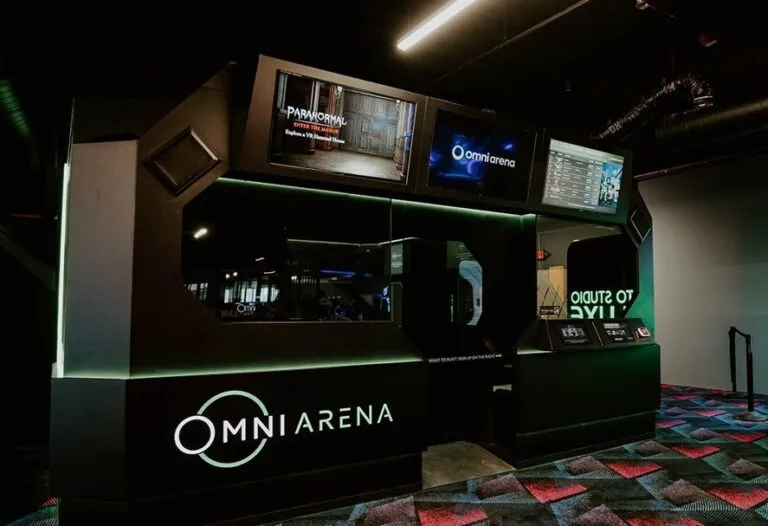
Vortex VR Arcade is located in Niagara Falls, NY.


Vortex VR Arcade: Where Reality Takes a Backseat in Niagara Falls, NY

Located in the heart of Niagara Falls, NY, Vortex VR Arcade offers a fun and unique virtual reality experience for families and individuals alike. They aim to transport visitors to new worlds with state-of-the-art technology, including the Omni Arena, Dark Ride, and a variety of other exciting attractions.

Vortex VR Arcade is the perfect venue for hosting unforgettable parties and events. Whether celebrating a birthday, graduation, or hosting a corporate gathering, they offer tailored experiences to suit every occasion. Their unique blend of VR thrills and classic arcade fun ensures a memorable and engaging event for all attendees. They work hard to create lasting memories.

Indoors
img
from $20
VR

Orions Landing is located in Blasdell, NY.


Looking for unforgettable adventures? Then step into Orion’s Landing VR Arcade, the region’s largest and most innovative destination for virtual reality, arcade games, and creative expression. They have meticulously crafted an environment where fun knows no bounds.

Planning a memorable birthday party or event? Orion’s Landing offers the perfect setting. Choose between thrilling VR adventures, a wild paint splatter party, or a combination of both. They also have classic arcade games and delicious food options, ensuring an unforgettable celebration for all.

All that excitement is sure to work up an appetite. Orion’s Landing offers a menu of satisfying options, including pizzas, crispy chicken fingers, and other treats to keep energy levels high. They have comfortable booths where guests can relax, recharge, and prepare for the next adventure.

They pride themselves on providing the best and most immersive virtual reality experience around. Choose from a selection of over a dozen VR games, designed specifically for arcade environments and group play. These are generally suitable for ages 8 and above. Games are designed for easy play, cater to all skill levels, and prevent motion sickness. Individual VR stations, powered by high-end PCs, ensure a visually stunning and immersive experience. They offer player-versus-player and cooperative gameplay.

Indoors

Best of the best Free-roam VR in Buffalo, NY


The evolution of digital entertainment has moved through several distinct eras, from the early days of pixelated arcade cabinets to the high-definition realism of modern home consoles. However, the most significant shift in recent years is the transition from passive observation to active participation. While traditional gaming requires the player to sit on a couch and manipulate a controller, free-roam Virtual Reality (VR) demands physical movement. It represents a fusion of the digital and physical worlds, creating a space where the player’s body becomes the controller. This technology is quickly becoming a staple of modern entertainment centers, redefining how people celebrate, work, and explore virtual environments.


Understanding the Concept: What is a Free-Roam VR Arena?

A free-roam VR arena is a large-scale, physical space specifically designed to allow multiple players to move around without being restricted by cables or wires. In a standard home VR setup, users are often tethered to a powerful computer or confined to a very small “guardian” area to prevent them from hitting furniture. In contrast, a free-roam arena utilizes untethered technology—usually in the form of wireless headsets or high-performance backpack PCs—to grant players total freedom of movement across a wide area, often ranging from 500 to several thousand square feet.

The magic of these arenas lies in their sophisticated tracking systems. These systems use a combination of external sensors and internal cameras built into the headsets to map the player’s position in real-time with sub-millimeter accuracy. Because the digital environment is mapped directly to the physical dimensions of the room, what a player sees in the goggles matches their physical footsteps. When a player walks forward five steps in the real world, their avatar moves five steps in the virtual kingdom. This synchronization eliminates the traditional motion sickness often associated with VR, as the brain’s vestibular system (which controls balance) and the visual system are in complete agreement.


Immersive Worlds: Common Free-Roam VR Scenarios

The versatility of free-roam VR is best demonstrated through the diverse range of scenarios available to participants. Because the environment is entirely digital, the same physical room can transform into an infinite variety of worlds. One of the most popular genres is the cooperative tactical shooter. In these scenarios, groups must work together to defend a base against waves of zombies or alien invaders. The physical freedom of the arena allows players to duck behind virtual crates, lean around corners, and physically move to revive a teammate, adding a level of intensity and realism that cannot be replicated on a screen.

Beyond traditional combat games, many arenas offer “escape room” style experiences. These scenarios emphasize puzzle-solving and environmental interaction rather than combat. Players might find themselves inside a collapsing Egyptian pyramid or a high-tech space station, requiring them to physically walk to different parts of the room to pull levers, solve geometric puzzles, or pass items to one another. There are also atmospheric adventures designed for exploration, where the focus is on the scale and beauty of the world. These scenarios often involve navigating high-altitude floating islands or deep-sea trenches, providing an awe-inspiring sense of scale that triggers a genuine emotional response.


The Target Audience: Who Inhabits These Virtual Spaces?

The appeal of free-roam VR is surprisingly broad, transcending the stereotype of the “hardcore gamer.” Because the interface is simply the human body, the learning curve is incredibly low. If a person knows how to walk and pick up an object, they know how to play. This accessibility makes it a hit for demographic groups ranging from tech-savvy teenagers to curious senior citizens. Families often frequent these arenas because it provides a rare opportunity for intergenerational play, where parents and children can interact on an even playing field.

A significant portion of the market is dedicated to VR for kids. Most arenas cater to children aged eight and older, ensuring that the equipment fits comfortably and the content is age-appropriate. For younger players, the scenarios are often bright, whimsical, and focused on creative play rather than intensity. Parents often favor these experiences because they promote physical activity. Unlike stationary gaming, a thirty-minute session in a free-roam arena can be quite the workout, involving walking, squatting, and constant movement. Furthermore, it fosters social development by requiring verbal communication and teamwork to succeed in the game.


Celebrating in a Virtual World: Birthdays, Graduations, and Corporate Events

The social nature of free-roam VR has made it a premier destination for group celebrations. For birthday parties, it offers a “wow factor” that traditional venues like bowling alleys or cinema complexes struggle to match. The shared experience of being “inside” a game creates lasting memories and provides a unique talking point for guests. Many facilities offer party packages that include private room rentals and recorded highlights of the gameplay, allowing the birthday host to share their virtual exploits on social media.

Graduation parties also find a home in VR arenas, serving as a rite of passage that feels modern and forward-thinking. It allows a group of friends who are about to head to different universities or cities to share one last high-stakes adventure together. The “all-encompassing” nature of the VR world helps groups bond in a way that is far more profound than traditional social gatherings.

Corporate events and team-building retreats utilize free-roam VR to address specific organizational goals. In a business context, these experiences are more than just games; they are simulations of team dynamics. Managers often use VR scenarios to observe how staff handle pressure, how they communicate during a crisis, and who among them naturally steps into a leadership role. Because the stakes in the virtual world feel real, the teamwork required to “survive” a scenario creates a genuine sense of camaraderie that translates back to the office environment.


The Expert Perspective: Science and Industry Views on Free-Roam VR

Scientists and industry analysts have taken a keen interest in the development of free-roam VR, viewing it as a critical step in human-computer interaction. From a psychological standpoint, experts focus on the concept of “presence.” This is the psychological state where the brain truly believes it is in another location. Neuroscientists have found that free-roam VR triggers the same spatial memory and navigation parts of the brain as real-world movement. This makes it an invaluable tool for “embodied cognition,” a theory suggesting that we learn better when our physical bodies are involved in the process.

Industry experts also see free-roam VR as the proving ground for the future of the “Metaverse.” While many companies are working on social VR platforms for the home, the high-end hardware found in professional arenas provides a glimpse of what the future of consumer technology will look like in a decade. Experts point out that the low latency and high-fidelity graphics found in these arenas set the gold standard for user comfort. They also highlight the potential for “haptic feedback”—wearable vests that allow users to feel the vibration of an explosion or the tap of a teammate’s hand—as the next frontier in making these experiences indistinguishable from reality.

Furthermore, medical and physical therapy experts view the technology as a potential tool for rehabilitation. The ability to create a controlled, safe space where a person can practice movement while being distracted by an engaging game is a concept known as “gamified therapy.” By turning physical exercise into an epic quest, these arenas could eventually play a role in health and wellness beyond the world of pure entertainment. As tracking technology becomes even more precise and hardware becomes lighter, the consensus among experts is that free-roam VR will move from a niche novelty to a fundamental component of the global digital infrastructure.