TOP 10 best of the best Free-roam VR in Denver, CO – Battleonix
El Monte
Log in
0

Advanced Search:

City

Rating

Playground


Price:

Main / Catalog / VR / Colorado, US / Denver, CO

The best Free-roam VR near me in Denver, CO

img
from $6
VR

Monster Mini Golf Denver is located in the Centennial area of the Denver metro, offering an indoor, black-lit escape from Colorado weather. The main attraction is an 18-hole mini golf course populated with animatronic monsters and neon scenery, complemented by a video arcade, a laser maze obstacle course, and virtual reality stations. The venue is designed for walk-in play as well as structured group events.


Private party rooms with a haunted mansion theme are available for birthdays, corporate team-building, school field trips, and other celebrations. The staff handles setup and cleanup, and packages can include arcade credits, return passes, and dedicated event coordination. Light concessions and a prize center round out the experience, making it a full-destination entertainment spot for families and groups of all sizes.

Indoors
img
from $16
Laser tagVR

Main Event Highlands Ranch is located in the southern Denver suburb of Highlands Ranch, Colorado, just off S Broadway and Centennial Blvd, near the intersection of C-470.


Spanning nearly 50,000 square feet, the venue offers 22 lanes of bowling, a multi-level laser tag arena, a 20-foot gravity ropes course, over 100 arcade games, billiards, Virtual Reality experiences, and Challenge Rooms. A full-service restaurant and bar serve chef-inspired American fare, craft beers, and cocktails. The facility is designed for all ages and skill levels, with dedicated party hosts, reserved event spaces, and customizable packages for birthdays, corporate events, and team-building gatherings.


Beyond the main attractions, Main Event Highlands Ranch provides a comfortable lounge area, free WiFi, and big-screen TVs for sports viewing. The venue handles all party logistics from invitations to cleanup, making it a popular choice for stress-free celebrations. The staff is frequently praised for being attentive and going the extra mile for guests. Private meeting rooms with AV equipment are available for corporate functions, and the venue has hosted large-scale private events for over 900 guests.

Indoors
img
from $5
VR

Urban Air Adventure Park is located in the Southlands area of Aurora, Colorado, near the intersection of East Briarwood Circle and South Powhaton Road.


The park is a full indoor playground featuring trampolines, indoor go-karts, a Sky Rider zip line, climbing walls, a Leap of Faith drop, a Warrior Course, a ropes course, laser tag, virtual reality, and a dedicated area for younger children. Birthday parties, group events, field trips, and team-building outings are all accommodated with dedicated hosts and private spaces.


The Urban Café serves pizza, snacks, and drinks for refueling between activities. Membership options are available for frequent visitors, offering unlimited play and exclusive perks. The staff is trained to maintain a safe and welcoming environment, and the park has received multiple awards for family-friendly entertainment.

Indoors
img
from $50
VR

Sandbox VR Lone Tree is located in the outdoor shopping district on the east side of Park Meadows mall in Lone Tree, Colorado, just south of Denver.


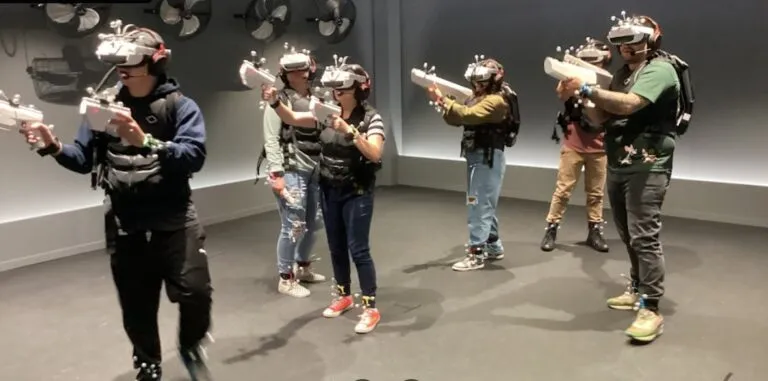
This is a full-body, free-roam virtual reality venue where groups of two to six players step into immersive worlds like Squid Game Virtuals, Stranger Things: Catalyst, the Deadwood zombie trilogy, Age of Dinosaurs, and more. Players wear haptic vests, motion trackers, and VR headsets inside a warehouse-sized room, experiencing realistic movement and feedback. Each session includes a free personalized highlight reel. The venue features four private VR rooms and a dedicated party room for groups.


Beyond the core gameplay, Sandbox VR Lone Tree offers private event packages for birthdays, corporate team building, and social gatherings. The staff is known for being friendly and thorough in guiding guests through the experience. A lounge area with complimentary water allows guests to watch their highlight reel after the game. The location is part of the Park Meadows shopping center, with restaurants and other attractions nearby, making it easy to build a full outing around the visit.

Indoors
img
from $5
VR

Urban Air Trampoline and Adventure Park is located in the eastern part of Denver, Colorado, in the Central Park neighborhood near East 40th Avenue.


The park offers over a dozen indoor attractions including trampolines, a zip line, climbing walls, a ropes course, a warrior obstacle course, dodgeball, a battle beam, virtual reality, and a dedicated kids’ area for children 7 and under. Visitors can purchase day passes at different access levels or opt for memberships for unlimited play. The facility is well-suited for birthday parties, with packages that include a private table or room, a dedicated host, food options, and full setup and cleanup service.


Beyond birthdays, Urban Air hosts school field trips, youth sports celebrations, corporate team-building events, and private park rentals. The on-site Urban Café serves pizza and refreshments, and the entire venue is indoor and climate-controlled for year-round use. A Friday morning Jumperoo event caters specifically to toddlers and preschoolers, while the Adventure 4 All bundle offers a convenient package for families of four.

Indoors
img
from $10
VR

VR Social is located in the Edgewater neighborhood of Denver, Colorado, within the Edgewater Public Market complex.


The venue features a 2,000+ square foot free-roam VR arena where up to 8 players can move untethered through immersive virtual worlds. With a library of 12+ games spanning action, horror, puzzle, and escape room genres, guests can enjoy cooperative missions or competitive showdowns guided by knowledgeable staff. The signature free-roam experience runs 25-minute sessions at $35 per person, with longer private sessions available for groups.


Beyond the arena, VR Social offers a bar and lounge with LED-lit furniture, a DJ booth, and a dedicated event space for up to 150 guests. The venue specializes in birthday parties, corporate team building, and private events, with dedicated party hosts, customizable packages, and catering coordination available. Additional attractions include 9D VR cinema rides and a full event planning service for larger celebrations.

Indoors
img
from $5
VR

Urban Air Adventure Park is located in the Columbine neighborhood of Littleton, Colorado, at 8196 West Bowles Avenue.


This indoor adventure park offers over a dozen attractions including trampoline courts, a warrior obstacle course, climbing walls, a ropes course, laser tag, virtual reality, bumper cars (Spin Zone and Flip Zone), a Battle Beam, DropZone, Sky Rider zip line, a Tubes indoor playground, and a dedicated kids’ area for children 7 and under. The park is designed for all ages and skill levels, with attractions ranging from gentle play zones to high-adrenaline challenges. It is a popular destination for birthday parties, school field trips, corporate team building, and family outings.


Beyond the attractions, the park features the Urban Café serving pizza, snacks, and drinks, as well as private party rooms for celebrations. The staff handles party coordination, setup, and cleanup for birthday packages. Safety is a priority — grip socks are required, staff are trained in CPR and first aid, and height and weight restrictions are enforced on certain attractions. The facility also offers memberships for frequent visitors and group rates for larger parties.

Indoors
img
from $5
VR

VR Arcade USA is located in the LoDo neighborhood of Denver, Colorado, just steps from the 16th Street Mall and Union Station.


The venue offers two main ways to play: the Featured Experience — a rotating interactive cinematic adventure (currently a haunted house escape) — and Free Play, which unlocks a library of hundreds of VR titles including bowling, laser tag, putt-putt golf, boxing, Beat Saber, zombie shooters, and more. Both options can be combined into the Ultimate Experience. Each participant admission includes an appetizer and beverage of choice. The arcade uses state-of-the-art VR headsets and controllers, and some setups feature omnidirectional treadmills for natural movement. The knowledgeable staff assess each guest’s skill level and provide personalized recommendations and tutorials.


The arcade is reservation-only, ensuring private or semi-private sessions for each group. Onsite party packages include two hours of Ultimate Experience gameplay plus food and beverages for all guests. The venue also offers nationwide delivery of VR equipment for off-site events. A lounge area is available for relaxing before or after sessions, and the LoDo location places guests within walking distance of Denver’s best restaurants and attractions. Gift cards are available. The space is well-suited for birthday parties, corporate team-building, family outings, and friend gatherings.

Indoors

Best of the best Free-roam VR in Denver, CO


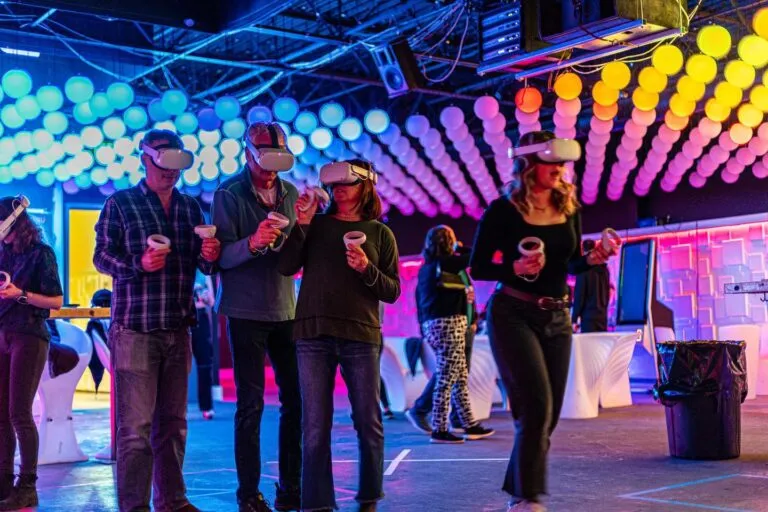
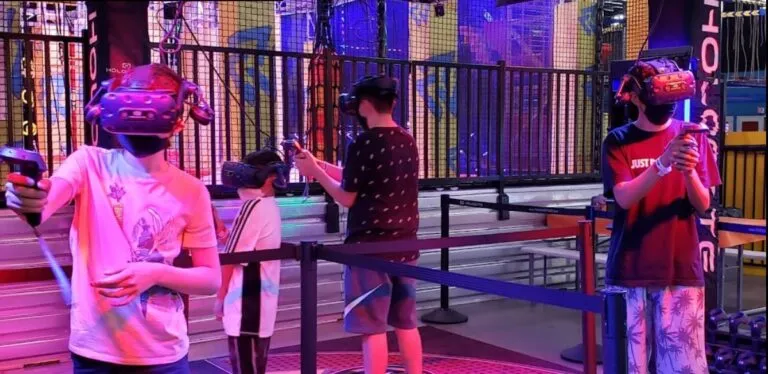
Denver, Colorado is quickly becoming a hotspot for virtual reality (VR) arenas and entertainment centers. VR is one of the most advanced and exciting gaming technologies on the market, and there is no shortage of amazing experiences in the Mile High City. Here’s a look at some of the most popular VR arenas in Denver, CO, that you need to check out on your next visit to the city.


VR in Denver, CO


What Is a Free‑Roam VR Arena?

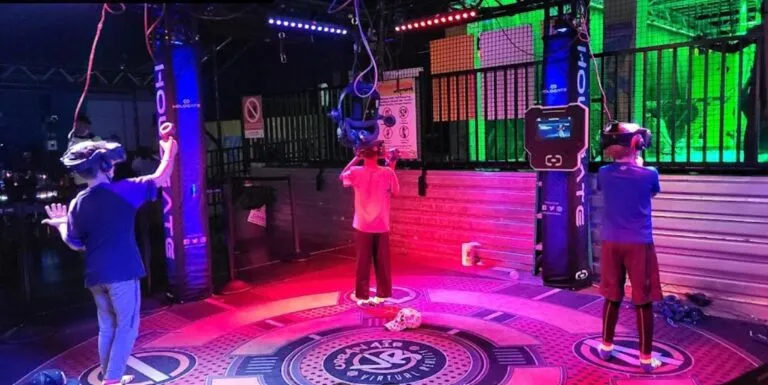
A free‑roam virtual‑reality arena is a purpose‑built physical space in which participants can move unhindered while immersed in a digital world. Unlike seated or tabletop VR setups that restrict movement to a fixed spot, free‑roam arenas outfit the floor with motion‑capture sensors, inside‑out tracking cameras, or a combination of both, allowing the system to constantly locate each headset and controller in three‑dimensional space. The result is a seamless blend of the real environment and the virtual one: users can walk, duck, leap, or even collaborate with strangers while their avatars respond in real time.

Architecturally, the arenas range from modest 1,000‑square‑foot rooms filled with padded walls to sprawling warehouses partitioned into multiple themed zones. The flooring is typically covered with low‑friction, anti‑static mats to protect equipment and keep participants safe. Safety protocols—such as guardian boundaries, on‑site staff, and emergency stop buttons—are baked into the design, ensuring that the high level of physical freedom does not translate into risk.

Free‑roam VR is more than a technological curiosity. It represents a convergence of gaming, training, and experiential marketing, providing an immersive platform where the body becomes an active controller rather than a passive observer.


Free‑Roam VR Scenarios

Because the technology tracks full‑body movement, creators can design experiences that would be impossible in traditional gaming formats. Below are some of the most compelling scenarios currently in circulation.

1. Collaborative Quest Adventures

Teams of four to eight players embark on narrative‑driven quests that require physical cooperation—solving puzzles by moving objects, forming human chains to cross virtual chasms, or simultaneously triggering switches in different rooms. The shared physicality intensifies the sense of camaraderie and makes the story feel lived rather than watched.

2. Competitive Sports Simulations

From futuristic hover‑ball matches to recreations of classic sports like basketball or soccer, free‑roam arenas let participants use their bodies to perform actions that translate directly into the virtual arena. The kinetic feedback—often reinforced with haptic vests or floor vibration—creates a visceral sense of speed and impact.

3. Immersive Education and Training

Complex procedures such as surgical drills, industrial maintenance, or emergency response can be rehearsed in a safe environment. Trainees walk through a virtual plant, locate equipment, and manipulate digital tools, receiving instant performance analytics that can be reviewed after the session.

4. Narrative Role‑Playing and Theatre

The ability to physically walk onto a virtual stage opens doors for interactive theatre. Actors in VR can improvise with live audiences who are themselves avatars, blurring the line between spectator and performer.

5. Exploration of Imagined Worlds

From underwater coral reefs to zero‑gravity space stations, free‑roam VR lets users explore settings that defy the constraints of physics. The sense of weightlessness or buoyancy is simulated through motion design, giving participants a feeling of true immersion.


Who Plays on Free‑Roam VR Arenas?

The appeal of free‑roam VR extends far beyond the typical gamer demographic. Its versatility draws a wide spectrum of participants, each motivated by different goals.

Casual Gamers and Thrill‑Seekers

Young adults looking for high‑octane entertainment gravitate toward fast‑paced combat or sports simulations. The novelty of physically moving in VR makes these venues a popular weekend destination, akin to an indoor theme park.

Families and Social Groups

Because the experience can be shared among participants of varying skill levels, families use free‑roam arenas as a bonding activity. The collaborative nature of many games encourages communication and teamwork among parents and children alike.

Corporate Teams

Businesses increasingly turn to free‑roam VR for team‑building exercises. The technology’s ability to place colleagues in high‑stress, problem‑solving scenarios without real‑world consequences makes it an effective tool for assessing leadership, communication, and adaptability.

Educational Institutions

Schools, universities, and vocational training centers employ free‑roam VR for experiential learning. Students can virtually reconstruct historical sites, practice language immersion, or simulate lab experiments that would be too costly or hazardous in a physical setting.

Researchers and Developers

The data generated by free‑roam sessions—movement trajectories, interaction timestamps, physiological responses—provides a rich dataset for psychologists, human‑computer interaction scholars, and game designers seeking to refine immersion metrics.


VR for Kids

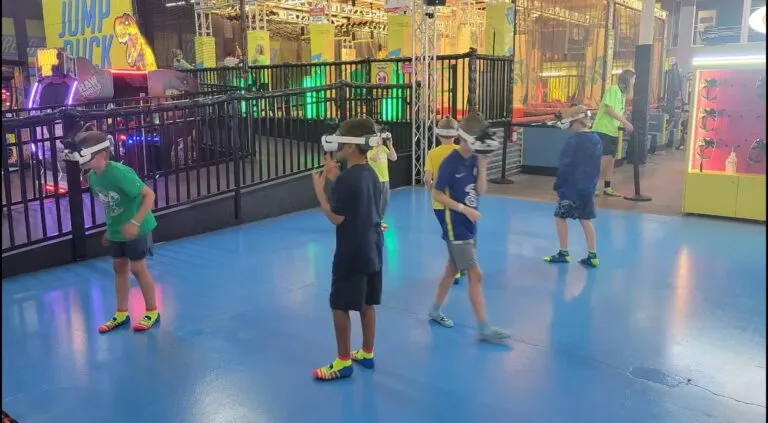
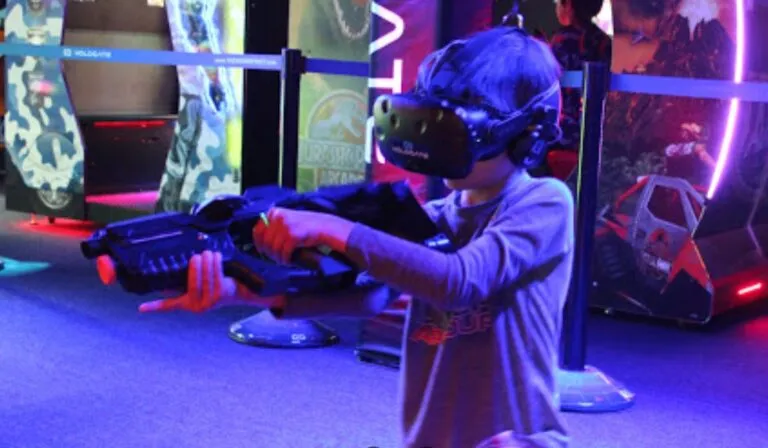
Introducing children to free‑roam VR demands a careful balance between excitement and safety. Operators typically design kid‑friendly zones with lower intensity visuals, simplified controls, and shorter session lengths to accommodate shorter attention spans and develop motor skills gradually.

Physical Development

Because participants must navigate real space, the technology encourages gross‑motor coordination, spatial awareness, and balance—skills that traditional screen‑based gaming does not target. Studies have shown that children who engage in moderate‑intensity VR movement exhibit improved proprioception and endurance.

Cognitive Engagement

Puzzle‑based adventures stimulate problem‑solving, memory, and logical reasoning. By requiring players to physically interact with virtual objects, the experience reinforces learning through embodied cognition—a theory suggesting that thinking is deeply linked to bodily actions.

Social Interaction

Multi‑player scenarios provide a controlled environment for children to practice collaboration, negotiation, and turn‑taking. Unlike online multiplayer games where avatars communicate solely through text or voice, free‑roam VR adds a layer of physical presence that mirrors real‑world social dynamics.

Safety Measures

Operators enforce strict hygiene protocols (sanitizing headsets between uses) and implement guardian boundaries that appear as translucent walls within the headset. Staff monitors each session, ready to intervene if a participant shows signs of motion sickness or disorientation.

Overall, when properly managed, free‑roam VR offers a potent blend of fun, education, and physical activity that appeals to both parents and children.


Free‑Roam VR for a Birthday Party, Graduation, or Corporate Event

The adaptability of free‑roam VR makes it an attractive venue for a range of celebrations and professional gatherings. Below is a look at how each event type can be enhanced.

Birthday Parties

A birthday celebration in a free‑roam arena transforms a typical party into an adventure quest. Organizers can customize themes—pirate treasure hunts, superhero trainings, or dinosaur expeditions—allowing the birthday child and guests to become the protagonists of a story crafted around their interests. The physical activity burns off excess energy, while the novelty factor often generates lasting memories and social media buzz.

Graduation Ceremonies

Educational institutions have begun to reimagine graduation ceremonies as immersive experiences. Graduates can walk through a virtual timeline of their academic journey, reliving milestones in a three‑dimensional gallery. The event can culminate in a shared “launch” simulation where participants virtually ascend a rocket or cross a finish line, symbolizing the transition from student life to professional pursuits.

Corporate Parties and Team‑Building

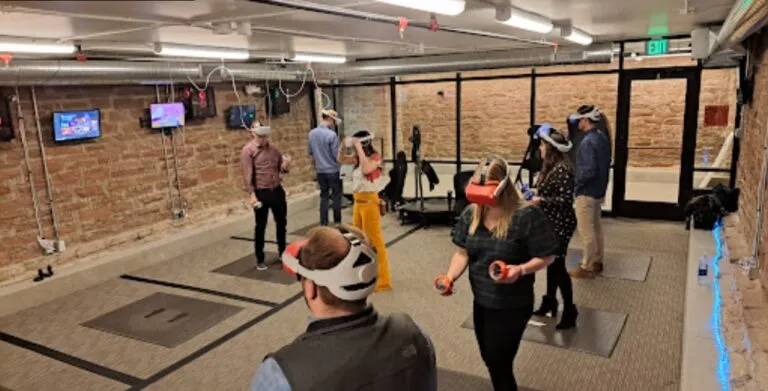
For companies, free‑roam VR offers a dual-purpose platform: celebration and skill development. A corporate holiday party might feature a themed “escape room” where teams must collaborate to solve challenges under a time limit. The physical nature of the tasks highlights leadership styles, communication effectiveness, and stress management—data that HR can later analyze to inform training programs. Moreover, the novelty of the environment fosters a relaxed atmosphere, encouraging bonding that traditional meeting rooms seldom achieve.

Across all these scenarios, the key advantage is the ability to tailor the virtual world to the event’s narrative, creating a cohesive story that resonates with participants while leveraging the embodied interaction that free‑roam VR uniquely provides.


Scientists and Industry Experts View on Free‑Roam VR

The scientific community and industry leaders have taken a keen interest in free‑roam VR, recognizing its potential to reshape multiple sectors.

Human‑Computer Interaction Researchers

Academics in HCI praise free‑roam VR as a “next‑generation interface” that expands the interaction vocabulary beyond button presses and joystick movements. By integrating whole‑body tracking, the technology enables researchers to study naturalistic gestures, gait patterns, and spatial cognition in controlled yet ecologically valid settings.

Neuroscientists

Neuroscientists point to the immersive, multisensory nature of free‑roam VR as a powerful tool for investigating brain plasticity. Studies have shown that navigating a virtual environment activates hippocampal regions similarly to real‑world navigation, suggesting potential therapeutic applications for patients with memory impairments.

Occupational Health Specialists

Experts in occupational safety recognize free‑roam VR as a low‑risk environment for high‑risk task training. Simulating hazardous scenarios—such as chemical spills or fire rescues—allows workers to rehearse proper protocols without exposure to actual danger, thereby reducing workplace incidents.

Gaming Industry Executives

From a commercial perspective, executives highlight the differentiating factor that free‑roam arenas bring to the crowded entertainment market. The high capital investment required for hardware and space is offset by premium pricing models, subscription packages for corporate clients, and the ability to host recurring events. As the technology matures and costs decline, industry leaders anticipate a proliferation of smaller‑scale “pop‑up” arenas in shopping malls and urban centers.

Educational Policy Makers

Policy makers in education see free‑roam VR as a bridge between classroom learning and experiential training. Pilot programs in STEM curricula have demonstrated improved student engagement and retention of complex concepts, prompting calls for increased funding to integrate VR labs into public schools.

In sum, the consensus among scientists and industry professionals is that free‑roam VR is more than a fleeting novelty. Its capacity to merge physicality with digital immersion positions it as a transformative medium with applications ranging from entertainment and education to health care and corporate development.


Conclusion

Free‑roam virtual‑reality arenas have evolved from experimental labs into bustling hubs of interactive experience. By allowing participants to move freely within a digitally constructed world, these venues unlock a range of scenarios—from collaborative quests and competitive sports to immersive training and celebratory events. The audience is equally diverse, encompassing casual gamers, families, corporate teams, educators, and researchers. For children, the blend of physical activity, cognitive challenge, and social interaction makes free‑roam VR a compelling educational tool when safety measures are rigorously applied. Meanwhile, event planners harness the technology to craft unforgettable birthdays, graduations, and corporate gatherings that leave participants both exhilarated and connected.

Scientific and industry perspectives converge on the idea that free‑roam VR is not merely an entertainment gimmick but a versatile platform with far‑reaching implications. As tracking precision improves, hardware becomes more affordable, and content creation pipelines mature, the reach of free‑roam VR is poised to expand beyond dedicated arenas into more accessible, modular formats. Whether in massive warehouses or compact pop‑up spaces, the promise remains the same: a space where the body and the mind move together, exploring worlds limited only by imagination.