TOP 10 best of the best Free-roam VR in Manchester, NH – Battleonix
El Monte
Log in
0

Advanced Search:

City

Rating

Playground


Price:

Main / Catalog / VR / New Hampshire, US / Manchester, NH

The best Free-roam VR near me in Manchester, NH

img
from $6
Laser tagVR

Block Party Social is located in Fremont, NH.


Nestled in the heart of Fremont, New Hampshire, Block Party Social has quickly emerged as a premier destination for immersive entertainment and high-energy social experiences.

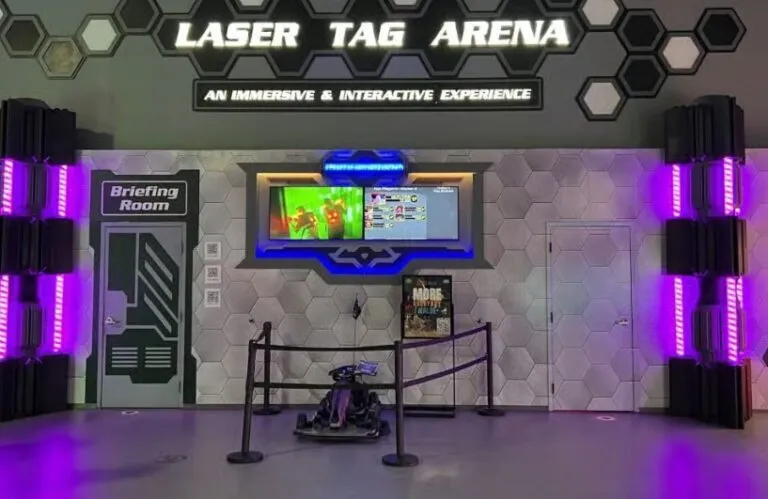
At the core of Block Party Social’s appeal are its standout attractions: laser tag and virtual reality (VR). The venue features a multi-level laser tag arena designed with strategic obstacles, glowing tunnels, and pulsing lights that transform the space into a futuristic battlefield.

Beyond its high-tech attractions, Block Party Social fosters a vibrant community atmosphere. The lounge-style common area, complete with modern seating and ambient lighting, invites guests to relax between games. Complimentary Wi-Fi, snack offerings, and digital leaderboards tracking scores from both laser tag and VR challenges add to the social appeal. The venue also hosts themed nights, birthday parties, and private events, positioning itself as a go-to hub for celebrations and gatherings.

Indoors

Best of the best Free-roam VR in Manchester, NH


The landscape of digital entertainment has undergone a radical transformation over the last decade. While home gaming and traditional cinema once held the crown for immersive experiences, a new contender has emerged that merges physical movement with digital environments: free-roam Virtual Reality (VR). Unlike the tethered experiences found in living rooms, free-roam VR breaks the physical barriers of cables and limited tracking spaces, allowing participants to step into a digital world where their physical body is the controller. This shift represents the pinnacle of location-based entertainment, offering a level of immersion that was previously the stuff of science fiction.


What is a free-roam VR arena

A free-roam VR arena is a specialized facility designed to host immersive, wireless virtual reality experiences within a large, open physical space. At its core, the technology allows multiple players to move around a room without being restricted by wires or cables connected to a computer. In a standard home VR setup, users are often confined to a “standing” or “room-scale” area of only a few square meters, frequently relying on joysticks to move their avatars. In a free-roam arena, movement is one-to-one; if a player takes ten steps forward in the physical room, their virtual character takes ten steps forward in the game world.

The infrastructure of these arenas typically involves sophisticated tracking systems. Some use “outside-in” tracking, where a perimeter of cameras or sensors monitors the position of headsets and peripherals with millimeter precision. Others utilize “inside-out” tracking, where the headsets themselves use embedded cameras and Simultaneous Localization and Mapping (SLAM) technology to understand the environment. To handle the high-end graphics required for immersion, players often wear specialized lightweight backpacks containing high-performance computers, or they utilize high-bandwidth wireless streaming from a central server to standalone headsets.

The physical environment is usually an austere, open floor plan, often fitted with padded walls and safety boundaries. However, within the headset, this empty space transforms into sprawling landscapes, futuristic space stations, or haunted mansions. Because the virtual environment is mapped exactly to the physical dimensions of the arena, the brain is effectively tricked into believing the digital world is real, a phenomenon known as “presence.”


Free-roam VR scenarios

The versatility of free-roam VR is perhaps best demonstrated by the wide array of scenarios available to players. Unlike traditional video games that might focus on a single mechanic, these arenas offer diverse narratives and gameplay styles tailored to the physical freedom of the space.

Action and survival scenarios remain the most popular. These often involve “wave-based” combat where a squad of players must defend a position against hordes of zombies, robots, or alien creatures. Because players can physically walk around, take cover behind virtual crates, and stand back-to-back with their teammates, the intensity is significantly higher than a standard screen-based game. The physical sensation of turning your head and seeing a teammate covering your flank creates a visceral sense of camaraderie and urgency.

Beyond combat, escape rooms have found a new life in free-roam VR. Traditional escape rooms are limited by physical props and the size of the building. In a VR arena, the “room” can shift and change. Players might start in a small dungeon and find themselves transported to a floating island or a crumbling underwater base. These scenarios focus on environmental puzzles that require physical coordination—such as two players needing to hold a virtual bridge steady while a third crosses it.

Educational and exploratory scenarios are also gaining traction. Some arenas offer “virtual tourism” or historical recreations, allowing users to walk through ancient Rome or explore the surface of Mars. These experiences prioritize atmosphere and detail over high-speed action, making them accessible to those who may not be interested in traditional gaming. The common thread across all these scenarios is the abandonment of the controller for movement; the player’s own footsteps are the primary engine of the narrative.


Who plays on free-roam VR arenas? VR for kids

The demographic of free-roam VR is surprisingly broad, bridging the gap between hardcore gamers and casual thrill-seekers. While early adopters were primarily young adults familiar with technology, the market has expanded to include families and older adults looking for novel social activities. One of the most significant growth areas is VR for children and teenagers.

For kids, free-roam VR offers a unique blend of digital engagement and physical activity. In an era where sedentary screen time is a major concern for parents, these arenas provide a solution that requires constant movement. Players are often walking, ducking, and reaching throughout the session, which translates to a moderate level of physical exercise. Because the tracking is so precise, the risk of motion sickness—often caused by a disconnect between visual movement and physical stillness—is greatly reduced, making it more comfortable for younger users whose vestibular systems are still developing.

Safety and content are carefully managed in these environments. Most arenas implement age restrictions, typically starting at eight or ten years old, to ensure the headsets fit properly and the content is age-appropriate. Developers have created a wealth of “family-friendly” content that avoids realistic violence in favor of cartoon-style aesthetics and cooperative problem-solving. This makes the arena a modern alternative to the traditional playground or arcade, fostering social skills like communication and teamwork in a high-tech environment.


Free-roam VR for a birthday party, graduation, corporate party

The social nature of free-roam VR makes it an ideal venue for milestone events and group gatherings. Unlike traditional VR, which can be an isolating experience, free-roam is built for groups. This shared reality is the primary draw for birthday parties and graduations. For a group of friends, the ability to see each other’s avatars and hear each other’s voices in real-time creates a collective memory that a movie or a dinner cannot replicate. The “spectator” element is also important; many arenas provide external screens so that those waiting their turn can watch the action unfold, making it a cohesive group event.

Corporate parties and team-building retreats have also embraced the technology. Modern management often looks for activities that break down workplace hierarchies and encourage genuine cooperation. In a VR scenario, a manager and an entry-level employee might find themselves in a situation where they must rely on each other to solve a puzzle or survive a digital challenge. The high-pressure but safe environment of a VR simulation can reveal much about a team’s communication styles and leadership dynamics.

Furthermore, the logistical ease of hosting these parties is a significant advantage. Arenas are designed to handle high turnover and provide a curated experience that includes safety briefings, the game session, and often a social area for post-game debriefing. Whether it is a graduation celebration where classmates take one final “adventure” together or a corporate office looking to blow off steam, the novelty and excitement of the technology ensure high engagement levels.


Scientists and industry experts view on Free-roam VR

From the perspective of scientists and industry experts, free-roam VR is more than just an entertainment novelty; it is a profound field of study for human-computer interaction and psychological research. Neuroscientists are particularly interested in how the brain processes “spatial presence” in free-roam environments. Studies suggest that when the body moves in sync with the eyes, the brain’s motor cortex and vestibular system are fully engaged, leading to much higher levels of information retention and emotional impact. This is why free-roam VR is increasingly being used for high-stakes training in fields like firefighting, policing, and surgical prep, where physical “muscle memory” is essential.

Industry experts point to the “Location-Based Entertainment” (LBE) sector as a vital part of the future of the retail economy. As e-commerce continues to dominate traditional shopping, physical venues are pivoting toward “experience-based” offerings that cannot be replicated at home. Experts emphasize that while home VR headsets are becoming more powerful, they cannot compete with the square footage and high-end tracking hardware available in a professional arena. This creates a sustainable niche for businesses that can provide these premium experiences.

Furthermore, psychologists observe the benefits of “embodied cognition” in these spaces. By placing the user in a situation where they must use their whole body to navigate a social or strategic challenge, the experiences can boost confidence and improve spatial reasoning. Industry analysts predict that as the technology becomes more lightweight and more affordable to operate, free-roam VR will move beyond specialized arenas and become a standard feature in community centers, schools, and various vocational training facilities, eventually blending the lines between play, education, and professional development.