TOP 10 best of the best Free-roam VR in Memphis, TN – Battleonix
El Monte
Log in
0

Advanced Search:

City

Rating

Playground


Price:

Main / Catalog / VR / Tennessee, US / Memphis, TN

The best Free-roam VR near me in Memphis, TN

img
from $29
VR

Urban Air Trampoline and Adventure Park is located in Collierville, Tennessee, a growing suburb in the greater Memphis metro area, along East Shelby Drive. It’s a fully indoor adventure center with more than 20 attractions, including trampoline arenas, an indoor zipline, a ropes course, a flying trapeze, climbing walls, bowling, unlimited virtual reality, and bumper cars. Guests can also enjoy dodgeball, the Warrior Course, the Battle Beam, and a dedicated Kid’s Area for ages 7 and under, all under one roof and open year-round regardless of weather.


Beyond open play, the park is a popular destination for kids’ birthday parties, school field trips, youth sports groups, and corporate team-building events, with party hosts, on-site catering, and private room rentals available. The café serves pizza, snacks, and treats for refueling between activities, while party tables and private rooms give families a comfortable place to relax. With All Day Play access and staff on hand to guide guests through every attraction, it’s a convenient, family-friendly choice for everything from a casual weekend outing to a full celebration.

Indoors
img
from $8
Laser tagVR

LASERTRON at Golf and Games Memphis sits in the Summer Avenue area of northeast Memphis, inside the larger Putt-Putt Family Park complex.


The venue runs 15-minute laser tag missions in a massive, multi-level LED-illuminated arena roughly three to four times larger than most U.S. laser tag arenas, with a capacity of up to 40 players. Players use LT-12.9 PRO equipment across team-based scenarios like Headquarters and Team Base, with coaching available and tournaments held throughout the year. A single mission costs $12, and the arena suits everyone from casual first-timers to competitive players.


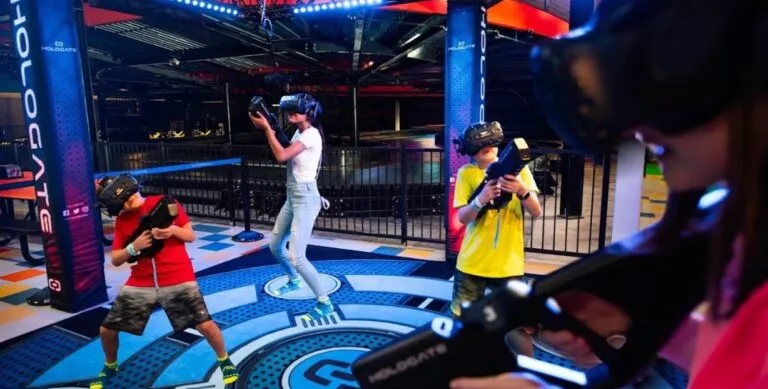
Beyond laser tag, the family-owned park adds go-karts, putt-putt golf, bumper boats, bumper cars, batting cages, an arcade, Hologate VR, and a Maxflight virtual rollercoaster. Spacious picnic areas and themed party rooms support birthdays, corporate events, group picnics, and family reunions, with packages that bundle attractions, arcade value, and food. Parking is free and the park is open year-round.

Indoors

Outdoors
img
from $5
VR

Urban Air Trampoline and Adventure Park sits in the Southaven Towne Center area of Southaven, Mississippi, off Southcrest Parkway, serving families across DeSoto County and the greater Memphis region.


The park is a full indoor adventure destination featuring APEX trampolines, a Slam Dunk Zone, Sky Rider zipline, ropes course, climbing walls, Leap of Faith, Tubes playground, Warrior Course, trampoline dodgeball, Battle Beam, and Spin Zone bumper cars. It offers day tickets, memberships with unlimited visits, and competitive games that suit everyone from toddlers to adults.


Beyond open play, the venue hosts birthday parties with reserved space and a shared host, plus field trips, teen nights, parents’ night out, fitness classes, and corporate events. An on-site café serves pizza, ICEEs, and drinks, and the KidHub app streamlines booking and entry. The friendly staff and required safety waivers help keep the experience clean, supervised, and enjoyable for all ages.

Indoors

Stepping Into the Infinite: The Rise of Free-Roam VR Arenas

Virtual reality has traveled a long road from the tethered, stationary headsets of the early 2010s. For years, the primary limitation of VR was the “bubble”—users were confined to a small square on the floor, tethered by thick cables to a PC, constantly worried about tripping over a chair or punching a lamp. Today, that barrier has vanished. Enter the free-roam VR arena: a warehouse-sized playground where the physical walls of the room are the only boundaries, and the digital world knows no limits.


What is a Free-Roam VR Arena?

A free-roam VR arena is an expansive, purpose-built facility designed to allow multiple players to walk, run, and interact within a simulated environment simultaneously. Unlike home VR systems, which rely on localized tracking, these arenas utilize sophisticated, high-precision motion-capture arrays. Through a combination of overhead infrared cameras and sensitive sensors mounted on lightweight wearable gear, the system tracks the precise coordinates of every player in real-time.

The core philosophy of a free-roam arena is “untethered immersion.” Players wear a backpack computer or connect to a high-speed wireless network that eliminates the need for physical wires connecting to a central tower. Because the hardware is mobile, the player’s body becomes the controller. When a player takes a step in the real world, they take an identical step in the virtual landscape. This 1:1 movement ratio drastically reduces the motion sickness often associated with joystick-based locomotion in stationary VR, creating a level of presence that feels indistinguishable from reality.


Exploring Free-Roam VR Scenarios

The versatility of free-roam arenas allows for a staggering variety of experiences that shift from high-octane action to thoughtful exploration. The most common scenario is the “tactical shooter,” where teams cooperate to navigate dense, digitally rendered urban centers, abandoned bunkers, or futuristic space stations. In these settings, the arena floor might feature physical props—such as walls, ledges, or barricades—that align perfectly with the virtual environment, providing haptic feedback when a player leans against a wall or ducks behind cover.

Beyond combat, free-roam VR offers “narrative puzzle-solving.” Players may find themselves trapped in an ancient Egyptian tomb, where they must physically lift large stone blocks or pull levers to unlock doors. Because the experience is cooperative, the group must communicate: one player might hold a virtual torch while another reads the inscriptions on a wall, or one player might stand on a pressure plate to allow the others to cross a chasm. There are also “horror escape rooms,” where the sheer scale of the arena allows developers to create long, winding corridors that build immense psychological tension, leveraging the vast floor space to induce feelings of genuine vulnerability.


Who Plays on Free-Roam VR Arenas? VR for Kids

While initially marketed toward the hardcore gaming demographic, the accessibility of free-roam VR has expanded its reach significantly. Families are increasingly turning to these arenas as a unique weekend activity. For kids, these spaces offer a rare opportunity for physical movement paired with digital engagement. Instead of sitting on a couch with a controller, children are encouraged to run, dodge, and collaborate.

It is important to note that most arenas enforce height and age restrictions, typically starting around age eight or ten, primarily due to the weight of the hardware. However, for those who meet the criteria, the experience is often transformative. It allows children to engage in “edutainment” scenarios, such as walking on the surface of Mars or exploring the interior of a human cell at a size that makes the organelles look like massive, interactive structures. By turning learning into a shared physical journey, free-roam VR is quickly becoming a staple in modern experiential entertainment for younger demographics.


Free-Roam VR for Birthdays, Graduations, and Corporate Parties

The “event” aspect of free-roam VR is perhaps its most successful commercial application. Standard parties—whether they be birthdays, graduations, or corporate retreats—often struggle with the “what do we actually do?” problem. A free-roam VR arena solves this by acting as a high-tech centerpiece that forces engagement.

For a birthday or graduation, the arena provides a memorable, shared narrative experience that attendees discuss long after the headsets come off. It removes the social awkwardness of a party by giving guests a collective objective. In the corporate world, this technology has become a gold standard for team building. Unlike a trust fall or a standard meeting, VR scenarios require genuine cooperation under pressure. When a team of coworkers must communicate flawlessly to survive a virtual zombie horde or solve a complex engineering puzzle in a simulated environment, the barriers of office hierarchy dissolve. Corporate organizers find that these sessions uncover leadership dynamics and communication habits that are invisible in a traditional boardroom setting.


Scientists and Industry Experts’ View on Free-Roam VR

From the perspective of human-computer interaction (HCI) researchers, free-roam VR is considered the “holy grail” of spatial computing. Experts point out that the human brain relies heavily on vestibular input—the sensation of movement—to understand space. When a user sits in a chair but moves a character with a joystick, the brain detects a sensory conflict, which leads to nausea. Free-roam VR eliminates this conflict by synchronizing physical movement with visual input, which neuroscientists identify as a key step toward the ultimate goal of “presence.”

Industry analysts view these arenas as the bridge between current gaming trends and the future of the “Metaverse.” While the Metaverse is often criticized for being an isolating digital experience, free-roam arenas prove that VR is actually an incredibly social tool when applied in a shared physical space. Experts suggest that as hardware becomes smaller and lighter, these arenas will stop being purely for entertainment. They predict a shift toward professional training—emergency response drills, flight deck simulations, and architectural walkthroughs—where the ability to move freely in a life-sized virtual replica of a workspace offers safety and cost-efficiency that traditional training cannot match.

The transition from a static, isolated experience to a fluid, communal one is the defining narrative of VR today. Through the lens of the free-roam arena, we see a future where the digital and the physical are no longer competing forces but partners in a new frontier of human experience. As technology continues to strip away the weight of equipment and the constraints of cables, the arena will remain the primary stage upon which we redefine what it means to play, to work, and to learn together.