Log in
Big Sky Arcadia is a popular arcade and entertainment center located in Missoula, Montana.
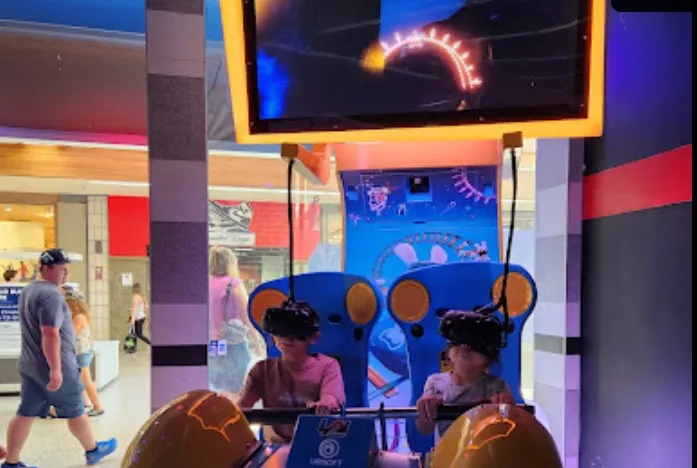
The arcade at Big Sky Arcadia features a variety of classic and modern video games, including racing games, shooting games, and redemption games. Players can enjoy the nostalgic feel of old-school arcade machines or try their hand at the latest virtual reality experiences.
In addition to the arcade, Big Sky Arcadia also offers other entertainment options such as laser tag and mini-golf. The laser tag arena provides an exciting and interactive experience, where players can compete against each other in a futuristic setting. The mini-golf course offers a fun and challenging game for players of all skill levels.
Indoors
Virtual reality has long been associated with being tethered to a desk or restricted to the confines of a living room rug. But a new frontier has emerged, one that strips away the wires, removes the walls, and allows players to physically walk through digital worlds. Welcome to the era of the free-roam VR arena—the closest technology has ever come to science fiction.
A free-roam VR arena (or “Location-Based VR”) is a large, open-plan physical space specifically designed to be traversed while wearing a wireless VR headset. Unlike home VR, which often relies on “teleportation” or analog sticks to move your character, free-roam VR maps your physical movements 1:1 in the digital environment.
In these arenas, players wear lightweight “VR backpacks” (powerful PCs strapped to their backs) or use standalone high-end headsets. The arena is equipped with motion-tracking cameras mounted on the walls or ceiling, ensuring that when you take a step in the real world, you take a step in the game. It is a full-body experience: if you need to duck behind a virtual crate, you physically crouch; if you need to peer around a corner, you lean. This eliminates motion sickness for many and creates an unparalleled sense of “presence”—the psychological feeling that your body is truly inside the simulation.
The beauty of a free-roam arena is that the physical space remains the same, but the digital landscape can change in an instant. The scenarios are limited only by the imagination of the game developers.
While early iterations of VR were often marketed toward hardcore gamers, free-roam arenas have democratized the experience. Today, the demographic is incredibly broad, ranging from tech-enthusiast teenagers to curious retirees.
One of the fastest-growing segments is VR for kids. Because free-roam VR is inherently social and physical, it acts as a “digital playground.” Unlike sitting on a couch staring at a tablet, kids in a VR arena are running, crouching, and high-fiving their teammates. It turns gaming into an active sport, making it an attractive “screen-time” alternative for parents who want their children to be physically engaged. With age-appropriate, non-violent software, these arenas are becoming the new-age replacement for trampoline parks and laser tag.
The “wow factor” of free-roam VR has made it a premier destination for events. It solves the biggest problem with party planning: how to get people interacting in a meaningful way.
The consensus among neuroscientists and technologists is that free-roam VR is a breakthrough in human-computer interaction. Psychologically, the brain struggles to ignore the “realness” of the environment when your proprioception (the sense of where your body is in space) matches your visual input. This is why free-roam VR is being studied not just for entertainment, but for cognitive training.
Industry experts view these arenas as the “third place”—a social space that is neither home nor work. As haptic technology (vests that let you feel impacts or textures) becomes more affordable and reliable, experts believe these arenas will eventually integrate more sensory feedback, such as temperature changes and specific smells.
While home headsets become more powerful, experts argue that they will never replace the free-roam arena for one simple reason: Space. The human desire to roam, explore, and exist in a shared environment with others is a fundamental social drive. As the technology matures, free-roam VR is poised to become as ubiquitous as the movie theater, offering us a window into worlds we could previously only visit in our dreams.