Log in
Another World NOLA is located in the Colonial Shopping Center in Harahan, Louisiana, just outside New Orleans.
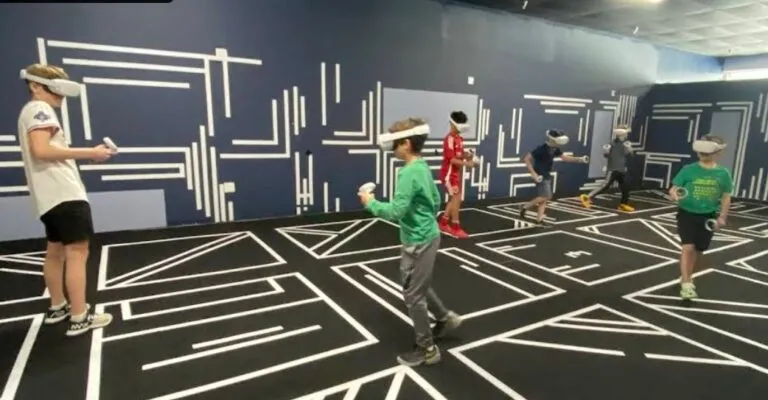
It is Louisiana’s first free-roam virtual reality arena, offering over 20 immersive multiplayer games where players move naturally through a 660-square-foot space wearing wireless Meta Quest 3 headsets. Sessions run 40 minutes and span shooters, sci-fi horror, dance battles, fishing adventures, and more — suitable for ages 6 and up with options for both competitive and cooperative play. The venue is ideal for birthdays, corporate team-building, date nights, and group hangouts, with private arena bookings so your party plays alone.
The space includes a comfortable lounge area where guests can bring their own food and drinks to celebrate. The staff handles all technical setup and game guidance, making it easy for first-timers and experienced players alike. Equipment is disinfected after every session, and the simple one-button controls ensure anyone can jump in and start playing within minutes.
IndoorsMain Event Baton Rouge is located just west of I-10 on The Boulevard outside the Mall of Louisiana, near the intersection of Bluebonnet Boulevard and Mall of Louisiana Boulevard.
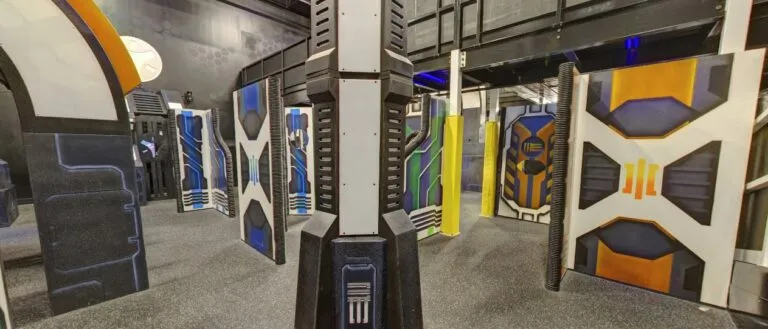
The 49,000-square-foot center features 22 high-tech bowling lanes, a two-story laser tag arena called Arena 51, gravity ropes with a zip line, billiards, shuffleboard, and an arcade with over 130 games plus virtual reality experiences. The venue offers tailored birthday packages with a dedicated party host, group and corporate event options including full facility buyouts, and school programs like lock-ins and field trips.
A full-service restaurant and bar serve burgers, pizza, wings, and cocktails, while a quick-service café provides lighter fare. The facility also includes private event rooms (Bayou and Bengal), hosts seasonal celebrations, and runs the Play Academy STEAM program. The staff is known for being attentive and accommodating, and the space works well for birthdays, corporate team building, date nights, and family outings.
IndoorsVirtual reality has traveled a long road from the tethered, stationary headsets of the early 2010s to the untethered, expansive playgrounds we see today. At the cutting edge of this evolution lies the free-roam VR arena—a specialized space where physical movement meets digital imagination. Unlike standard home setups, which are limited by the dimensions of a living room or the length of a cable, free-roam arenas remove the boundaries, allowing users to walk, run, and collaborate in vast, simulated worlds.
A free-roam VR arena is a purpose-built facility designed to offer a “full-body” immersive experience. While a typical VR setup at home might involve standing in one spot while wearing a headset, a free-roam arena utilizes a large, open-floor plan—often spanning hundreds or thousands of square feet—that is mapped precisely to the virtual environment.
These arenas utilize advanced tracking technology, such as optical motion-capture systems or sophisticated inside-out tracking sensors, to translate every step, duck, and turn into the game world with near-zero latency. Players are equipped with lightweight backpacks (or standalone high-end headsets) that house the computing power required to render complex graphics, eliminating the need for trailing cables that would otherwise restrict movement. The result is a seamless blend of reality and fiction, where the physical space the player occupies feels as vast as the digital landscape they are navigating.
The versatility of free-roam VR allows for a diverse range of scenarios that cater to different interests and adrenaline levels. Because the player’s physical body becomes the controller, the scenarios are designed to feel visceral and immediate.
One of the most popular experiences involves tactical combat simulations. In these scenarios, groups of friends or colleagues navigate tight corridors, abandoned space stations, or fantasy ruins, using haptic vests that provide physical feedback when a digital projectile hits. Others might lean into exploration and puzzle-solving, where teams must manipulate giant virtual objects or coordinate their movements to navigate complex dreamscapes that defy the laws of gravity.
Horror experiences are also a staple of the industry. By utilizing the freedom of movement, developers can craft “stalker” scenarios where players must physically move through dark, claustrophobic environments, ramping up the tension by forcing players to actually step into the shadows rather than using a joystick to move their character. The ability to look around corners and physically hide behind cover makes these experiences significantly more intense than any traditional screen-based game.
The demographic for free-roam VR is surprisingly broad, encompassing everyone from casual weekend thrill-seekers to dedicated gamers. However, the rise of VR for younger audiences is particularly notable.
When it comes to children, free-roam VR acts as an active, engaging alternative to sedentary screen time. Many arenas now offer “kid-friendly” modes with lower difficulty settings, simplified controls, and content curated for younger players, such as cooperative treasure hunts or friendly monster-taming games. Because the technology requires active physical movement, it promotes coordination and teamwork.
Safety is the primary focus for facilities catering to kids. These arenas are padded, monitored by trained staff, and carefully designed to prevent collisions. For children, the sense of wonder—seeing a cartoon world reach out and wrap around them—is profound. It transforms the screen from a window into a world, providing a tactile experience that captures the imagination in a way that traditional gaming simply cannot match.
The social nature of free-roam VR has made it a primary destination for event hosting. As digital experiences become increasingly lonely, the local, shared experience of a physical arena is reclaiming importance.
For a birthday party, free-roam VR offers an unforgettable “main event.” Instead of traditional games, groups can be thrust into a high-stakes adventure where the guest of honor takes the lead. The shared narrative of winning a virtual battle or solving a complex escape room creates lasting memories and natural photography opportunities.
Graduation celebrations are also gravitating toward these spaces. For young adults looking to celebrate a milestone, these sessions provide a high-energy environment that suits the celebratory spirit.
For the corporate world, free-roam VR is rapidly evolving into the ultimate team-building tool. Traditional office outings often suffer from a lack of genuine engagement. In a free-roam arena, hierarchies blur. A CEO and an intern must communicate clearly, trust one another, and strategize under pressure to succeed in a virtual mission. The immediate feedback loop of a VR game forces teams to adapt their communication styles, leading to genuine lessons in leadership and collaboration that are far more effective than a standard boardroom workshop.
The academic and industrial interest in free-roam VR goes well beyond gaming. Scientists and researchers are closely monitoring these spaces to study human spatial cognition and kinesthetic learning. Experts point out that the human brain processes information differently when it believes it is physically navigating a 3D environment. This suggests that free-roam VR could revolutionize training in hazardous fields, such as fire fighting, emergency medicine, or military operations, by allowing trainees to practice life-or-death scenarios in a high-fidelity, high-pressure environment without any actual risk.
Industry experts also view these arenas as the “third space” of the future. As the technology behind headsets continues to shrink in size and cost, they predict that the boundary between physical locations and digital overlays will diminish. Some analysts suggest that in the coming decade, we will see these arenas evolve into “hybrid reality” zones where physical props interact with virtual overlays, creating a tactile experience that is indistinguishable from reality.
Furthermore, health researchers are examining the fitness benefits of these arenas. By gamifying physical activity, free-roam VR has the potential to combat sedentary lifestyles among teens and adults alike. Experts argue that when the brain is fully immersed in a task, players often expend far more energy than they realize, turning a 30-minute gaming session into a genuine aerobic workout.
In conclusion, free-roam VR arenas represent a pivotal shift in how humans interact with technology. By reclaiming physical space and encouraging social interaction, these arenas provide a bridge between the convenience of digital gaming and the depth of real-world experience. Whether for a school excursion, a corporate retreat, or a simple Friday night out, the ability to walk into a new world with your friends is no longer a concept from science fiction—it is a thriving industry that is only just beginning to show us what is possible.