TOP 10 best of the best Free-roam VR in Springfield, MO – Battleonix
El Monte
Log in
0

Advanced Search:

City

Rating

Playground


Price:

Main / Catalog / VR / Missouri, US / Springfield, MO

The best Free-roam VR near me in Springfield, MO

img
from $5
VR

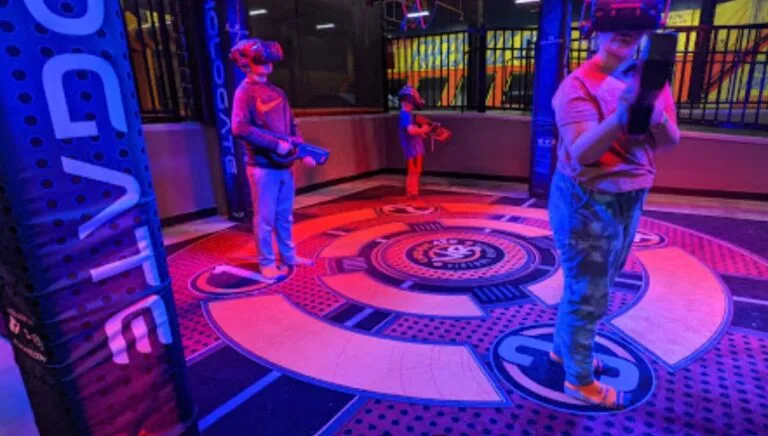
Urban Air Adventure Park sits inside the Battlefield Mall on South Glenstone Avenue in Springfield, Missouri, a 30,000-square-foot indoor playground that has been open since fall 2018. The park is packed with wall-to-wall trampolines, the Sky Rider indoor coaster, an indoor ropes course, climbing walls, Leap of Faith, Stairway to Heaven, Virtual Reality, the Tubes Playground, and the Warrior Course. Competitive guests can enjoy dodgeball courts and the Battle Beam, while the Urban Cafe serves pizza, ICEEs, and snacks between adventures.


The park specializes in kids’ birthday parties with Deluxe and Ultimate packages that include tickets, socks, balloons, a t-shirt, and setup and cleanup handled by a dedicated party host. A Small Squad package offers a more intimate celebration for six guests, and a private room upgrade adds an HDTV and two pizzas. Membership plans provide unlimited play for a low monthly price, and the venue also suits school events, church gatherings, and corporate outings.

Indoors

Beyond the Screen: Stepping Into the Future of Free-Roam VR Arenas

Virtual reality has traveled a long way from the clunky, tethered headsets of the early 2010s that left users prone to motion sickness and tangled in cables. Today, we are witnessing the rise of the “Free-Roam VR Arena”—a high-octane, immersive evolution of gaming that removes the walls and lets you physically walk through digital worlds. It is no longer about pressing buttons on a controller; it is about moving your own body through a landscape limited only by the imagination.


What is a Free-Roam VR Arena?

At its core, a free-roam VR arena (often referred to as Location-Based VR or LBVR) is a dedicated physical space equipped with high-end motion-tracking technology, haptic gear, and untethered headsets. Unlike home VR, where you are confined to a “play zone” the size of a rug, a free-roam arena provides a large, wide-open warehouse space.

Using advanced sensors and “outside-in” tracking, the arena maps your physical movements to your digital avatar with sub-millimeter precision. Because the hardware is wireless and the tracking environments are designed to sync with the digital map, you can walk, run, crouch, and dodge in the real world, knowing that your digital counterpart is doing exactly the same. It is the closest human beings have ever come to the “Holodeck” experience seen in science fiction.


Free-Roam VR Scenarios

The beauty of a free-roam arena is that the “world” can change in the blink of an eye. Because the environment is computer-generated, you aren’t just playing in a room; you are playing in a meta-reality.

  • The Zombie Apocalypse: Players are dropped into a derelict city block. The floorboards creak underfoot, and you have to physically back away as a swarm of undead approaches.
  • Deep-Space Exploration: Imagine walking out onto a bridge of a starship, looking over the railing into a black hole, and feeling the rumble of a hull breach through a haptic vest.
  • The Impossible Puzzle: Escaping a high-security vault or a ticking-clock dungeon where you must physically reach out to manipulate levers, pick up objects, and work as a team to unlock the exit.
  • Fantasy Battlegrounds: Entering a lush, high-fantasy realm where magic spells are cast with hand gestures and you must learn to defend your team against mythical beasts.


Who Plays on Free-Roam VR Arenas? VR for Kids

While early VR was marketed toward tech-savvy adults, the free-roam arena has democratized the experience. It is inherently intuitive; if you can walk and use your hands, you can play in VR.

For kids, free-roam VR is a revelation. It turns screen time—usually a sedentary and isolating activity—into a physical, collaborative workout. It’s a way for children to bond with friends in a shared, safe environment that requires communication and teamwork. Most arenas now offer specialized “family-friendly” modes with non-violent, exploration-based gameplay, making it an excellent development tool for spatial awareness and collaborative problem-solving.


Free-Roam VR for Birthdays, Graduations, and Corporate Parties

The “event” aspect of free-roam VR is perhaps its greatest strength. It is quickly replacing traditional venues like bowling alleys and escape rooms for high-impact social gatherings.

  • Birthday Parties: When the goal is to make a birthday memorable, free-roam VR offers an “unforgettable” factor. It provides a unique, high-energy activity that makes every guest feel like the star of their own movie.
  • Graduations: Stepping into a massive, multi-player VR arena acts as a “rite of passage” experience, perfect for celebrating a milestone with a group of friends who want to experience something transformative together.
  • Corporate Parties: For team building, there is no better “icebreaker” than being forced to work together to survive a zombie hoard or solve a high-stakes corporate espionage puzzle. It bypasses office hierarchies and encourages natural leadership, communication, and strategy, all while keeping the atmosphere light and exhilarating.


Scientists and Industry Experts View on Free-Roam VR

The consensus among scientists and industry experts is that free-roam VR represents the “gold standard” of immersion. Psychologists have noted that the “presence” achieved in these arenas—the feeling of truly being in another place—is significantly higher than in any other medium. This is attributed to the combination of movement (proprioception) and visual immersion.

Industry experts view free-roam VR as the logical next step for the entertainment and training sectors. Beyond gaming, we are seeing the technology utilized for:

  • Military and Tactical Training: Giving soldiers the ability to practice complex maneuvers in high-cost simulations without the physical danger.
  • Phobia Treatment: Using controlled, free-roam environments to help patients confront fears under the supervision of a therapist.
  • Architectural Visualization: Allowing developers to walk through a building before it is even constructed, feeling the scale and flow of a space in real-time.

As technology continues to shrink and tracking sensors become more refined, free-roam VR is set to become as commonplace as the local cinema. It is moving us away from the era of “watching” content and into the era of “living” it. The walls are down—are you ready to step inside?