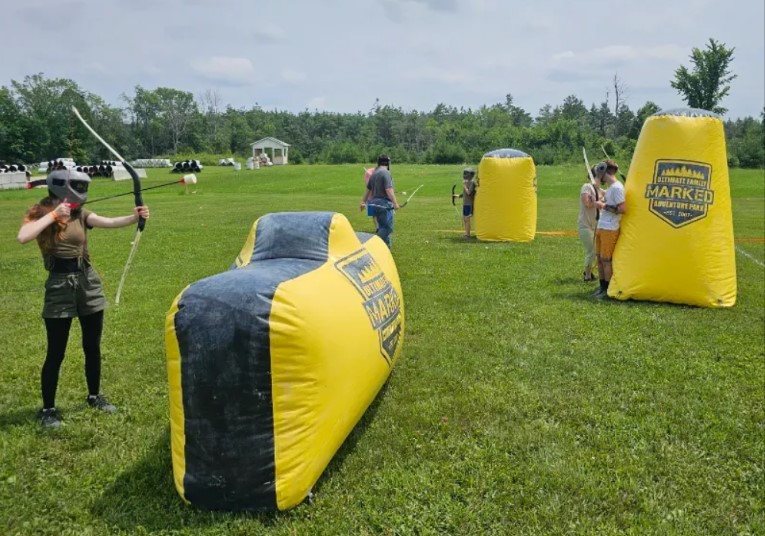
MARKED Ultimate Family Adventure Park is located in Carleton Place, Ontario, along Highway 7 between Ottawa and Perth.
This outdoor adventure park offers paintball, airsoft, and Nerf battles on themed fields featuring a Ghost Town and Fortress. Additional attractions include an 18-hole mini golf course, zipline, axe throwing, and air rifle/slingshot shooting ranges. Equipment rental is included with all tactical activities, and combination packages are available for a full day of fun.
The park is designed for group events like birthday parties, corporate team building, and family reunions. Private group bookings are available for paintball, airsoft, and Nerf sessions (minimum 10 people). The venue has a lounge area, picnic tables, and an on-site canteen. It operates seasonally from spring to fall, and advance reservations are recommended for large groups.
Archery Games Ottawa is located near Bank Street and Walkley Avenue in Ottawa.
This indoor arena offers combat archery — a blend of dodgeball and archery using bows and foam-tipped arrows — along with Nerf Wars for younger kids. The 8,000-square-foot playing field features inflatable bunkers and high ceilings for dynamic gameplay. Sessions include training, all equipment, and a variety of game modes. The venue also houses Room Escape Ottawa and Playback, an in-house games bar. It’s a popular choice for birthday parties, corporate team-building, and league play.
Archery Tag is a fast‑paced, team‑oriented sport that blends the precision of traditional archery with the excitement of dodgeball. Participants use specially designed bows that fire low‑impact foam‑tipped arrows, allowing players to “shoot” at one another in a safe yet competitive environment. The concept originated in the United States in the early 2010s and has since spread to gyms, schools, corporate campuses, and outdoor adventure parks worldwide. Unlike conventional archery, which emphasizes static accuracy and solitary focus, Archery Tag is dynamic, encouraging movement, strategy, and quick decision‑making.
The equipment is deliberately engineered for safety. The bows are lightweight composite models that can be used by both children and adults, and the arrows are soft, biodegradable, and equipped with a blunt tip that disintegrates on impact. Protective face masks, elbow guards, and padded vests are also standard, ensuring that even enthusiastic volleys remain injury‑free. The sport’s accessibility and the thrill of “real‑life laser tag with bows” have helped it become a popular choice for recreation, team‑building, and celebration events.
How Is Archery Tag Played?
The basic structure of an Archery Tag match mirrors that of a conventional team sport. A typical game pits two teams—often five or seven players each—against one another on a field or court that is roughly the size of a basketball court for indoor play, or a cleared, fenced‑in area for outdoor sessions. The playing surface may include obstacles such as inflatable bunkers, cardboard barriers, or natural features like trees and benches, giving each side opportunities for cover and strategic positioning.
Equipment Set‑Up
Bows – Each player receives a lightweight, draw‑weight‑adjustable bow (usually 15–30 lb).
Arrows – Foam‑tipped, rubber‑coated arrows are loaded into a quiver or rack.
Protective Gear – Mandatory face masks, elbow pads, and optional chest protectors.
Scoring Devices – Some venues use electronic hit‑count systems; others rely on manual “out” calls from referees.
Game Flow
Warm‑up and Rules Briefing – A short safety demonstration explains proper stance, loading, and the “safe zone” where players cannot be targeted.
Starting Positions – Teams line up behind a neutral line or at opposite ends. The first round begins with a “bang” signal, and players rush to retrieve arrows from a central “reload zone.”
Objective – The primary goal is to eliminate opponents by hitting them on the torso or limbs with a foam‑tipped arrow. A hit results in an immediate “out,” and the eliminated player must step back to a designated “penalty box” until the next round.
Rounds and Timing – Matches consist of 3–5 timed rounds (usually 3–5 minutes each). Points are tallied by the number of opponents eliminated per round.
Winning – The team with the most cumulative points at the end of the final round wins. In case of a tie, a sudden‑death “shoot‑out” is used, where the first successful hit decides the champion.
Variations
Capture the Flag – Teams must infiltrate the opponent’s territory to retrieve a flag while avoiding hits.
Zombie Mode – Eliminated players become “zombies” that can only tag opponents with a single foam projectile.
Last‑Man‑Standing – No rounds; the game continues until only one player remains.
These adaptations keep the core mechanics familiar while allowing organizers to tailor the experience to specific age groups or event themes.
Benefits of Archery Tag
Archery Tag delivers a surprisingly broad spectrum of physical, mental, and social advantages, making it an attractive option for schools, corporate wellness programs, and community centers.
Physical Fitness
Cardiovascular Conditioning – The constant movement—running, dodging, and quick direction changes—elevates heart rate and improves aerobic capacity.
Strength Development – Drawing a bow engages the upper back, shoulders, and core muscles, while footwork strengthens the lower body.
Coordination and Balance – Accurate shooting while on the move hones hand‑eye coordination and proprioception.
Cognitive Gains
Strategic Thinking – Players must assess cover, anticipate opponent movement, and decide when to attack or retreat.
Focus and Concentration – The requirement to aim precisely under pressure sharpens attention span.
Teamwork and Communication – Success hinges on clear signals, shared plans, and mutual trust.
Confidence Building – Mastery of a skill traditionally associated with expertise (archery) boosts self‑esteem, especially in younger participants.
Stress Relief – Physical exertion combined with a playful environment releases endorphins, reducing anxiety and improving mood.
Collectively, these benefits align well with modern health guidelines that advocate for activities integrating physical exertion, mental engagement, and social interaction.
Scientists and Industry Experts View on Archery Tag
Researchers in sports science, ergonomics, and child development have begun to examine Archery Tag as a case study for emerging “hybrid” recreation. Their findings, though still emerging, point toward several key observations.
Safety Profile
A 2022 study conducted by the University of Colorado’s Department of Kinesiology measured impact forces of foam‑tipped arrows across a range of draw weights. The results indicated average peak forces well below thresholds for causing bone fractures or serious soft‑tissue injuries. When combined with mandated protective gear, the incident rate for minor bruising or superficial cuts was comparable to that of organized paintball.
Motor Skill Development
Neuroscientists at the Institute of Human Performance in Stockholm found that participants who engaged in Archery Tag for eight weeks displayed measurable improvements in fine motor coordination and reaction time, as assessed by computerized tracking tasks. The researchers attributed these gains to the simultaneous demand for precision (aiming) and rapid motor response (dodging).
Psychological Impact
Industrial psychologists from the Corporate Wellness Alliance have highlighted Archery Tag’s potential for building “psychological safety” within teams. In a pilot program with a multinational tech firm, employees reported a 27% increase in perceived trust among colleagues after a series of Archery Tag sessions, suggesting that the low‑risk competitive environment encourages openness and camaraderie.
Market Outlook
Industry analysts at SportsTech Forecast predict a compound annual growth rate (CAGR) of 12% for Archery Tag facilities over the next five years, driven by rising demand for experiential entertainment that blends physical activity with novelty. The report notes that “the sport’s scalability—from pop‑up indoor arenas to full‑scale outdoor courses—makes it a versatile addition to any recreation portfolio.”
Overall, the scientific consensus underscores Archery Tag as a low‑injury, high‑engagement activity with measurable benefits for physical health, motor development, and team dynamics.
Who Can Play Archery Tag? People of All Ages
One of Archery Tag’s most compelling selling points is its inclusivity. The sport has been deliberately engineered to accommodate participants ranging from early elementary school children to senior adults.
Children (Ages 6–12)
Adjusted Draw Weight – Bows can be set to a light pull (≈15 lb), allowing young shooters to manage the equipment comfortably.
Simplified Rules – Games often feature larger “safe zones” and a reduced number of arrows to keep the experience enjoyable and less intimidating.
Developmental Benefits – Improves motor control, encourages cooperative play, and introduces basic physics concepts (trajectory, force).
Teens (Ages 13–18)
Competitive Leagues – Many cities now host youth Archery Tag leagues that incorporate rankings, playoffs, and skill clinics.
Skill Progression – Teens can experiment with different bow styles, learn advanced stance techniques, and participate in mixed‑team formats.
Social Outlet – Provides an alternative to screen‑based recreation, promoting physical activity and peer interaction.
Adults (Ages 19–64)
Corporate Events – Teams engage in structured challenges that double as leadership and communication workshops.
Fitness Programs – Gyms include Archery Tag in circuit training to add variety and functional strength work.
Recreation – Many adults enjoy the novelty of “playing with bows,” treating it as a weekend hobby or a birthday activity.
Seniors (65+)
Low‑Impact Adaptation – Reduced pace, larger targets, and optional “standing only” rules accommodate reduced mobility while still offering the cognitive challenge of aiming.
Social Engagement – Group sessions foster community and reduce feelings of isolation.
Safety Assurance – Strict adherence to protective equipment and limited draw weights ensures a risk‑averse environment.
Because the sport’s intensity can be modulated by adjusting draw weight, round length, and obstacle density, virtually anyone can find a version that matches their physical capabilities and comfort level.
Archery Tag for Birthdays and Parties
Celebrating a milestone with a traditional cake and balloons is enjoyable, but Archery Tag introduces an element of adventure that can transform a birthday or special occasion into an unforgettable experience.
Customizable Packages
Event providers typically offer tiered packages that include:
Venue Rental – Private access to indoor arenas or outdoor fields for the duration of the party.
Equipment Bundles – Enough bows and arrows for the entire guest list, with optional upgrades such as themed quivers or custom‑colored foam tips.
Facilitators – Trained staff members to brief participants on safety, manage gameplay, and keep the event flowing smoothly.
Add‑Ons – Photo booths, “target challenges” with prize trophies, and catered snack stations.
Age‑Appropriate Themes
Superhero Showdown – Players receive colored arrows representing their favorite hero, and obstacles are decorated with comic‑book graphics.
Pirate Plunder – The field is transformed into a “cove” with treasure chests; teams compete to “capture” the loot while firing foam arrows.
Retro Arcade – Classic video‑game imagery lines the arena walls, and scoreboards mimic high‑score tables.
Benefits for Party Hosts
All‑Inclusive – The provider handles setup, safety gear, and clean‑up, allowing parents or organizers to focus on socializing.
Engagement – Guests remain active and entertained for the entire duration, reducing the need for multiple activity stations.
Memorable Keepsakes – Many facilities offer video highlights or group photos captured during play, giving participants lasting mementos.
Because the sport can be scaled to accommodate groups as small as eight participants or as large as fifty, Archery Tag parties work well for both intimate family gatherings and larger community celebrations.
Where Can You Play Archery Tag? Outdoor and Indoor Venues
The versatility of Archery Tag shines through its adaptability to both indoor and outdoor settings. This flexibility has fueled its rapid expansion across varied geographic regions.
Indoor Arenas
Dedicated Centers – Cities such as Austin, TX, and Manchester, UK, host purpose‑built facilities featuring padded walls, inflatable barricades, and climate control.
Multi‑Use Sports Complexes – Many gyms integrate Archery Tag lanes within existing basketball or volleyball courts, utilizing modular netting and temporary lighting.
Corporate Spaces – Some offices convert conference rooms or large lobbies into pop‑up arenas for team‑building sessions, often renting portable equipment kits.
Indoor venues provide several advantages:
Weather Independence – Gameplay is unaffected by rain, wind, or extreme temperatures.
Controlled Environment – Lighting and sound can be tuned for optimal visibility and excitement.
Compact Footprint – Smaller spaces enable quick set‑up and turnover, making it feasible to schedule multiple sessions per day.
Outdoor Locations
Adventure Parks – Rope courses, zip‑line parks, and obstacle gyms frequently add Archery Tag courses to diversify their activity menus.
Community Fields – Municipal parks and school grounds can be temporarily fenced and equipped with portable targets for weekend leagues.
Nature Reserves – Some providers design “forest‑style” games where natural terrain (trees, rocks, streams) serves as organic cover, adding a tactical layer.
Outdoor play offers distinct experiences:
Natural Ambience – The fresh air and open sky heighten the sense of adventure.
Larger Play Areas – Fields can be scaled up to accommodate more players or longer-range bows.
Seasonal Events – Summer festivals and fall fairs often feature Archery Tag as a headline attraction.
Choosing the Right Venue
When selecting a location, organizers should consider:
Safety Measures – Adequate padding, clear boundaries, and a flat surface to prevent trips.
Space Dimensions – Minimum 20 × 30 m for indoor play; 30 × 50 m or larger for outdoor sessions.
Accessibility – Ramps, wheelchair‑friendly pathways, and nearby restrooms for inclusive participation.
Local Regulations – Some municipalities require permits for projectile‑based activities, even when using foam‑tipped arrows.
Whether under a roof or beneath open skies, Archery Tag’s adaptable nature ensures that enthusiasts can find a suitable venue close to home, making the sport both convenient and widely available.
Archery Tag has evolved from a niche novelty into a mainstream recreational phenomenon, offering a safe yet exhilarating blend of precision, strategy, and physical activity. Its adaptable rules, scalable equipment, and inclusive design make it suitable for participants of any age, from schoolchildren to seniors. The sport’s documented benefits—ranging from improved cardiovascular health and motor coordination to enhanced teamwork and confidence—have attracted the attention of scientists, wellness consultants, and industry analysts alike.
Whether the goal is a dynamic birthday party, a corporate team‑building exercise, or simply a new way to stay active, Archery Tag provides a compelling alternative to traditional sport and screen‑time pastimes. With venues now available in both indoor arenas and outdoor adventure parks, the opportunity to “shoot, dodge, and score” is more accessible than ever. As the sport continues to expand, it promises to remain a vibrant, community‑building activity that invites everyone to step into the line, pull back the string, and experience the satisfying thud of a foam‑tipped arrow finding its mark.

 El Monte
 Log in

 Outdoors
 Indoors


 13259 Highway 7 Carleton Place, Ontario, K7C 3P1
