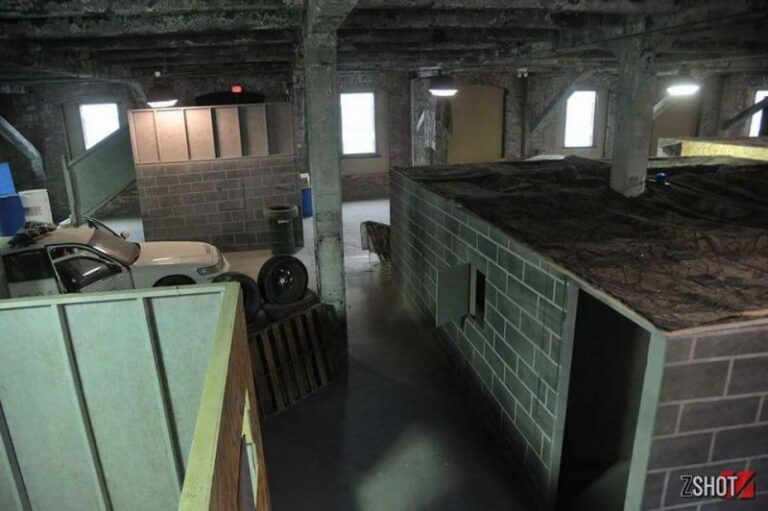
Ohio Valley Airsoft is an open space with inimitable decorations with lots of cover. The location introduces all kinds of barricades, 2 story buildings, that are easy to access and use a strategic advantage. Use thick columns to hide behind, police cars to rain heavy fire from.
You can book this place for a private party or a remarkable weekend. You can also book a custom nerf of laser-tag game in your own location. All the needed equipment will be delivered to your location of choice.
Introduction – Stepping Into a World Without Walls
Imagine slipping on a headset, hearing the faint whirr of the equipment, and suddenly finding yourself in a dense jungle, a bustling space‑station, or a medieval castle—without a single cord tethering you to a chair. You can duck, sprint, leap, and even collaborate with strangers who are right beside you, not just a pixel on a screen. This is the promise of free‑roam virtual reality (VR), a rapidly growing niche that is redefining how we play, learn, and celebrate.
In this article we’ll explore every angle of the phenomenon: what a free‑roam VR arena actually is, the scenarios that bring it to life, who’s stepping inside, how kids experience it, how it can turn ordinary celebrations into unforgettable spectacles, and what scientists and industry insiders think about its future.
What Is a Free‑Roam VR Arena?
A free‑roam VR arena is a physically bounded space—often a warehouse‑sized room or a purpose‑built modular structure—equipped with a network of sensors, motion‑capture cameras, and sometimes infrared or LIDAR tracking rigs. Unlike “seated” or “room‑scale” VR that limits you to a small play area, free‑roam systems let you move unrestricted within the arena’s perimeter while your headset and controllers stay perfectly synced with the virtual world.
Core Components
Component
What It Does
Typical Technology
Tracking System
Continuously maps your exact position and orientation in 3D space
Opti‑track, HTC Vive Pro Lighthouse, Mocap suits, or custom infrared arrays
Safety Netting & Soft Barriers
Prevent collisions with walls or other participants
Padded walls, foam padding, or transparent safety nets
Haptic Feedback Gear (optional)
Adds tactile sensations like vibration, wind, or temperature changes
Vests, gloves, or shoe inserts
High‑Performance PCs/Servers
Renders immersive graphics in real‑time with low latency
GPU rigs, render farms, or edge‑computing nodes
Environmental Props
Physical objects that match virtual items (e.g., swords, shields)
Because the arena’s tracking is room‑wide, you can sprint across a 50‑meter floor without worrying about losing accuracy—something that standard tabletop VR setups can’t guarantee.
The Experience Gap
Feature
Traditional Room‑Scale VR
Free‑Roam VR Arena
Movement Freedom
2 × 2 m or 3 × 3 m play area
Up to 100 × 100 m
Physical Interaction
Limited to handheld controllers
Full‑body gestures, props, even obstacles
Social Dynamics
Mostly solo or small groups
Large groups (10‑30+), team‑based games
Immersion Depth
Strong visual/audio, limited proprioception
Full proprioceptive feedback, real–world physics
Free‑Roam VR Scenarios – From Fantasy Quests to Real‑World Simulations
The magic of a free‑roam arena lies in the scenarios that designers build for it. Below are the most popular—and some emerging—use‑cases that keep the technology fresh.
1. Narrative Adventures
The Lost Temple of Aztlan – Players become archaeologists racing against a rival team to solve puzzles, avoid traps, and retrieve a golden idol before the temple collapses.
Starship Command – A cooperative mission where participants pilot a massive spacecraft, each taking a role (pilot, weapons officer, engineer) and reacting to dynamic asteroid fields.
These experiences blend storytelling with physical gameplay, encouraging players to crouch under low ceilings, climb simulated ladders, or physically swing a foam sword.
2. Competitive Sports & E‑Sports
VR Laser Tag – Teams navigate a darkened arena with “laser” emitters on their vests. Scoring is tracked in real time, and a live leaderboard is projected onto a big screen.
Zero‑Gravity Dodgeball – Using magnetic boots and haptic gloves, players toss virtual balls that bounce off invisible walls, offering a futuristic spin on classic gym class.
3. Training Simulators
Firefighter Drill – Trainees must locate victims in a smoke‑filled virtual building, using real hoses and breathing masks. Immediate performance metrics are logged for after‑action review.
Industrial Safety – Workers practice heavy‑machine operation or hazardous‑material handling without exposing themselves to real danger.
4. Immersive Escapes & Puzzles
The Time‑Loop Library – A high‑tech escape room where each clue is hidden in a different era, requiring participants to physically move between different “time zones” within the arena.
5. Social Hangouts & Virtual Concerts
Virtual Nightclub – DJs perform in a digital club while avatars dance on a glowing floor. Real‑world speakers and vibro‑tactile floors give the feeling of bass thumping through your feet.
These scenarios demonstrate that free‑roam VR is not just about games; it can be a platform for training, socializing, and even artistic expression.
Who Plays on Free‑Roam VR Arenas? – Demographics & Motivations
1. The Core Gamers
Age Range: 18‑35
Motivation: Seeking the next level of immersion beyond console or PC gaming.
Typical Spend: $30‑$60 per session, often in groups of 4‑8.
2. Families & Kids
Age Range: 6‑14 (with adult supervision)
Motivation: A safe, physically active alternative to screen‑time.
Parental Preference: Emphasis on educational themes and low‑impact physical activity.
Why Free‑Roam? The novelty factor draws media coverage and social‑media buzz.
Overall, the user base is increasingly diverse. Data from a 2023 market report showed that 42 % of free‑roam VR participants are over 30, while 28 % are children under 15, reflecting the industry’s push into family‑friendly programming.
VR for Kids – Safe, Educational, and Pure Fun
Safety First
Soft‑Wall Construction: All arenas are padded, and emergency stop zones are clearly marked.
Age‑Appropriate Content Filters: No graphic violence or mature language.
Supervision Protocols: Staff members monitor each session, ready to intervene if a child loses balance or feels disoriented.
Team‑based quests require communication and role allocation.
Physical Literacy
Running, ducking, and reaching develop gross‑motor skills.
STEM Curiosity
Simulations (e.g., building a robot) spark interest in engineering.
Popular Kids‑Focused Scenarios
Dino Expedition: Kids become paleontologists searching for fossils in a prehistoric jungle, learning about geology and taxonomy along the way.
Space Explorer Academy: A low‑gravity environment teaches basic physics concepts—mass, inertia, and propulsion—through hands‑on challenges.
Parents love that the experience combines learning with active play, while kids appreciate the “real‑life video game” feel.
Free‑Roam VR for Celebrations – Turning Milestones Into Epic Adventures
1. Birthday Parties
Theme Packages: Superhero training camp, pirate treasure hunt, or magical unicorn quest.
Customization: Names, ages, and favorite colors can be woven into the narrative, making each child the “hero” of the story.
Case Study: A 10‑year‑old’s superhero birthday in Toronto’s “VR Galaxy Arena” attracted 12 friends, each receiving a custom cape with a QR‑code linking to a post‑party digital comic of their adventure.
2. Graduation Ceremonies
Virtual Campus Tour: Graduates walk through a stylized version of their university, reliving iconic spots (library, quad) in a surreal, glowing aesthetic.
Future‑Vision Rooms: A scenario where graduates “step” into their projected careers—engineering labs, art studios, or medical simulators.
Impact: Surveys showed a 68 % increase in memorable feelings compared to traditional hall‑based ceremonies.
3. Corporate Parties & Product Launches
Team‑Building Quests: Companies can design a scenario that mirrors their brand values—e.g., a “Sustainability Sprint” where teams must restore a virtual ecosystem.
Interactive Product Demos: Attendees can physically interact with a new car model, appliance, or software interface in virtual space, giving immediate tactile feedback.
ROI Insight: A Fortune‑500 firm reported a 32 % lift in post‑event brand recall after a VR‑driven launch, versus a conventional trade‑show booth.
4. Hybrid Events
Free‑roam arenas now integrate live streaming and AR overlays, enabling remote participants to view the action on a giant screen, or even control certain in‑arena elements via a web interface. This opens the door to global celebrations where families across continents can “join” the same VR party.
Scientists and Industry Experts View on Free‑Roam VR
1. Cognitive Psychologists
“The embodied interaction that free‑roam VR offers is a potent catalyst for neuroplasticity. When users physically move while solving spatial puzzles, the brain integrates vestibular, proprioceptive, and visual cues, leading to stronger memory encoding.” – Dr. Maya Patel, University of Chicago Cognitive Lab
Research from 2022 shows that participants in free‑roam VR retain up to 45 % more information from a training module than those who experienced a seated VR version.
2. Human‑Factors Engineers
“Safety is paramount, but the technology has matured to a point where we can reliably track 30 + users in a 100 × 100 m space with sub‑10 ms latency. This opens the door for large‑scale live performances that were previously impossible.” – Luis Ortega, Lead Engineer at VRealms
Ortega highlights that edge‑computing—processing data on local servers rather than the cloud—reduces lag and prevents motion sickness, a classic VR pitfall.
3. Medical Researchers
Rehabilitation: Studies at the Mayo Clinic use free‑roam VR for post‑stroke gait training, reporting a 20 % faster recovery compared to standard physiotherapy.
Mental Health: Exposure therapy for phobias (e.g., heights, crowds) benefits from the ability to walk away from a trigger rather than simply look at it, providing a more realistic desensitization.
4. Industry Trend Analysts
“The free‑roam market is projected to reach $2.4 billion by 2030, driven by decreasing hardware costs and the rise of experiential retail. Companies that embed VR into their brand story will out‑perform those that don’t.” – Sophie Nguyen, Analyst, Grandview Insights
Key drivers: modular arena kits that can be shipped and assembled in weeks, and software-as-a-service (SaaS) platforms that let non‑technical staff build custom scenarios via drag‑and‑drop interfaces.
5. Ethical and Societal Concerns
Data Privacy: Tracking systems collect granular movement data; experts urge clear consent frameworks and anonymization.
Accessibility: Efforts are underway to design inclusive controllers for users with limited mobility, ensuring the experience isn’t limited to the able-bodied.
Overall, the consensus among experts is optimistic but cautious: free‑roam VR is a transformative medium with proven benefits for education, health, and entertainment, yet it must be deployed responsibly.
The Future of Free‑Roam VR – Where Do We Go From Here?
Mixed‑Reality Fusion – Combining AR projections with VR interiors could allow participants to see real‑world objects (like tables or food stations) while staying immersed.
AI‑Generated Worlds – Procedurally generated landscapes that adapt to player actions, providing endless replayability without manual content creation.
Portable Micro‑Arenas – Inflatable, sensor‑filled bubbles that can be set up in community centers, schools, or even outdoor festivals.
Biometric Integration – Real‑time heart‑rate and GSR (galvanic skin response) data feeding into the narrative, dynamically adjusting difficulty or ambience.
As hardware costs fall and software tools become more intuitive, free‑roam VR will likely shift from a niche entertainment offering to an everyday platform for learning, celebration, and work.
The Open Horizon of Unbounded Play
Free‑roam VR arenas are more than just high‑tech amusement parks; they are living laboratories where imagination, physicality, and technology converge. Whether you’re a teen battling a virtual dragon, a child excavating dinosaur fossils, a corporate team solving a sustainability crisis, or a scientist testing a new rehabilitation protocol, the arena invites you to move, interact, and truly be present in a world where the only limits are the walls you choose to build.
As we watch the field evolve—driven by scientific validation, industry innovation, and a growing appetite for immersive experiences—one thing is clear: the future of free‑roam VR is not just about seeing new worlds, but about living them, together.

 El Monte
 Log in

 Indoors


 2200 Union St, Bellaire, OH 43906