
 El Monte
 Log in
Log in
Log in

Stars and Strikes Family Entertainment Center sits at the Coastal Grand Mall in Myrtle Beach, South Carolina, near U.S. 17, U.S. 501, and the Myrtle Beach airport, welcoming both locals and the area’s many visitors.
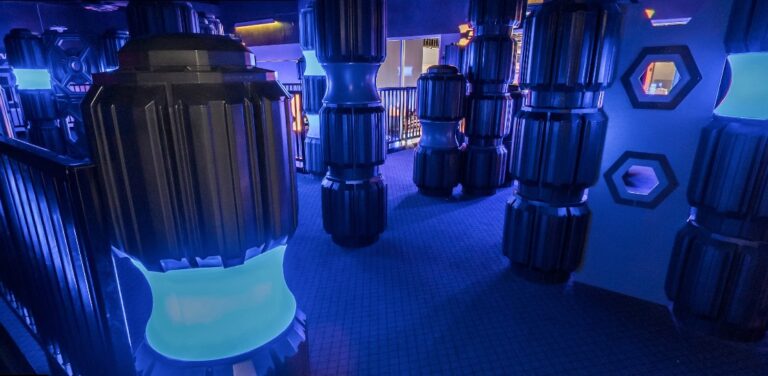
The venue centers on a multi-level laser tag arena with modern equipment, ramps, obstacles, and glowing hideouts, plus 24 bowling lanes, SPARK augmented reality bowling, virtual reality gaming, and axe throwing at Lumberjack Alley. A 10,000-square-foot arcade, bumper cars, an escape room, and karaoke round out the action. Beyond walk-in play, the Laser Tag Blast birthday package bundles four laser tag games, VR experiences, arcade cards, and food, while the event team handles corporate events, team building, fundraisers, and group parties of nearly any size. An on-site kitchen and full bar let guests refuel between games, and dedicated party hosts and trained coaches keep every visit running smoothly.
 Indoors
Laser tag has transformed from a futuristic novelty of the 1980s into a sophisticated, high-energy gaming phenomenon enjoyed by millions globally. It blends physical exertion, strategic thinking, and technological immersion, providing an experience that few other recreational activities can match. Whether played in a dimly lit arena filled with neon fog or across a sprawling forest landscape, laser tag remains a cornerstone of interactive entertainment.
At its core, laser tag is a recreational shooting sport where players compete to “tag” opponents using infrared-sensitive devices. Unlike paintball or airsoft, which involve physical projectiles, laser tag is entirely non-contact and painless. Each participant carries a phaser (or blaster) and wears a set of sensors, usually located on a vest or a headband.
When a player fires their phaser, it emits an invisible or visible infrared beam. If that beam hits a sensor on an opponent, the system registers a “tag,” often accompanied by sound effects, lights, or vibrations. Modern equipment is managed by complex software that tracks scores, accuracy, and casualty counts in real-time, allowing for a level of data-driven competition that keeps players coming back to beat their personal bests.
The versatility of laser tag lies in its ability to adapt to nearly any narrative. While a standard game of “Team Deathmatch” is a classic, arenas frequently employ more intricate scenarios to keep the gameplay fresh:
These scenarios force players to communicate, delegate roles, and think critically under pressure, elevating the game from simple target practice to a tactical exercise.
Beyond the thrill of the chase, laser tag offers significant physical and psychological benefits. It is an excellent cardiovascular workout; in a high-intensity session, players often run, crouch, and sprint for extended periods, burning calories without the monotony of a traditional treadmill workout.
Mentally, the game sharpens cognitive functions. Success in laser tag requires rapid decision-making, spatial awareness, and strategic planning. Participants must constantly assess their environment, predict enemy movements, and manage their resources. Furthermore, it fosters teamwork. Because most games are team-based, players learn the value of cooperation, leadership, and sacrifice to achieve a collective goal.
Research into human behavior and gamification often points to laser tag as a prime example of “active play.” Educators and sports scientists have noted that laser tag provides a “flow state”—a psychological condition where a person is fully immersed in an activity. This engagement is crucial for children and adults alike, as it encourages physical activity through intrinsic motivation rather than external pressure.
Industry experts observe that the technology behind laser tag continues to evolve. With the integration of augmented reality (AR) and smartphone-linked tracking, the gap between the virtual and real worlds is closing. Experts suggest that as technology advances, laser tag will likely incorporate more realistic haptic feedback and dynamic environment control, making the experience more immersive and safer for all demographics.
While laser tag is often associated with youthful exuberance, its appeal is truly universal. For children, it is a rite of passage. It provides a safe environment for kids to burn off energy, practice social interaction, and develop coordination.
Because the equipment is adjustable and the rules are easily simplified, even younger children can participate. The non-contact nature of the game is particularly appealing to parents, as it eliminates the bruises and mess associated with physical-impact sports. It serves as a great confidence builder, helping shy children find their voice as they coordinate with teammates to “save the base.”
The adaptability of laser tag makes it an elite choice for milestone celebrations and professional gatherings.
Choosing the right venue depends on the desired atmosphere and the season.
Indoor Arenas: These are the most common and are often located in specialized entertainment centers. Indoor venues offer controlled environments with elaborate themes—such as space stations, neon-lit jungles, or post-apocalyptic ruins. They are climate-controlled and available year-round, regardless of the weather. The close-quarters layout of indoor arenas results in fast-paced, high-intensity gameplay.
Outdoor Arenas: These venues utilize natural terrain, forest clearings, or specially designed “tactical” fields. Outdoor laser tag offers a more realistic, military-simulation feel. With natural obstacles like trees, dirt mounds, and structures, the play style is more spread out and requires more stealth and long-range tactical planning. Outdoor play is perfect for large groups who prefer sunlight and fresh air, though it is usually restricted to warmer, dry weather.
Laser tag has cemented its place in modern culture by offering a perfect blend of high-tech excitement and primal human competition. By prioritizing safety, inclusivity, and active engagement, it has survived decades of shifting trends to remain a favorite for social gatherings and individual adrenaline seekers alike. As technology continues to bridge the gap between imagination and reality, the arenas of tomorrow will undoubtedly offer even deeper levels of immersion, ensuring that the thrill of the tag remains a permanent fixture in the landscape of play.


 600 Coastal Grand Cir, Myrtle Beach, SC 29577, United States