
 El Monte
 Log in
Log in
Log in

Stars and Strikes Family Entertainment Center sits at the Coastal Grand Mall in Myrtle Beach, South Carolina, near U.S. 17, U.S. 501, and the Myrtle Beach airport, welcoming both locals and the area’s many visitors.
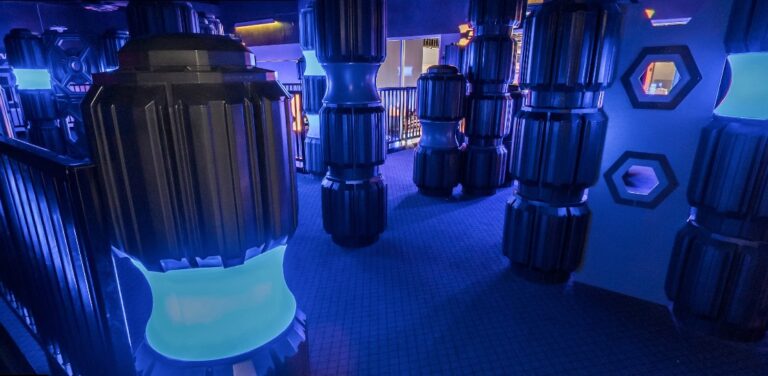
The venue centers on a multi-level laser tag arena with modern equipment, ramps, obstacles, and glowing hideouts, plus 24 bowling lanes, SPARK augmented reality bowling, virtual reality gaming, and axe throwing at Lumberjack Alley. A 10,000-square-foot arcade, bumper cars, an escape room, and karaoke round out the action. Beyond walk-in play, the Laser Tag Blast birthday package bundles four laser tag games, VR experiences, arcade cards, and food, while the event team handles corporate events, team building, fundraisers, and group parties of nearly any size. An on-site kitchen and full bar let guests refuel between games, and dedicated party hosts and trained coaches keep every visit running smoothly.
 Indoors
Virtual reality has traveled a long distance since the days of tethered headsets and static chairs. For years, VR enthusiasts were confined to small living room rugs, constantly worried about bumping into furniture or tripping over a stray controller cable. Today, that narrative has shifted entirely. The emergence of the free-roam VR arena has redefined what it means to step into a digital world, offering a physical space where movement is no longer a restriction, but the very foundation of the experience.
A free-roam VR arena is a purpose-built facility designed to facilitate untethered, full-body immersion. Unlike home VR, which often relies on stationary sensors and limited play zones, a free-roam arena is a large, open-plan physical space—often ranging from 500 to several thousand square feet—covered in high-precision motion-tracking technology.
Participants wear lightweight, high-performance headsets, often powered by backpack computers or advanced wireless streaming technologies, which eliminate the need for restrictive cables. The arena itself acts as a digital playground; sensors on the ceiling or walls track the exact coordinates of the player in real-time. This translates physical movement directly into the virtual environment. If a player walks ten feet forward in the arena, they walk ten feet forward in the game. If they crouch, peer around a digital corner, or sidestep an incoming obstacle, the software responds instantaneously. This “room-scale” freedom creates an unparalleled sense of presence, tricking the brain into believing that the digital walls and landscapes are as tangible as the floor beneath the player’s feet.
The versatility of free-roam VR is perhaps its greatest strength. Because the environment is entirely digital, the arena can transform from a zombie-infested post-apocalyptic city to the surface of Mars or an underwater research station at the click of a button.
Common scenarios often involve cooperative gameplay. Teams of players are dropped into a narrative-driven mission where success depends on communication and spatial awareness. One popular type of scenario is the “tactical shooter,” where players move through corridors and open plazas, utilizing physical cover that mirrors the virtual world. Another frequently deployed scenario is “environmental puzzle-solving,” where teams must navigate complex architecture, manipulate virtual objects in tandem, or fend off waves of enemies while managing limited resources.
Horror experiences are another staple of the free-roam industry. The ability to physically walk through a terrifying environment—a haunted Victorian manor, for instance—amplifies the adrenaline response far beyond what a traditional screen can provide. When the player knows they have to walk down a dark hall themselves, rather than just pressing a joystick, the fear becomes visceral and deeply personal.
The demographic for free-roam VR is as broad as the technology’s applications. While the primary audience historically leaned toward tech-savvy teenagers and young adults, the accessibility of the hardware has opened the doors to a much wider range of participants.
VR for kids has become a major industry vertical. Modern free-roam arenas often feature child-friendly content, such as fantasy adventures, cartoon-style exploration games, or educational historical tours. For children, the appeal is intuitive; the natural interaction of walking and reaching is far more accessible than mastering complex gamepad controls. Parents are increasingly looking toward VR arenas as a “positive screen time” option, as these activities require physical exertion, social collaboration, and cognitive engagement, providing a stark contrast to the sedentary nature of traditional video gaming. However, operators generally maintain strict age minimums to ensure the headsets fit correctly and that younger participants can handle the intensity of the immersion.
As the technology has matured, free-roam VR arenas have become highly sought-after venues for event hosting. Traditional birthday parties, graduations, and corporate retreats often suffer from a lack of novelty, but VR provides an “event anchor” that is genuinely unique.
For birthday parties and graduations, the arena creates a shared memory. Unlike a movie theater where guests sit in silence, a free-roam session is a cacophony of laughter, shouts of encouragement, and team strategy. It breaks the ice instantly, allowing groups to bond through the shared challenge of surviving a virtual gauntlet or solving a collaborative mystery.
Corporate parties and team-building events have found a particularly strong use for the technology. In a workplace context, free-roam VR acts as a “leveler.” It forces managers and entry-level employees to work together to complete a task, often placing them in roles that require non-hierarchical communication. Because the simulation requires players to physically walk around, look at each other, and coordinate movements, it mimics real-world team dynamics more effectively than a standard workshop. It pushes the team out of their collective comfort zone, leading to improved trust and communication that persists long after the headsets are removed.
The consensus among scientists and industry experts is that free-roam VR is effectively the “final frontier” for consumer entertainment. Researchers studying human-computer interaction point to the concept of “proprioceptive fidelity”—the level to which a digital simulation aligns with the body’s natural sense of movement. Experts argue that when the brain receives consistent sensory feedback from the inner ear (vestibular system) and the limbs, the risk of motion sickness is significantly reduced, and the psychological impact of the experience is deepened.
Industry analysts emphasize the economic scalability of these arenas. As the cost of high-quality tracking systems and untethered hardware decreases, the barrier to entry for arena operators continues to lower. Experts predict that the future of free-roam VR will move toward “hybrid reality,” where virtual elements are combined with haptic feedback—suits or props that allow players to actually feel the weight of a virtual object or the impact of a gust of wind.
Furthermore, medical and psychological experts are observing the potential for “therapeutic play.” By facilitating controlled movement within safe, gamified environments, free-roam VR is being explored as a tool for physical rehabilitation and the treatment of anxiety disorders. In these settings, the arena becomes a controlled environment where patients can practice real-world movements or confront phobias under the watchful eyes of professionals.
As we look toward the future, free-roam VR is not merely a passing trend or a novelty act. It is a fundamental shift in how humans interact with compute-generated information. By removing the boundaries of the desk and the chair, we have moved the digital experience into the physical realm, creating a landscape that is as boundless as the human imagination. Whether for play, celebration, or training, the free-roam arena represents the next logical step in our collective journey toward total immersion.


 600 Coastal Grand Cir, Myrtle Beach, SC 29577, United States