Log in
Atomic City Family Fun Indoor Center is located in Paducah, KY
The Atomic City Family Fun Center in Paducah, KY offers a variety of entertainment options for families. With go-kart racing, laser tag, mini golf, bumper boats, and an arcade, there is something for everyone. The facility also has party rooms available for birthdays or other special events. Additionally, Atomic City offers a snack bar and a prize counter where players can redeem tickets earned from playing arcade games. The center is open daily and is a popular destination for families looking for a fun and exciting day out.
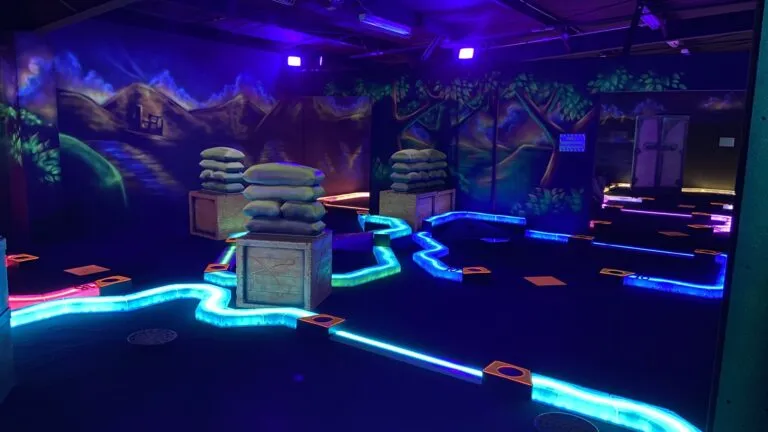
Indoors
In the modern era of digital distraction, the quest for immersive, physical, and social entertainment has led many back to the arena. Laser tag, a high-octane tactical game, has evolved from a niche hobby into a sophisticated global phenomenon. By blending cutting-edge infrared technology with strategic gameplay, it provides an adrenaline-fueled experience that transcends age, background, and fitness levels.
At its core, laser tag is a recreational shooting sport in which players use infrared-emitting light guns to tag designated targets—usually sensors worn by other players or integrated into vests. Unlike paintball or airsoft, which involve physical projectiles, laser tag is entirely painless. When a player’s sensor is “hit” by an infrared beam, the system registers the strike, providing immediate audio and visual feedback.
The technology relies on complex communication between the phaser (the weapon) and the sensors, often utilizing radio frequency or infrared signals to track hits, ammunition counts, and “respawn” times. Because it requires no protective gear like goggles or thick padding, it is accessible, clean, and safe, allowing players to focus entirely on the thrill of the hunt and the complexity of the tactical maneuvers.
The beauty of laser tag lies in its modularity. What begins as a simple game of “tag” can quickly transform into a high-stakes simulation. Common scenarios include:
Beyond the excitement, laser tag functions as a highly effective form of exercise. A typical round involves continuous movement—sprinting, ducking, crouching, and navigating complex obstacles. This cardiovascular challenge helps improve endurance, but the cognitive benefits are equally significant.
Players must develop spatial awareness, rapid decision-making skills, and the ability to communicate under pressure. It fosters teamwork, as success in most scenarios is impossible without coordinated movement and verbal communication. Furthermore, because it is a “gamified” form of exercise, players often find themselves burning hundreds of calories without the monotony associated with gym-based workouts.
Behavioral scientists have taken an interest in laser tag as a tool for “pro-social” play. Research suggests that structured competition in a low-stakes environment helps develop emotional regulation in younger players and stress-management skills in adults. By forcing participants to handle “defeat” in a fast-paced setting, the game builds resilience.
Industry experts point to the shift toward “Tactical Laser Tag” as the biggest trend in the sector. The move away from darkened, neon-lit “space-themed” arenas toward realistic, movie-set-style urban environments has attracted a more serious demographic. Experts suggest that the high-fidelity sound effects, weight-accurate phasers, and objective-based gameplay have turned the industry into a viable alternative to virtual reality (VR) gaming, offering a tactile immersion that screens simply cannot replicate.
While laser tag is often associated with the youth market, its demographic reach has expanded significantly. For kids, laser tag provides a rare chance to engage in “rough and tumble” play within a safe, rule-bound framework. It allows children to expend energy while learning to follow instructions and work with teammates.
Today, laser tag is increasingly viewed as a “family-inclusive” activity. Many arenas now offer “no-run” zones or adjusted sensitivity settings to ensure that younger players can compete fairly with more experienced adults, making it one of the few sports where parents and children can participate on the same team as equals.
The versatility of laser tag makes it a premier choice for event planning.
The playing environment dictates the intensity of the game. Indoor arenas are typically characterized by labyrinthine layouts, UV-reflective paint, fog machines, and futuristic barricades. These venues are popular because they are climate-controlled and available 365 days a year. They often emphasize close-quarters combat and fast reaction times.
Outdoor laser tag, conversely, utilizes expansive natural or custom-built terrain. Think wooded areas, abandoned warehouses, or inflatable pop-up courses. Outdoor venues often use longer-range equipment with advanced infrared optics, allowing for sniping, flanking, and long-range strategies that are impossible in indoor settings.
Whether played in a dimly lit, high-energy indoor maze or under the open sky on a sprawling tactical field, laser tag remains an enduring staple of social entertainment. It successfully bridges the gap between active athletics and digital gaming. As technology continues to improve—incorporating more realistic feedback, mobile app integration, and live-score tracking—laser tag will likely continue to evolve, offering a timeless way for people to test their reflexes, sharpen their minds, and have fun in a world that thrives on connection.