Log in
Atomic City Family Fun Center is located in Paducah, Kentucky, right off Interstate 24 on Hinkleville Road.
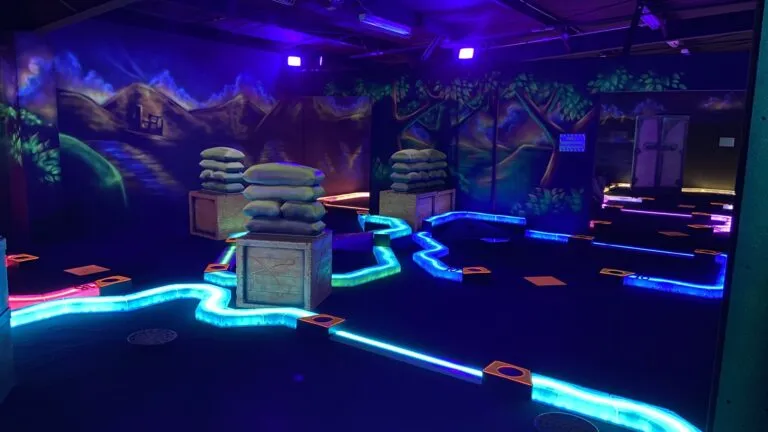
This 44,000-square-foot indoor entertainment complex offers a wide range of attractions including electric go-karts with four speed levels, a laser tag arena, 18-hole mini glow golf, Flip & Spin bumper cars, a soft play zone for younger children, duckpin bowling, golf simulators, and a full arcade with a redemption prize counter. The venue operates on a credit-based system with day passes also available, and the entire space is climate-controlled so weather never interrupts the fun.
Beyond the main attractions, Atomic City features Social 360 — a 21-and-over lounge with a bar, live music stage, axe throwing, and pool tables. Private party rooms accommodate up to 30 guests for birthday celebrations, and full facility rentals are available for corporate events and large gatherings. An in-house kitchen serves food and drinks, and the friendly staff focuses on creating a welcoming experience for families, groups, and repeat visitors alike.
IndoorsVirtual reality has traveled a long distance from the days of sitting tethered to a console with a bulky headset, struggling against the limitations of a small living room. Today, the cutting edge of immersive technology lies in the free-roam VR arena—a specialized space where the physical boundaries of the room melt away, allowing players to walk, run, and explore vast digital worlds with their own two feet. This evolution represents the transition from “watching” a game to truly “inhabiting” one.
A free-roam VR arena is an expansive, dedicated physical space—often ranging from a few hundred to several thousand square feet—equipped with advanced motion-tracking technology. Unlike home VR systems, which rely on stationary sensors or limited-range cameras, free-roam arenas utilize sophisticated optical and inertial tracking systems. Players wear high-fidelity headsets and often carry lightweight, powerful VR-ready backpacks (or utilize wireless streaming) to ensure complete freedom of movement.
The defining characteristic of these arenas is the absence of tethering. In a traditional VR setup, the biggest enemy of immersion is the “leash”—the cable connecting the headset to a computer. In a free-roam arena, that cable is gone. Furthermore, the environment is mapped precisely to a digital coordinate system. This means that when a player turns a corner in the physical room, they turn a corner in the game. This creates a state of “presence,” a psychological phenomenon where the brain accepts the digital environment as reality because the physical sensations of movement match the visual input.
The versatility of free-roam VR allows for a staggering variety of experiences. Since the software controls the environment, an arena can transform from a post-apocalyptic wasteland to a distant alien planet in a matter of seconds.
Common scenarios often fall into three genres: cooperative exploration, competitive combat, and narrative-driven puzzle solving. In cooperative exploration, groups of friends might find themselves embarking on a mission to traverse a haunted mansion, where they must physically work together to solve locks, light torches, and scavenge for supplies. The shared physical space is essential here; because players can see their teammates standing in the room with them, cooperation feels instinctive rather than digital.
In competitive combat arenas, the space becomes a tactical playground. Teams navigate cover, lean around digital pillars, and coordinate flanking maneuvers. Because the players’ movements are 1:1 reflections of their digital avatars, the combat feels visceral. Finally, narrative-driven scenarios often lean into the “escape room” model. These experiences challenge players to interact with the environment, manipulating objects or repairing machinery in a virtual setting to progress through a complex story.
While many might assume that VR arenas are the exclusive domain of hardcore gamers, the reality is far more diverse. These venues are increasingly accessible to a wide demographic, including families and curious newcomers.
When considering VR for kids, free-roam arenas offer a unique advantage over home systems. Because the environment is curated by staff and the space is physically padded or managed, the risk of “VR motion sickness”—often caused by a mismatch between movement and visual input—is significantly reduced. Many arenas offer age-appropriate content, such as whimsical adventures or cooperative games involving treasure hunts and magical creatures. For children, this is more than a game; it is an active, social experience that encourages communication and teamwork rather than the isolated staring-at-a-screen common with traditional gaming.
Free-roam VR has rapidly become a premier choice for event hosting. Because these arenas offer a “wow factor” that traditional party venues lack, they are increasingly popular for milestone celebrations.
For a birthday party, an hour inside a VR arena provides a memorable, high-energy centerpiece. It eliminates the social awkwardness of a party where guests might not know each other well; once the headsets are on and the mission begins, the focus shifts to communication and laughter, effectively breaking the ice.
Graduations and corporate events have also embraced the technology for team-building purposes. A corporate party in a VR arena is a sophisticated upgrade from the standard “dinner and drinks” event. It requires employees to collaborate in a high-stakes, low-risk environment. Colleagues who might rarely interact in an office setting often find themselves working together to solve a digital crisis or defend a virtual base. The shared adrenaline of the experience builds a sense of camaraderie that is difficult to replicate in static settings. Furthermore, because these arenas are flexible, corporate groups can often reserve the entire facility, allowing for a private, customized event that caters to the specific company culture.
The academic and professional interest in free-roam VR extends far beyond its entertainment value. Psychologists and neuroscientists are closely monitoring the evolution of these arenas, particularly regarding their potential for cognitive therapy and training.
Industry experts view free-roam VR as the foundation of the “spatial internet”—a future where digital information is layered over our physical reality. For researchers, the arena is a controlled laboratory. By tracking how individuals navigate virtual spaces, scientists are gaining new insights into spatial memory, navigation habits, and social interaction under stress. Because the environment is fully customizable, researchers can create scenarios that would be impossible or dangerous to recreate in real life, such as high-pressure emergency response simulations or exposure therapy for phobias.
From a business perspective, industry analysts see a bright future for “Location-Based Entertainment” (LBE). While at-home VR is growing, it rarely provides the physical space required for true, full-body movement. Expert consensus suggests that as VR hardware becomes lighter and more powerful, free-roam arenas will become the primary way the public engages with high-end virtual experiences. They are viewed as the “cinema of the 21st century”—a destination where content is not just consumed, but experienced through the entire human sensory system.
As technology continues to mature, the distinction between the physical arena and the virtual world will grow increasingly thin. What started as an experimental novelty is trending toward becoming a staple of social life, educational training, and corporate team development. By removing the obstacles of traditional gaming and placing the human body at the center of the experience, free-roam VR arenas are successfully redefining what it means to step into a new world.