Log in
Main Event Tulsa is a large entertainment hub in the southern part of the city, set in the Tulsa Hills district not far from the metro’s main shopping and dining corridor.
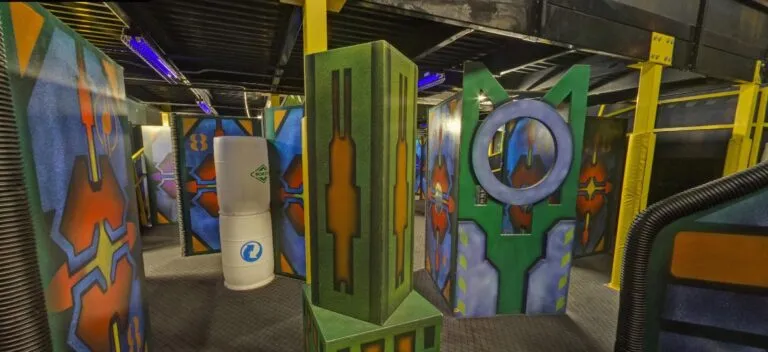
The centerpiece for many visitors is a multi-level, two-story laser tag arena with ramps, walls, and neon-lit fantasy decor, where up to 30 players can face off in fast-paced sessions. Beyond that, the venue offers bowling, a gravity ropes course, billiards, virtual reality, story rooms, mini-golf, and an arcade with more than 100 games.
Main Event Tulsa is well set up for birthdays, corporate events, team building, and school groups, with dedicated party hosts, reserved party space, and packages that bundle activities and food. A full-service restaurant and bar with shareables and pizza, plus a comfortable lounge, make it easy to relax between rounds and settle in for a long visit.
IndoorsAndy B’s sits in the south Tulsa area, in the 74137 zip code, a short drive off the city’s main corridors. It’s a large family entertainment center that recently underwent a major renovation and reopened in November. The venue combines traditional and luxury “VIB” bowling with duckpin bowling, a fully stocked arcade, a winding laser tag arena, an indoor go-kart track, and automated-scoring axe throwing lanes — all under one roof, so guests can move between attractions without leaving the building.
Beyond the games, Andy B’s offers a full restaurant and bar with shareables, burgers, and pizza, plus a banquet hall that seats large groups. Dedicated birthday packages for kids and teens come with a party host, food, and a choice of attractions, while corporate and group events range from small gatherings to full facility buyouts with private event spaces. Professional event planners handle the details, making it a low-stress choice for birthdays, team-building days, and company get-togethers.
IndoorsLaser tag has evolved from a niche hobby inspired by science fiction films into a global phenomenon. It is a high-tech, heart-pumping activity that combines athleticism, strategy, and pure adrenaline. Whether played in a dimly lit, fog-filled indoor arena or across an expansive woodland expanse, laser tag offers a unique experience that transcends the digital world of gaming, pulling participants into an immersive, real-time adventure.
At its core, laser tag is a tag-based shooting sport that utilizes infrared-emitting light guns to “tag” designated targets, usually worn by other players. Unlike paintball or airsoft, which involve physical projectiles, laser tag is completely painless and mess-free. Players wear vests or headbands equipped with sensors that detect hits from the infrared beams.
When a player fires their “phaser,” an invisible or low-visibility infrared signal is transmitted toward the opponent. If the signal strikes a sensor, the system logs the hit, typically triggering lights, sounds, and sometimes a momentary deactivation of the tagged player’s equipment. The technology has advanced significantly over the decades; modern systems use sophisticated radio frequency communication to provide real-time statistics, health tracking, and mission-based gameplay, making the experience feel like stepping onto the set of a futuristic film.
The versatility of laser tag is one of its greatest strengths. Arenas and event organizers often move far beyond simple “free-for-all” matches to create complex, mission-based scenarios.
These scenarios force players to communicate, delegate roles, and think critically under pressure, transforming a simple game into a test of leadership and tactical coordination.
While often viewed as simple entertainment, laser tag offers substantial physiological and psychological benefits. Physically, a session of laser tag is an excellent form of cardiovascular exercise. The constant movement—sprinting, crouching, dodging, and navigating obstacles—improves endurance and agility. Because players are often so focused on the game, they achieve a high level of physical exertion without the monotony of traditional gym workouts.
Psychologically, laser tag fosters teamwork and social bonding. It requires players to synchronize their movements and rely on the strengths of their teammates. For younger participants, it helps develop spatial awareness, problem-solving skills, and the importance of fair play. Even for adults, the game serves as an effective stress reliever, providing a “flow state” experience that helps players disconnect from the pressures of daily life.
Research into human behavior and play suggests that structured, competitive physical activities like laser tag are instrumental in cognitive development. Industry experts note that as digital screens consume more of our time, the demand for “active entertainment” has surged. Experts in the sports-tech industry highlight that laser tag provides a much-needed bridge between gaming culture and physical fitness.
Unlike traditional sports that require years of training, laser tag has a low barrier to entry, allowing people of varying fitness levels to compete safely. Furthermore, behavioral scientists have observed that the collaborative nature of team-based laser tag encourages “pro-social behavior,” where participants learn to suppress impulsive actions in favor of group success, thereby strengthening interpersonal relationships and community spirit.
Laser tag is famously inclusive. While it is a staple of childhood birthday parties, it has also captured the interest of teenagers and adults alike. For kids, laser tag is an empowering experience. It allows them to act out heroic fantasies in a controlled, safe environment. Because there is no physical contact or projectile force, parents feel comfortable allowing their children to engage in competitive play that builds confidence and sportsmanship. It is an ideal environment for kids to learn the value of winning and losing with grace while burning off excess energy.
The adaptability of laser tag makes it an elite choice for celebrations and professional gatherings.
Choosing the right venue depends on the desired atmosphere and the number of players.
Indoor Arenas: These provide a climate-controlled, immersive experience. They often feature multi-level mazes, neon lighting, fog machines, and pulsating soundtracks. Indoor venues are ideal for year-round play, regardless of weather conditions. They offer high-tech sensors and computerized scoring, providing a very precise, arcade-like experience.
Outdoor Venues: These offer a more rugged, tactical experience. Often utilizing woodland, pop-up inflatable obstacles, or abandoned urban structures, outdoor laser tag allows for longer sightlines and more realistic movement. These venues are better suited for large groups looking for a “mil-sim” (military simulation) style of play. They offer the freedom of natural terrain, which changes the strategic approach since players must account for hills, trees, and environmental factors.
In conclusion, whether you are a corporate executive looking for a bonding experience, a parent planning an unforgettable birthday, or an individual seeking a fun way to improve your fitness, laser tag is an unparalleled choice. It is a sport that blends the digital sophistication of video games with the tactile intensity of real-world athleticism, ensuring that every session is a unique, memorable, and thrilling endeavor.