TOP 10 best of the best Free-roam VR in Tulsa, OK – Battleonix
El Monte
Log in
0

Advanced Search:

City

Rating

Playground


Price:

Main / Catalog / VR / Oklahoma, US / Tulsa, OK

The best Free-roam VR near me in Tulsa, OK

img
from $5
VR

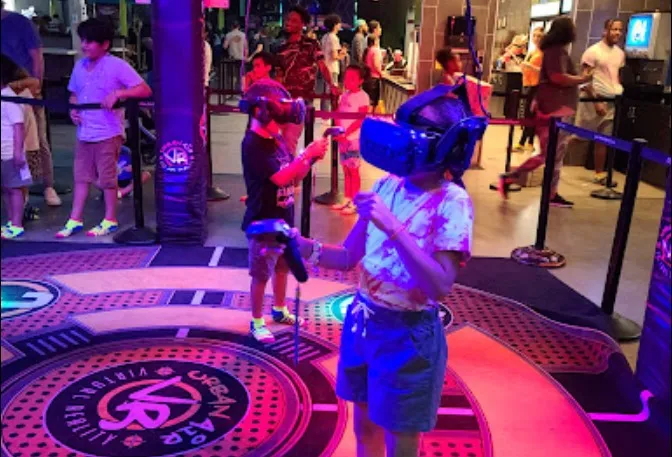
Urban Air Trampoline and Adventure Indoor Park is located in Tulsa, OK.


 The Urban Air Trampoline and Adventure Park in Tulsa, OK offers a range of exciting activities for all ages. The park features trampolines, obstacle courses, climbing walls, a ninja warrior course, and more. Visitors can also enjoy virtual reality experiences and an arcade. Additionally, the park is available for birthday parties and group events. With its exciting attractions and fun atmosphere, the Urban Air Trampoline and Adventure Park is sure to provide a memorable experience for all who visit.

Indoors
img
from $15
Laser tagVR

Main Event Indoor Laser Tag arena is located in Tulsa, OK.


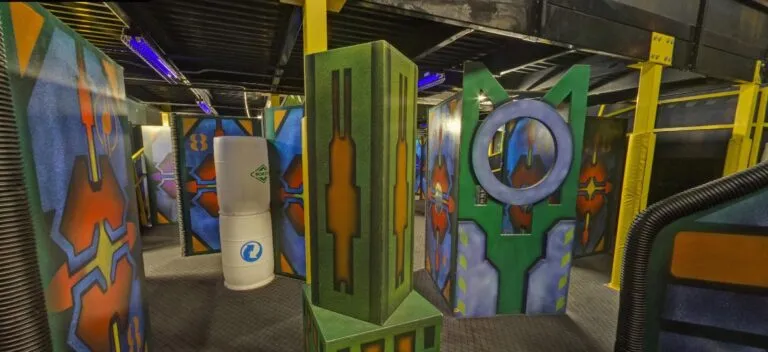
Main Event is a huge entertainment hub where you can spend your weekend or throw a birthday party. These laser-tag battles take place in a multi-story arena with fantasy-like decorations, neon lights, and laborious obstacles. Climb up the towers and rain fire on unsuspecting enemies. 


There is also a large recreation area with snacks and drinks to chill after the game. There’s also bowling, pool, VR, mini-golf, a story room, and a ropes course – all available at one single place!

Indoors

Best of the best Free-roam VR in Tulsa, OK


Stepping Into the Impossible: The Revolution of Free-Roam VR Arenas

Virtual reality has traveled a long road from the clunky, tethered headsets of the early 2010s to the immersive, high-fidelity experiences available today. Yet, the most significant leap forward has not been in headset resolution or processing power alone, but in the evolution of physical space. Enter the era of the free-roam VR arena: a specialized environment where gravity, walls, and distance take a backseat to the boundless potential of digital architecture.


What is a free-roam VR arena?

A free-roam VR arena is a purpose-built physical space designed to allow users to move naturally within a digital environment. Unlike traditional home VR, which requires a small, cleared-out living room space and often involves a tethered cable connected to a powerful PC, a free-roam arena removes the boundaries. In these facilities, the play area is expansive, often encompassing hundreds or thousands of square feet.

The core technology behind these arenas involves sophisticated motion-tracking systems—often relying on overhead camera arrays or ultra-wideband sensors—that map the player’s exact position in the room to their avatar in the game. Players typically wear a high-end wireless headset and, in many cases, a lightweight “backpack” computer, granting them total freedom of movement. Because the arena is cleared of physical obstacles, users can walk, run, crouch, and dodge in the real world, with every action translated perfectly into the game. It is the closest humanity has come to the “Holodeck” concept, effectively erasing the line between the physical and the digital.


Free-roam VR scenarios

The versatility of free-roam VR is limited only by the imagination of developers. Because these spaces allow for movement over large distances, players are not confined to a single “standing” spot. This opens up narrative possibilities that were previously impossible in home gaming.

One of the most popular genres is the cooperative shooter. Players act as a squad, exploring sprawling, multi-level digital complexes, defending against waves of enemies or navigating alien landscapes. The physical act of walking down a hallway or stepping over a virtual obstacle triggers a visceral psychological response that a controller-based game cannot replicate.

Beyond combat, free-roam VR is increasingly used for immersive “escape room” puzzles. These scenarios focus on teamwork, environmental interaction, and spatial logic. Players might find themselves working together to repair a spacecraft, solve ancient riddles in a lost temple, or navigate a surreal, gravity-defying dreamscape. Other scenarios include high-stakes cinematic experiences where players feel as though they are walking onto a movie set, participating in a heist, or witnessing historical events. The sense of presence—the feeling that you are truly “there”—is significantly heightened when your body moves in tandem with your eyes.


Who plays on free-roam VR arenas? VR for kids

The demographic for free-roam VR is surprisingly broad, drawing in everyone from hardcore tech enthusiasts to casual socialites. However, a significant portion of the audience consists of younger players. Parents are increasingly turning to VR arenas as a way to provide children with a “moving” gaming experience.

For kids, VR represents a playground without limits. Where video games are often criticized for their sedentary nature, free-roam VR serves as an active, physical activity. It encourages spatial awareness and motor coordination. Furthermore, these arenas are designed with safety in mind; the floors are padded, the boundaries are monitored by staff, and the headsets are sanitized between sessions. Because it requires active communication and collaboration, many schools and youth organizations are also beginning to explore free-roam VR as a tool for teaching teamwork and problem-solving in a setting that feels like play rather than a classroom.


Free-roam VR for a birthday party, graduation, or corporate party

The “experience economy” has revolutionized how people celebrate milestones, and free-roam VR arenas have quickly become a premier destination for social gatherings.

For a birthday party, it offers a unique “wow” factor that traditional venues lack. Whether it is a child’s tenth birthday or a thirtieth, placing the guests inside their favorite video game world creates a shared memory that is far more engaging than a standard theater outing. Birthday groups can compete or cooperate in arena-scale matches, turning the celebration into a high-octane event.

Graduations and corporate parties, on the other hand, benefit from the team-building potential of free-roam VR. For a corporation, the arena serves as a powerful venue for “co-op” training. Moving a team from the office into a virtual survival scenario forces them to communicate clearly under pressure, delegate tasks, and rely on one another—all while laughing and bonding in a way that typical trust-falls or seminars cannot achieve. It levels the playing field; in the virtual world, the CEO and the intern are judged solely on their ability to solve a puzzle or defend a position, fostering a unique sense of camaraderie.


Scientists and industry experts view on Free-roam VR

The academic and industrial interest in free-roam VR extends far beyond entertainment. Researchers in human-computer interaction (HCI) are fascinated by the phenomenon of “proprioceptive drift”—the way the brain adapts to virtual space when physical movement is integrated. Studies suggest that when the brain receives consistent sensory feedback from the inner ear and muscles during movement, the sense of immersion (or “presence”) remains stable, even if the visual environment is fantastical.

Industry experts see free-roam VR as a precursor to more advanced simulations. In the medical field, clinicians are observing the potential for these arenas as training grounds for surgeons, allowing them to practice complex procedures in a large-scale, 3D environment. In architecture and urban planning, VR arenas allow stakeholders to “walk through” buildings before the foundation is even poured, identifying structural issues or aesthetic flaws that would be invisible on a blueprint.

Furthermore, psychologists are exploring the use of these spaces for exposure therapy. By recreating environments that trigger phobias in a controlled, safe, and easily escapable space, experts can help patients overcome their fears in a physical way. The consensus among those at the cutting edge of the technology is that we have only scratched the surface. As motion-tracking becomes cheaper and more precise, and as haptic feedback—the ability to feel the texture or impact of virtual objects—becomes more refined, the free-roam arena will likely move from being a novelty attraction to a foundational piece of human infrastructure, changing how we learn, work, and connect with one another in a digital age.