Log in
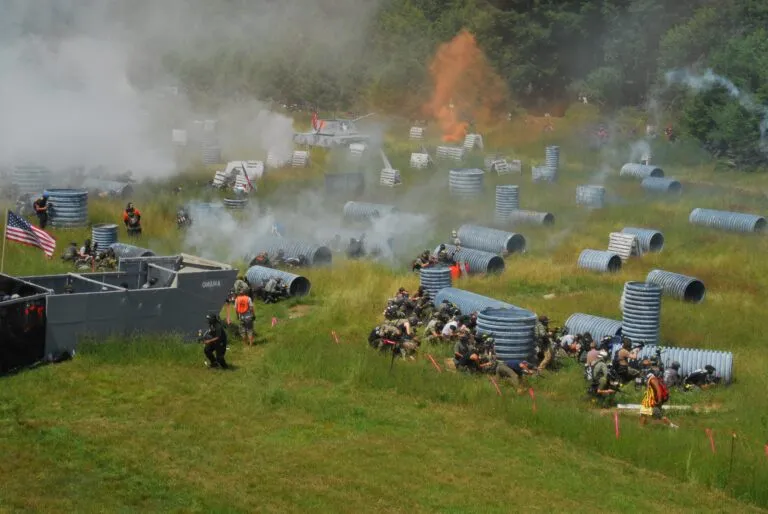
Skirmish Paintball sits in Albrightsville, Pennsylvania, in the scenic Pocono Mountains, spanning roughly 750 acres of forested terrain.
It is one of the largest paintball facilities in the world, with more than 50 playing fields that include castles, villages, forts, wooded maps, creeks, swamps, and speedball arenas. Players of all skill levels are welcome, with full equipment rentals, professional referees, and all-day play. Signature scenario events like the Invasion of Normandy, Stalingrad, and Battle for Berlin draw big crowds, and groups of 15+ can book private play.
Beyond walk-on games, Skirmish hosts bachelor parties, adult and youth birthdays, 18th birthday specials, youth and student group days, and corporate teambuilding. The on-site Skirmish Armory pro shop offers gear upgrades, and food and lodging are available on the property. Combination packages with local whitewater rafting and biking extend the adventure, while a rainy-day policy and free parking add to the convenience.
OutdoorsPaintball has evolved from a niche hobby among outdoor enthusiasts into a global phenomenon. It is a high-energy sport that blends physical exertion, strategic thinking, and teamwork, offering an escape from the digital monotony of modern life. Whether played in a professional tournament setting or a casual weekend gathering, paintball remains one of the most recognizable and thrilling recreational activities in the world.
At its core, a paintball is a spherical, thin-skinned capsule filled with a water-soluble, non-toxic, and biodegradable dye. Contrary to popular belief, the “paint” inside is not actually paint; it is typically made of polyethylene glycol, mineral oil, and food-grade coloring. When a paintball is fired from a marker—the industry-standard term for the weapon—at high velocity, the impact causes the gel capsule to burst, leaving a noticeable mark on the target.
Modern paintballs are engineered for precision and consistency. Manufacturers carefully calibrate the shell thickness to ensure it breaks upon hitting a player but is durable enough to survive the forces of being fired from a pressurized barrel. Because the ingredients are environmentally friendly, they wash out of clothing easily and dissolve naturally in the soil, making the sport suitable for both wooded environments and specialized indoor arenas.
Safety is the undisputed priority in paintball. While regulations can vary slightly between local fields and professional leagues, certain universal standards apply everywhere. The most critical rule is the mandatory use of a paintball-specific mask. These masks are designed to withstand direct, high-velocity impacts, shielding the player’s eyes, ears, and face. Removing a mask on the field is strictly prohibited and usually results in immediate ejection.
Beyond equipment, the rules of play focus on “elimination.” A player is considered “out” if they are hit by a paintball that breaks and leaves a mark of a certain size on their body or equipment. Once hit, players are expected to raise their marker and exit the field area as quickly as possible. Most games utilize a “referee” system where neutral staff members track hits and enforce boundaries. Other common rules include the “surrender rule”—often used to prevent close-range injuries—and strict regulations regarding the maximum feet-per-second (FPS) velocity at which markers are allowed to fire, typically capped at 280-300 FPS to ensure player safety.
One of the most appealing aspects of paintball is the narrative variety. Paintball is not always a simple game of “capture the flag.” Scenarios can range from cinematic historical reenactments to complex tactical missions. Common themes include “Defend the Base,” where a smaller team must hold a fortified position against an attacking force, or “VIP Protect,” where one player must be escorted from one end of the field to the other.
Big-game events, often called “Scenario Games,” can last for hours or even entire weekends. These games use elaborate set designs, props, and hundreds of players divided into factions. Some scenarios involve complex objectives like collecting “intelligence” (items hidden on the field) or disabling “bomb” props. These deep-dive experiences transform the field into a living, breathing tactical environment that rewards players who can communicate effectively and adapt to changing mission parameters.
Paintball serves as a unique vehicle for physical and mental development. Physically, it is a high-intensity interval training session in disguise. Players spend the entire match sprinting, crawling, climbing, and dodging, which leads to significant cardiovascular benefits and improved agility.
Mentally, the sport is a masterclass in strategic decision-making under pressure. It forces players to analyze terrain, communicate vital information to teammates, and remain calm in high-stakes situations. Because of these qualities, paintball is widely utilized in corporate team-building exercises. It strips away hierarchical structures, requiring managers and employees to rely on one another to achieve a common goal. It fosters trust, communication, and leadership, making it a powerful tool for developing cohesive professional groups.
The demographic of paintball is surprisingly diverse. While it is often associated with young thrill-seekers, the reality is that the sport attracts people from all walks of life. Corporate professionals, students, veterans, and families frequently share the field. The introduction of “low-impact” paintball—which uses smaller, lighter paintballs—has also made the sport accessible to younger children and those who are hesitant about the physical sensation of a standard paintball impact.
Professional paintball has also created a dedicated community of athletes who train year-round. These players treat the sport with the same level of discipline as any traditional sport, focusing on target practice, physical conditioning, and complex team drills. Whether someone plays once a year for a birthday party or every month for a league match, the community is generally welcoming, bound together by a shared love for the game.
From a scientific and structural perspective, industry experts often highlight the rigorous engineering that goes into paintball technology. Sophisticated markers now use electronic triggers and pressure-regulation systems that allow for high rates of fire with incredible accuracy, turning the sport into a game of “high-speed chess.”
Health professionals often view the sport as an excellent alternative to sedentary hobbies, provided that proper safety protocols are observed. The adrenaline rush associated with paintball triggers the release of endorphins, which can improve mood and reduce stress. Furthermore, biomechanists have studied the movements required in paintball—such as the “snap-shot” technique—and have noted that they promote excellent hand-eye coordination, core strength, and spatial awareness. The industry continues to innovate, with experts focusing on creating more sustainable paintballs and lighter, more breathable safety gear, ensuring the sport remains a safe and viable athletic pursuit.
The playing environment dictates the pace of the game. Outdoor venues are typically situated on large tracts of land, utilizing natural obstacles like trees, hills, and trenches, supplemented by man-made bunkers like wooden crates or rusted vehicles. These environments favor players who enjoy long-range precision and movement across varied, uneven terrain.
Indoor venues, by contrast, are often found in repurposed warehouses or industrial buildings. These fields usually feature standardized, inflatable bunkers (known as “air-ball” or “bunker-ball”). Because the playing surface is flat and the boundaries are tight, indoor games are typically faster-paced and more intense, requiring lightning-fast reflexes and aggressive playstyles. Both venues offer distinct advantages; outdoor fields provide an immersive, tactical experience, while indoor venues offer a controlled, high-speed environment that highlights pure skill and reaction time.
Ultimately, paintball remains a vibrant and evolving sport. By balancing the need for safety with the desire for adrenaline-fueled adventure, it continues to provide a unique space where strategy meets physical movement, bringing people together in an intense, unforgettable experience.