El Monte
 Log in
Log in
Log in

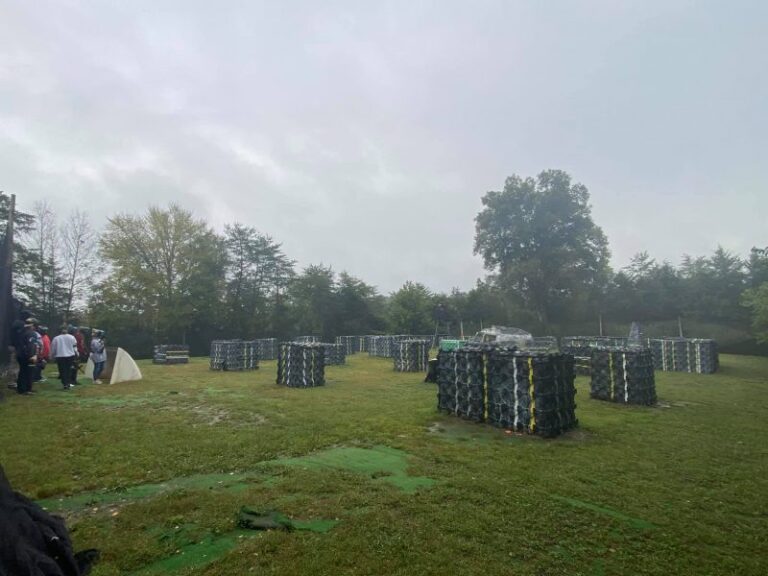
ennessee Mountain Paintball sits on Happy Hollow Lane in Sevierville, Tennessee, tucked into the Smoky Mountain vacation corridor between Pigeon Forge and Gatlinburg and about a 30-minute drive from Knoxville.
The park built its reputation on low-impact “Little Or No Pain Paintball,” using gentler 0.50-caliber balls that make the sport approachable for families and first-timers, while still offering standard paintball for experienced players. Its 20-acre grounds feature themed fields including a Western City course with NFL-grade turf, a Vietnam Village, log cabins, two-story towers, tunnels, bridges, and a 60-foot multilevel base. Laser tag, kids’ soft paintball, and hydroball round out the lineup for younger visitors.
The on-site pro shop stocks rental gear, high-quality markers, and disposable jumpsuits, and field paint is sold at the park. Reviews consistently highlight the friendly, patient staff and referees who lead multiple games throughout the day. With a lounge area for resting between rounds, the park suits birthday parties, bachelor parties, corporate outings, and family reunions, and it’s open seven days a week by reservation.
 Outdoors
Smoky Mountain Paintball sits on nearly 20 acres of rolling hills at the foot of the Smoky Mountains in Seymour, Tennessee, a short drive from Knoxville, Sevierville, Pigeon Forge, and Gatlinburg, and has been serving the East Tennessee area since 1994.
The facility offers four distinct fields, from large wooded courses to a hybrid speedball field, along with low-impact paintball and SPLATMASTER guns for younger players. Rental packages include gun, mask, paintballs, and CO2, and the pro shop carries coveralls, jackets, chest protectors, and other gear. The staff runs a variety of game types, from capture the flag to defend-the-fort scenarios, and keeps all markers below 280 feet per second.
The club hosts birthdays, bachelor and bachelorette parties, church groups, corporate team building, fraternity and sorority outings, and military and police groups, accommodating parties as large as 100 players. Picnic tables sit outside the field netting for spectators, and private weekday reservations are available for special events.
OutdoorsPaintball has evolved from a niche hobbyist activity into a globally recognized sport that combines physical endurance, tactical problem-solving, and sheer high-octane fun. Whether played in the thick of a forest or within the sterile, fast-paced confines of a blow-up arena, paintball creates an environment where every movement carries consequences and every decision can shift the momentum of the game.
At its core, a paintball is a spherical capsule made of a thin, gelatinous shell—similar to a nutritional oil supplement capsule—filled with a non-toxic, water-soluble, biodegradable dye. When fired from a paintball marker (the specialized air-powered gun used in the sport), the ball is designed to rupture upon impact. The bright, viscous fill leaves a distinct “mark” on the target, serving as an undeniable indicator that a player has been eliminated.
The technology behind these projectiles has advanced significantly over the decades. Modern paintballs are engineered for “flight stability,” meaning they are more likely to travel straight and burst reliably upon impact rather than bouncing off the target without leaving a mark. They are environmentally friendly, typically washing out of clothing with a simple rinse, making the sport accessible for casual weekend gatherings and professional tournaments alike.
While rules can vary depending on whether the game is a recreational walk-on session or a professional league match, a few core tenets remain universal. Safety is the primary rule: players must wear protective masks at all times while on the field. These masks are constructed of impact-resistant polycarbonate designed to withstand hits from paintballs traveling at high velocities.
Beyond safety, the fundamental rule is the “hit.” If a paintball strikes a player, their marker, or any gear they are carrying and leaves a mark, that player is considered “out.” Once hit, the player must immediately raise their marker, signal their elimination by yelling “Out!”, and exit the field through the designated path. In many formats, wiping off paint to stay in the game is considered a major violation, often resulting in penalties or expulsion. Furthermore, most fields enforce a “chrono” limit—a restriction on the velocity at which the marker can fire—to ensure that no player is injured by a projectile moving faster than the safety threshold.
The variety of gameplay, often referred to as “scenarios,” is what keeps paintball fresh for veterans and newcomers. The most common format is “Elimination,” where two teams attempt to tag all members of the opposing team to claim victory. However, game designers have expanded well beyond this.
“Capture the Flag” remains the gold standard of competitive paintball, requiring teams to infiltrate enemy territory, secure a flag, and return it to their base without getting hit. Tactical scenarios, often played in massive outdoor environments, might include “VIP Protection,” where one team must escort a player across the field while the other attempts to tag them, or “Search and Destroy,” where hidden objectives (like smoke canisters or prop bombs) must be located and deactivated. These varied objectives force players to balance aggression with defensive positioning, ensuring that the team with the best strategy often beats the team with the fastest trigger finger.
Paintball is much more than a game of tag with consequences; it is an incredible tool for personal and professional development. Physically, it is a high-intensity cardiovascular workout. Navigating a field requires sprinting, crouching, crawling, and sudden bursts of explosive movement, all of which improve agility and stamina.
Beyond the physical, paintball is a masterclass in communication and leadership. In a high-pressure environment, players must relay information about enemy locations and coordinate maneuvers within seconds. This necessity for “combat communication” makes it a popular choice for corporate team-building retreats. It forces individuals out of their comfort zones, strips away office hierarchies, and requires groups to foster trust and mutual reliance to achieve a common goal.
The demographic of paintball is remarkably diverse. Because the sport does not rely on raw brute strength, it is an equalizer. It is common to see teenagers playing alongside middle-aged professionals, and men and women competing on the same squads.
There are generally three tiers of players. First, the “recreational” group—friends or families who rent equipment for a birthday party or a weekend outing. Second, the “rec-baller,” a hobbyist who owns their own marker and mask and plays consistently at local fields to hone their skills. Finally, there are the competitive tournament athletes. These individuals train with the discipline of any traditional sports player, studying field geometry, practicing specific drills, and participating in regional and international leagues.
From a scientific standpoint, paintball is frequently analyzed through the lenses of physics and psychology. Ballistic experts regularly study the flight path of the paintball, noting how weather, humidity, and barrel bore size influence accuracy. Meanwhile, sports psychologists have used paintball to study “flow state” or “the zone”—that mental point where a player becomes so immersed in the game that their reaction times sharpen and their decision-making becomes instinctive.
Industry experts also point to paintball as a case study in equipment evolution. The transition from CO2 propellant to high-pressure air (HPA) and the invention of electronic firing systems that allow for high rates of fire have transformed the sport from a slow-paced tactical endeavor into a blistering, high-speed athletic pursuit. Professionals in the industry emphasize that while technology makes the game exciting, the future of the sport lies in sustainability and safety, with constant research into making the environment cleaner and the goggles more comfortable for extended sessions.
Paintball venues generally fall into two categories, each offering a distinct atmosphere. Outdoor fields usually take advantage of natural terrain—forests, bunkers, and hills—often replicating historical battlefields or cinematic set pieces. These venues are favored for long-form scenario games where stealth and camouflage play a larger role.
Indoor venues, often called “speedball” fields, offer a completely different experience. Usually set up in large warehouses with inflatable bunkers (known as “air bunkers”), these fields are bright, fast, and symmetrical. They are designed for high-intensity, tournament-style play where visibility is constant and the game moves at a relentless pace. Choosing between an indoor or outdoor field depends on what the player is looking for: the tactical, immersive mystery of the woods or the adrenaline-fueled, athletic intensity of the indoor arena. Regardless of the location, the goal remains the same: push your limits, stay alert, and don’t get hit.



 721 Happy Hollow Ln, Sevierville, TN 37876, United States