Log in
Apex Entertainment Albany is located in Albany, NY.
Apex Entertainment Albany, located in Albany, NY, at Crossgates Mall, positions itself as an extraordinary palace of fun.
Regarding games and attractions, Apex Entertainment features 22 bowling lanes (both ten-pin and candlepin) and over 60 arcade games, ranging from the latest multidimensional releases to beloved classics, including VR experiences.
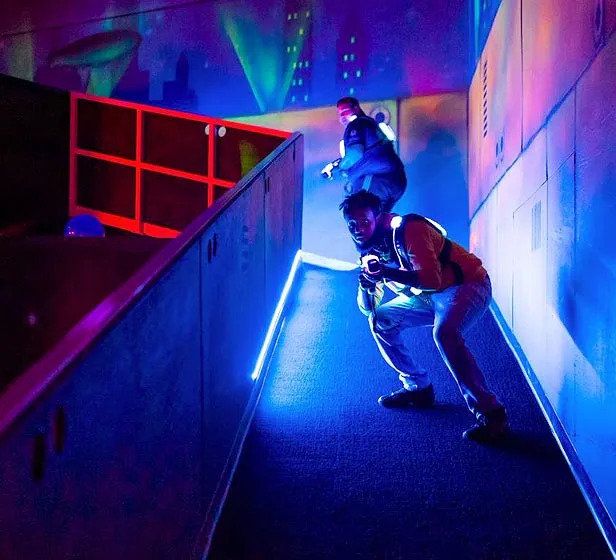
Furthermore, a 4,000 square foot laser tag arena, a 360-degree bumper car ride, Hologate, and multisport simulators are available, in addition to a host of other attractions. Whatever an individual’s idea of fun may be, it is likely they will find it at Apex Entertainment.
Apex Entertainment offers an extensive menu featuring custom-built snacks and cocktails, always readily available from their team of hardworking and friendly servers.
Beyond its attractions, Apex Entertainment is well-suited for meetings and corporate events, offering a 2,500 square foot meeting space with a flexible design and modern technology. They provide packages for kids’ parties, teen parties, private events, team building activities, holiday parties, and nearly any other type of event imaginable within their expansive venue.
Indoors
Beyond the confines of a traditional monitor or a handheld controller lies a new frontier of digital engagement: the free-roam virtual reality (VR) arena. For decades, the dream of stepping inside a video game has been limited by the physical tether of cables and the narrow field of stationary play. However, recent technological leaps have birthed a more expansive experience that allows users to walk, run, and interact with a digital universe as naturally as they do in the physical world. This shift from sedentary immersion to active, large-scale movement represents a significant milestone in how people consume entertainment and interact with technology.
A free-roam VR arena is a dedicated physical space designed to allow multiple participants to move through a virtual environment without being restricted by wires or physical boundaries. Unlike home-based VR systems, which often require the user to stay within a small radius or remain seated, free-roam arenas utilize large, open floor plans paired with sophisticated tracking technology. In these environments, the physical floor of the arena corresponds directly to the floor of the virtual world, creating a one-to-one movement ratio that significantly enhances the feeling of presence.
The infrastructure of a free-roam arena typically involves several key components. First is the tracking system, which can be either “outside-in” using wall-mounted sensors and cameras or “inside-out” using cameras built directly into the headsets. These systems monitor the precise location of every player in the room with sub-millimeter accuracy. Players are usually equipped with standalone enterprise-grade headsets or backpack PCs that process high-fidelity graphics without the need for a connection to a wall outlet. To complete the immersion, many arenas incorporate haptic feedback vests, which allow players to feel physical sensations—such as the impact of a virtual object or the rumble of an explosion—adding a tactile layer to the visual and auditory experience.
The true appeal of the free-roam experience lies in the variety of scenarios that users can inhabit. Because the physical space is a blank canvas, developers can overlay any number of digital skins onto the arena. One of the most popular genres is the tactical shooter or survival scenario. In these games, a team of players must navigate a zombie-infested wasteland or a futuristic space station, working together to clear rooms and achieve objectives. The ability to physically peak around corners or crouch behind virtual cover makes these scenarios feel far more visceral than any traditional gaming console could provide.
Beyond combat, free-roam VR is an ideal medium for hyper-realistic escape rooms and mystery-solving adventures. Instead of clicking on objects on a screen, players must physically walk over to a bookshelf, examine items, and communicate with their teammates in real-time to solve puzzles. Some high-end arenas also experiment with “4D” effects, where physical fans simulate wind or heat lamps mimic the glow of a fire, further blurring the line between reality and simulation. Educational scenarios are also becoming more prevalent, allowing groups to walk through ancient historical sites or explore the depths of the ocean together, providing a level of spatial understanding that a textbook or a documentary simply cannot offer.
The demographic for free-roam VR is surprisingly broad, spanning from hardcore gamers to casual tech enthusiasts. However, one of the fastest-growing segments is the younger generation. VR for kids has evolved from a niche interest into a mainstream recreational activity. Because children are digital natives, they often adapt to the mechanics of virtual reality faster than adults. For kids, the appeal of free-roam VR is the realization of their imagination; they are no longer just watching a superhero or a space explorer on a screen—they are becoming one.
Safety and accessibility are paramount when designing VR experiences for children. Most arenas have age-appropriate content tailored to younger audiences, focusing on bright colors, whimsical environments, and non-violent gameplay. From a developmental perspective, free-roam VR offers more than just fun. It encourages physical movement in an era where childhood obesity and sedentary lifestyles are growing concerns. Furthermore, these games often require high levels of cooperation and spatial awareness, helping children develop social skills and hand-eye coordination in an engaging, high-tech setting. Many facilities implement adjustable headset straps and lightweight equipment to ensure that the hardware is comfortable for smaller frames, making the technology accessible to a wide range of ages.
The social nature of free-roam VR makes it a premier destination for group events. Unlike traditional VR where players might feel isolated in their own individual headsets, free-roam systems allow players to see each other’s digital avatars and hear each other’s voices naturally. This makes it an ideal choice for birthday parties. It provides a high-energy, memorable experience that serves as a centerpiece for the celebration. The shared adrenaline of a virtual battle or the shared triumph of solving a difficult puzzle creates lasting memories that standard party activities often struggle to match.
For graduations and milestone celebrations, free-roam VR offers a modern way to reward achievement. It provides a safe yet thrilling environment where graduates can let loose and enjoy a sense of freedom with their peers. Similarly, the corporate world has begun to embrace free-roam VR as a powerful tool for team building. Professional organizations often look for ways to break down silos and improve communication among staff. In a VR arena, titles and hierarchies tend to disappear. A manager and a junior employee must rely on each other’s eyes and ears to survive a virtual mission. This “pressure-cooker” environment helps teams practice leadership, crisis management, and collaborative problem-solving, all while under the guise of an entertaining game.
The scientific community and technology industry experts have closely monitored the development of free-roam VR, particularly regarding its physiological and psychological impacts. One of the most significant observations from experts is the reduction of motion sickness in free-roam environments compared to stationary VR. “Vestibular mismatch”—the conflict between what the eyes see and what the inner ear feels—is the primary cause of VR-induced nausea. In free-roam, because the user’s physical movement matches their virtual movement exactly, this mismatch is largely eliminated. This makes the technology much more palatable for the general public and those who are traditionally sensitive to screen-based motion.
Psychologists have also explored the concept of “embodiment” in free-roam VR. When a user can see their hands and feet move in the virtual space exactly as they do in the real world, the brain quickly accepts the digital avatar as its own body. This level of immersion has profound implications for training and education, as the brain tends to retain information gathered during an embodied experience much better than information gathered through passive observation. Industry experts predict that as 5G connectivity and edge computing continue to advance, the latency in these arenas will drop even further, allowing for even larger play spaces and more complex simulations. The consensus among technologists is that free-roam VR is not just a passing trend in gaming; it is a foundational step toward the future of spatial computing and the eventual integration of the digital and physical worlds.
In summary, the free-roam VR arena represents the pinnacle of modern location-based entertainment. By combining physical activity with limitless digital possibilities, it offers a unique form of engagement that appeals to children, families, and corporate teams alike. As the hardware becomes more optimized and the scenarios more diverse, these arenas are set to become a staple of the modern social landscape, proving that the most exciting way to experience technology is to walk right into the heart of it.