El Monte
 Log in
Log in
Log in

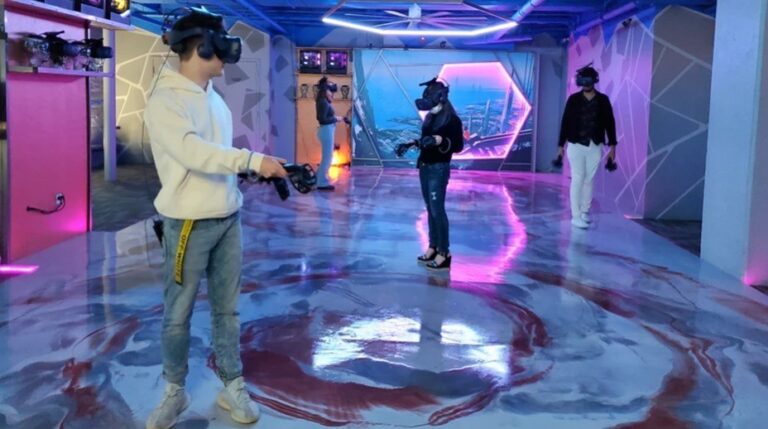
Key To Amaze VR is located in Boston’s Kenmore Square at 530 Commonwealth Avenue, just steps from the Kenmore T stop. It is Boston’s first Virtual Reality Gaming Lounge, offering wireless free-roam VR adventures with over 100 games and experiences across three immersive arenas. Guests can defend villages from zombies, solve VR escape room puzzles, play mini golf, or battle pirates — all in 40-minute sessions guided by expert game masters. The venue accommodates up to 12 players simultaneously and is suitable for ages 13 and up.
Beyond gaming, Key To Amaze is a popular destination for birthdays, corporate events, team-building, date nights, and private parties, with space for up to 50 guests. The venue offers customizable LED lighting, a high-fidelity audio system, in-house catering options, and a comfortable lounge area. The staff — frequently praised in reviews for their patience and expertise — handles everything from setup to game recommendations, making the experience accessible even for complete beginners.
 Indoors
Platinum City Gaming is located in Taunton, Massachusetts, along Winthrop Street in a convenient strip mall area.
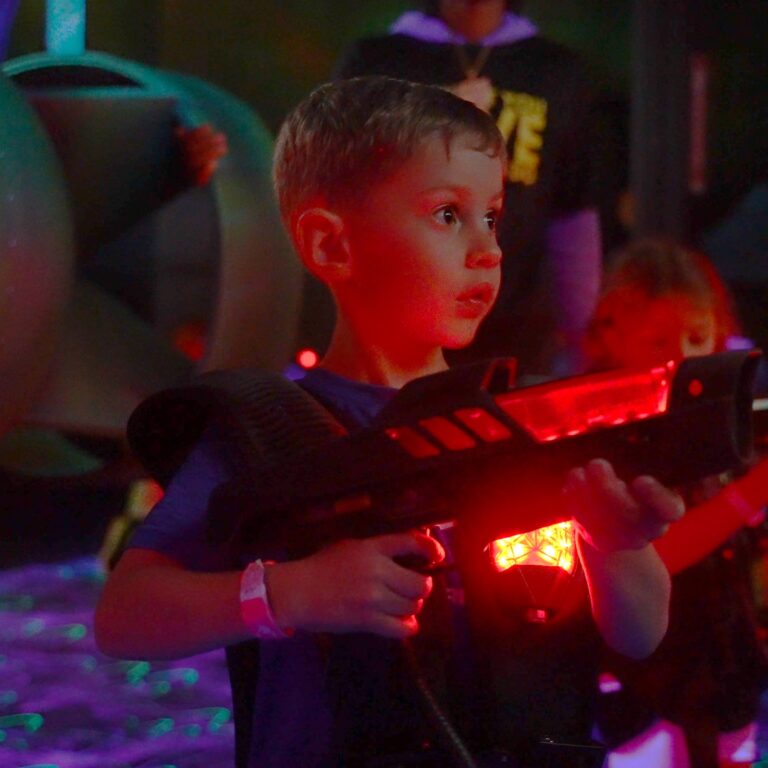
The 7,300-square-foot facility offers a wide range of interactive entertainment including laser tag, Nerf and Gellyball arenas, a retro arcade, console gaming stations with PS5 and Xbox Series X, half-court basketball, pool tables, bumper cars, and virtual reality experiences. Guests can book private sessions for tactical games or drop in for walk-in arcade and console play. The venue specializes in party packages that combine multiple activities with pizza, drinks, and dedicated party space, making it a popular choice for birthday celebrations, school field trips, and corporate team-building events.
Beyond the core gaming offerings, the club features a Smash Room for stress relief, private and open-stage karaoke, splatter painting, axe throwing, and a full bar with food service. Additional amenities include helium balloon decorations, a gaming truck for off-site rentals, a food cart, and a photo booth. The staff is known for attentive service and community involvement, and the space can be adapted for fundraisers, private events, and large group gatherings with customizable activity rotations and catering options.
IndoorsLaunch Family Entertainment Park Woburn is located at 366 Cambridge Road in Woburn, Massachusetts, just north of Boston.
The park offers a wide range of attractions including trampoline courts, Fury Laser Tag, a Ninja Course with multiple difficulty levels, XP Arena, Omni Virtual Reality, an arcade, X-treme Dodgeball, Launch Pad, basketball, Battle Pit, and a slackline. Guests can purchase an Unlimited All Day Action Pass ($29.99) for access to the core attractions, or choose à la carte options for laser tag ($5), VR ($5), and XP Arena ($5). The park also offers an Ultimate Add-On bundle ($11.99) combining 40 arcade credits with one game each of VR, XP Arena, and laser tag.
For celebrations, Launch Woburn provides five birthday party packages ranging from $229 (Hangout, 5 guests) to $749 (A-List, 14 guests), each including a party host, dedicated room time, food from Krave Restaurant, arcade credits, and grip socks. The facility also hosts private events, corporate gatherings, fundraisers, field trips, and teen nights (IGNITE). Krave Restaurant serves house-made pizza, appetizers, ice cream, and drinks on-site, while Toddler Time on Sunday mornings offers a dedicated experience for children ages 5 and under.
IndoorsLaunch Family Entertainment Park is located on Providence Highway (Route 1) in Norwood, Massachusetts, along the Auto Mile. The venue offers a wide range of active indoor attractions including trampoline courts, Fury laser tag in a custom-built arena, a ninja warrior course, trampoline dodgeball and basketball, Omni virtual reality, a Formula 1 race simulator, and a full arcade with prize redemption. Guests can choose from three admission combos — Loaded, Charged Up, and Supercharged — that bundle Action Pass access with arcade credits and optional laser tag or VR.
The park also features the Krave Restaurant serving made-to-order pizzas and snacks, dedicated party rooms for birthdays and celebrations, and recurring programs like Toddler Time for ages 5 and under and Ignite teen glow parties. The facility is available for private rentals, corporate events, fundraisers, field trips, and group outings of all sizes. A Loyal Launcher Rewards program offers discounted pricing and exclusive perks to members.
IndoorsRyan’s Hanover Crossing is located about 25 miles south of Boston in Hanover, MA, within the Hanover Crossing retail complex. This two-level, 40,000-square-foot flagship venue offers laser tag in a 4,000-square-foot haze-filled arena, 16 ten-pin bowling lanes, axe throwing, virtual reality rides and games, a golf simulator, and nearly 100 arcade games. Walk-in laser tag is available at $9 per game or $15 for two games, while bowling, axe throwing, and VR each have their own pricing tiers. The venue is well-suited for birthday parties, corporate team-building, fundraisers, and casual family outings.
A full restaurant and two bars are on-site, with laneside service for bowlers and a spectator viewing area for the laser tag arena. Private VIP Rooms feature dedicated bowling lanes, a bar, and a large television for private events. The staff is consistently praised for being helpful and patient, and the Ryan’s Card system allows guests to earn prize points toward custom rewards. The space is designed to accommodate everything from a child’s birthday party to a corporate holiday event, all under one roof.
IndoorsVirtual reality has traveled a long distance from the tethered, stationary headsets that first introduced the masses to digital landscapes. For years, VR was a solitary, confined experience—a user stood in a small square, wearing a heavy cable that anchored them to a PC, constantly reminded of the physical boundaries of their living room. Today, the industry has shifted toward the “Free-Roam VR Arena,” a revolution in spatial computing that allows players to physically walk, run, and collaborate in vast, untethered environments. By removing the wires and expanding the play area, developers have turned VR into an athletic, social, and truly transformative medium.
A free-roam VR arena, often referred to as “Warehouse-Scale VR,” is a purpose-built facility designed to allow multiple players to navigate a physical space while their movements are mirrored in a virtual environment. Unlike home-based VR, these arenas utilize advanced optical tracking systems—often consisting of ceiling-mounted infrared cameras—to monitor the precise position of every player in real-time.
The core technology relies on standalone, wireless headsets (such as high-end enterprise-grade HMDs) and tracked accessories like haptic vests or prop weapons. Because the floor is unobstructed and the tracking covers a large area, players can walk hundreds of feet, duck behind virtual cover, and move in tandem with teammates without the fear of tripping or hitting a wall. This synthesis of physical exertion and digital immersion creates a phenomenon known as “presence”—the psychological state where the brain stops perceiving the digital world as a simulation and begins to accept it as reality.
The versatility of free-roam VR is limited only by software design. Because the physical arena remains the same, creators can swap the digital environment with a single command, transforming a warehouse floor into anything imaginable.
Common scenarios range from high-adrenaline tactical shooters to cooperative puzzle-solving adventures. In tactical simulations, groups of players find themselves navigating sprawling space stations or post-apocalyptic ruins, communicating over headsets to clear rooms and neutralize threats. These scenarios emphasize team coordination, requiring players to cover each other’s flanks just as they would in a real-world tactical exercise.
On the other end of the spectrum are narrative-driven “escape room” style experiences. Here, the focus shifts from combat to exploration and mystery. Players might find themselves inside an ancient Egyptian tomb, forced to manipulate oversized virtual mechanisms, or working together to pilot a starship through an asteroid field. Some arenas also offer horror experiences, where the combination of haptic feedback (feeling a rumble when a monster draws near) and the tactile sensation of walking through a dark, cramped space elevates the tension far beyond what a traditional cinema or console game could achieve.
The demographic for free-roam VR is surprisingly broad. While the technology was initially synonymous with “hardcore” gamers seeking the next level of competitive shooting, it has rapidly expanded into a mainstream entertainment medium for families, tourists, and casual players.
VR for kids has become a significant driver of this growth. For younger generations, who have grown up with smartphones and tablets, VR feels like the natural evolution of gaming. Free-roam arenas offer a way for children to engage in physical activity that is inherently social. Rather than sitting on a couch, kids are moving, jumping, and collaborating with their peers to solve problems. Safety protocols in professional arenas—such as padded walls, safety briefings, and age-appropriate content filters—make these facilities a controlled environment for social development. It allows children to practice teamwork and spatial awareness in an environment that feels like a real-life video game.
The rise of the “experience economy” has made free-roam VR a highly sought-after venue for milestone events.
For birthday parties, it provides an unforgettable centerpiece. Parents turn to VR arcades because they offer an “active” entertainment option that keeps groups of teenagers and pre-teens engaged, moving, and talking to one another. The shared sense of wonder that occurs when a group “logs in” together creates a bonding experience that traditional parties often struggle to replicate.
Graduation parties and student group outings similarly benefit from the novelty of the medium. It serves as a great equalizer, where the digital nature of the game makes it accessible to everyone, regardless of athletic ability.
Perhaps the most surprising shift, however, is in the corporate sector. Companies are increasingly booking free-roam VR arenas for team-building exercises. In a traditional corporate retreat, “team building” can often feel forced or mundane. In a VR arena, employees are forced into a high-stakes environment where communication is not just recommended—it is a requirement for survival. If the team doesn’t talk, they lose. This provides a unique window for managers to observe leadership styles, communication barriers, and group dynamics in a safe, fun, and non-office environment.
The academic and industrial interest in free-roam VR extends far beyond entertainment. Scientists studying human-computer interaction (HCI) view these arenas as the ultimate testing ground for human behavior. Because free-roam VR monitors physical movement, researchers can analyze how people make decisions under pressure, how they navigate virtual spaces, and how “embodiment”—the feeling of being in a digital avatar—changes self-perception.
Industry experts see free-roam VR as a critical stepping stone toward the broader “Metaverse.” While the consumer-grade headsets of today are still improving in battery life and resolution, the warehouse-scale model provides a blueprint for how people will interact in a digital-physical hybrid future. Experts suggest that as the cost of high-fidelity tracking decreases, these arenas will move from specialized arcades into schools, museums, and training centers.
Furthermore, medical and psychological professionals are observing the potential for these spaces in rehabilitation and therapy. Using free-roam VR for exposure therapy, for example, allows patients to confront fears in a controlled environment where the therapist can guide them through the space. The physical act of walking while immersed in a simulation is proving to be a potent tool for sensory processing and cognitive retraining.
Ultimately, the free-roam VR arena is more than just a place to play games; it is an experimental frontier. As technology continues to bridge the gap between our physical capabilities and digital desires, these arenas stand as the first true manifestation of a world where we are no longer just looking at screens, but stepping right through them. Whether for a child’s birthday or a high-level corporate workshop, the ability to walk together in a virtual world is reshaping how we play, work, and perceive the reality around us.


 530 Commonwealth Ave, Boston, MA 02215, United States