El Monte
 Log in
Log in
Log in

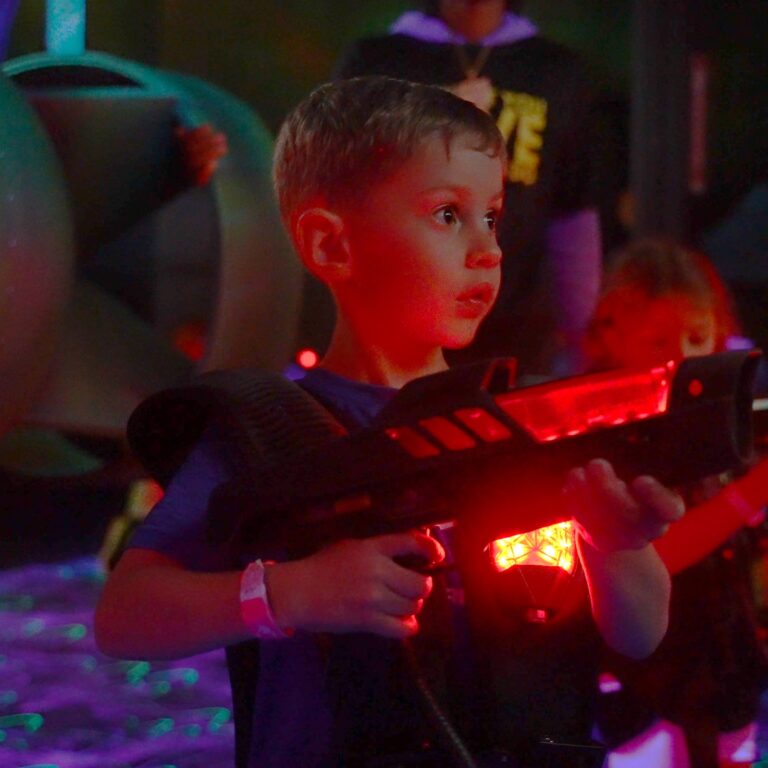
Launch Family Entertainment Park is located on Providence Highway (Route 1) in Norwood, Massachusetts, along the Auto Mile. The venue offers a wide range of active indoor attractions including trampoline courts, Fury laser tag in a custom-built arena, a ninja warrior course, trampoline dodgeball and basketball, Omni virtual reality, a Formula 1 race simulator, and a full arcade with prize redemption. Guests can choose from three admission combos — Loaded, Charged Up, and Supercharged — that bundle Action Pass access with arcade credits and optional laser tag or VR.
The park also features the Krave Restaurant serving made-to-order pizzas and snacks, dedicated party rooms for birthdays and celebrations, and recurring programs like Toddler Time for ages 5 and under and Ignite teen glow parties. The facility is available for private rentals, corporate events, fundraisers, field trips, and group outings of all sizes. A Loyal Launcher Rewards program offers discounted pricing and exclusive perks to members.
 Indoors
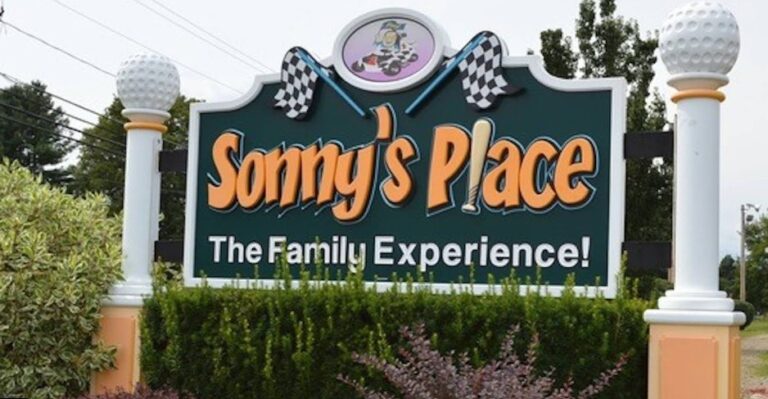
Sonny’s Place sits along Main Street in Somers, Connecticut, a family-owned amusement complex that opened in 2008 and has grown steadily ever since. The park features a two-story Zap Zone Laser Tag Arena by Lasertron with multiple game modes, outdoor go-karts, two mini-golf courses, a zipline, batting cages, a 7,000-square-foot arcade, climbing wall, bumper boats, and a soft indoor playground. Birthday parties come with private rooms and dedicated hosts, while the Sonny’s Pavilion accommodates groups of over 500 for corporate events, school trips, reunions, and social gatherings.
Beyond the attractions, the park offers several dining options including a smokehouse, bar, and ice cream counter, plus live music on summer weekends and special adult-only late-night events. The staff is known for being friendly and professional, and the park runs community appreciation programs for teachers, first responders, and military personnel. With family night bundles, date night specials, and seasonal events like character days and the North Pole Experience, Sonny’s Place functions as a genuine community gathering spot rather than just a collection of rides.
Indoors Outdoors
Launch Family Entertainment Park Woburn is located at 366 Cambridge Road in Woburn, Massachusetts, just north of Boston.
The park offers a wide range of attractions including trampoline courts, Fury Laser Tag, a Ninja Course with multiple difficulty levels, XP Arena, Omni Virtual Reality, an arcade, X-treme Dodgeball, Launch Pad, basketball, Battle Pit, and a slackline. Guests can purchase an Unlimited All Day Action Pass ($29.99) for access to the core attractions, or choose à la carte options for laser tag ($5), VR ($5), and XP Arena ($5). The park also offers an Ultimate Add-On bundle ($11.99) combining 40 arcade credits with one game each of VR, XP Arena, and laser tag.
For celebrations, Launch Woburn provides five birthday party packages ranging from $229 (Hangout, 5 guests) to $749 (A-List, 14 guests), each including a party host, dedicated room time, food from Krave Restaurant, arcade credits, and grip socks. The facility also hosts private events, corporate gatherings, fundraisers, field trips, and teen nights (IGNITE). Krave Restaurant serves house-made pizza, appetizers, ice cream, and drinks on-site, while Toddler Time on Sunday mornings offers a dedicated experience for children ages 5 and under.
IndoorsRyan’s Hanover Crossing is located about 25 miles south of Boston in Hanover, MA, within the Hanover Crossing retail complex. This two-level, 40,000-square-foot flagship venue offers laser tag in a 4,000-square-foot haze-filled arena, 16 ten-pin bowling lanes, axe throwing, virtual reality rides and games, a golf simulator, and nearly 100 arcade games. Walk-in laser tag is available at $9 per game or $15 for two games, while bowling, axe throwing, and VR each have their own pricing tiers. The venue is well-suited for birthday parties, corporate team-building, fundraisers, and casual family outings.
A full restaurant and two bars are on-site, with laneside service for bowlers and a spectator viewing area for the laser tag arena. Private VIP Rooms feature dedicated bowling lanes, a bar, and a large television for private events. The staff is consistently praised for being helpful and patient, and the Ryan’s Card system allows guests to earn prize points toward custom rewards. The space is designed to accommodate everything from a child’s birthday party to a corporate holiday event, all under one roof.
IndoorsPlatinum City Gaming is located in Taunton, Massachusetts, along Winthrop Street in a convenient strip mall area.
The 7,300-square-foot facility offers a wide range of interactive entertainment including laser tag, Nerf and Gellyball arenas, a retro arcade, console gaming stations with PS5 and Xbox Series X, half-court basketball, pool tables, bumper cars, and virtual reality experiences. Guests can book private sessions for tactical games or drop in for walk-in arcade and console play. The venue specializes in party packages that combine multiple activities with pizza, drinks, and dedicated party space, making it a popular choice for birthday celebrations, school field trips, and corporate team-building events.
Beyond the core gaming offerings, the club features a Smash Room for stress relief, private and open-stage karaoke, splatter painting, axe throwing, and a full bar with food service. Additional amenities include helium balloon decorations, a gaming truck for off-site rentals, a food cart, and a photo booth. The staff is known for attentive service and community involvement, and the space can be adapted for fundraisers, private events, and large group gatherings with customizable activity rotations and catering options.
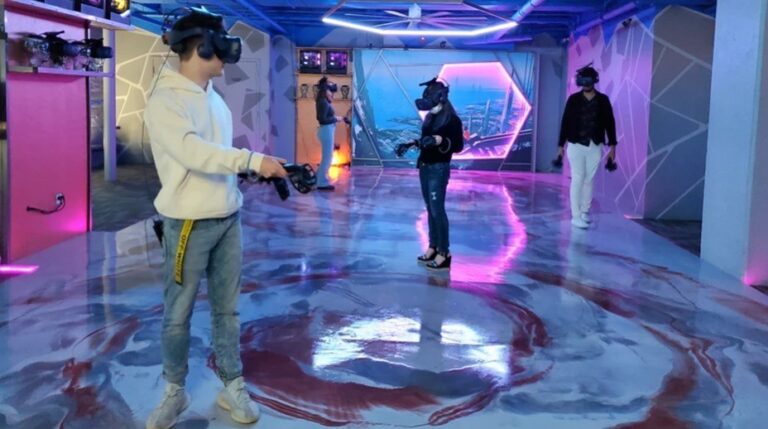
IndoorsKey To Amaze VR is located in Boston’s Kenmore Square at 530 Commonwealth Avenue, just steps from the Kenmore T stop. It is Boston’s first Virtual Reality Gaming Lounge, offering wireless free-roam VR adventures with over 100 games and experiences across three immersive arenas. Guests can defend villages from zombies, solve VR escape room puzzles, play mini golf, or battle pirates — all in 40-minute sessions guided by expert game masters. The venue accommodates up to 12 players simultaneously and is suitable for ages 13 and up.
Beyond gaming, Key To Amaze is a popular destination for birthdays, corporate events, team-building, date nights, and private parties, with space for up to 50 guests. The venue offers customizable LED lighting, a high-fidelity audio system, in-house catering options, and a comfortable lounge area. The staff — frequently praised in reviews for their patience and expertise — handles everything from setup to game recommendations, making the experience accessible even for complete beginners.
IndoorsA free‑roam virtual‑reality arena is a specially designed physical space where participants can move unhindered while wearing an untethered headset. Unlike tabletop or seated VR setups that confine users to a small play area, free‑roam arenas are typically 2,000 to 5,000 square‑feet rooms equipped with motion‑tracking cameras, safety‑netting, and padded walls. The tracking system continuously maps the user’s position in real time, allowing the virtual world to respond to every step, turn, and leap as naturally as the physical movement itself.
The technology behind these arenas combines high‑resolution head‑mounted displays (HMDs) with inside‑out or external optical tracking, inertial measurement units, and sometimes even haptic floor panels. The result is an immersive experience that blurs the line between the real and the virtual. Because users are not tethered to a PC or console, they can dash across the space, crouch under virtual obstacles, or collaborate with friends in a fully three‑dimensional environment without the risk of tripping over cords.
Free‑roam arenas have emerged as a commercial niche for entertainment centers, theme parks, and event venues. Their appeal lies in the freedom they grant: participants can explore massive digital landscapes, solve puzzles that require physical interaction, or engage in high‑intensity games that would be impossible in a stationary setting.
The flexibility of a free‑roam venue fuels a diverse catalogue of scenarios, each crafted to exploit the physical freedom of movement. Below are some of the most popular categories:
Players become heroes in sprawling fantasy realms, climbing virtual cliffs, leaping across chasms, and wielding swords that feel weightless in their hands. The arena’s tracking system translates real jumps into in‑game vaults, making the experience feel like a true quest.
Futuristic combat zones let participants dash behind holographic cover, duck under laser barriers, and fire motion‑controlled blasters. Because the arena is spacious, gunfights can involve complex tactics such as flanking and vertical movement, mirroring first‑person shooters on a larger scale.
Traditional escape‑room logic is amplified by VR. Players must physically manipulate oversized virtual objects, align laser grids, or navigate mazes that rearrange themselves as they walk. The combination of mental problem‑solving and bodily motion heightens immersion and encourages teamwork.
From virtual soccer fields to futuristic hover‑board races, sports‑oriented scenarios let users experience kinetic activities that would be impossible or unsafe in reality. The arena can simulate the feel of a ball’s impact or the wind resistance of a high‑speed vehicle through haptic feedback and visual cues.
Museums and science centers use free‑roam VR to place visitors inside the human bloodstream, on the surface of Mars, or within ancient cities. The ability to walk through a reconstructed Roman forum or explore a coral reef at a life‑size scale provides an unforgettable learning experience.
Narrative‑driven experiences invite groups to enact a story together, with each participant taking on a distinct role. The arena serves as a stage where actors can improvise, interact with virtual props, and influence the plot through physical choices.
Each scenario is built around the core principle that movement matters. Developers design challenges that demand real‑world actions—squatting, stretching, sprinting—making the virtual environment feel like an extension of the participant’s own body.
When the concept of untethered VR first entered the market, many observers assumed it would appeal exclusively to hardcore gamers and tech enthusiasts. In practice, the audience is far broader, stretching across age groups, interests, and professional backgrounds.
Children are among the most enthusiastic users of free‑roam VR. The ability to physically explore a world of dinosaurs, outer‑space stations, or magical castles resonates with a youthful sense of wonder. Parents appreciate that the experience encourages active play rather than passive screen time. Many venues enforce age‑based safety guidelines, such as limiting session length for younger users and providing lighter, ergonomically sized headsets.
High‑school and college students gravitate toward competitive multiplayer scenarios, especially shooter and sports simulations. The social aspect—forming teams, competing for leaderboards, and sharing the experience on social media—adds a layer of appeal that traditional arcade games lack.
Companies use free‑roam VR for team‑building exercises, leadership training, and creative brainstorming. Scenarios that require coordination, such as puzzle‑escape rooms or collaborative storytelling, highlight communication skills and foster trust among participants. Because the technology immerses users in a shared virtual space, the “real‑world” barriers that sometimes hinder collaboration dissolve.
A growing niche involves using free‑roam VR for physical therapy and cognitive training. Simulated walking trails, gentle stretching games, and memory challenges can be tailored to the abilities of older adults, providing a safe environment for movement that might be difficult in a conventional gym.
Birthday parties, graduation celebrations, and corporate gatherings increasingly include free‑roam VR as a centerpiece activity. The novelty factor makes the event memorable, while the variety of scenarios ensures that guests of all ages find something they enjoy.
Overall, the demographic spread underscores that free‑roam VR is not a niche hobby but a versatile platform capable of satisfying a wide spectrum of entertainment and educational needs.
The flexibility of free‑roam VR makes it an attractive option for special occasions. Organizers can tailor the experience to match the theme, size, and budget of the event, turning a standard celebration into an unforgettable adventure.
For a child’s birthday, the arena can be transformed into a themed quest: a pirate treasure hunt on a virtual island, a superhero training camp, or a magical forest where participants must rescue enchanted creatures. Packages often include a dedicated game master who guides the group through the storyline, ensures safety, and helps younger players navigate the controls. Because the experience is physically active, children expend energy in a structured, supervised environment, which many parents find preferable to conventional party activities.
Graduates often seek experiences that symbolize transition and achievement. A graduation‑themed VR session might involve scaling a virtual mountain together, representing the climb toward future goals, or completing a collaborative puzzle that reveals a congratulatory message. Some venues offer customized digital souvenirs—such as a 360‑degree video of the group’s final moments—that can be shared with friends and family. The sense of shared accomplishment adds an emotional layer to the celebration.
Corporate events benefit from the blend of fun and purposeful interaction that free‑roam VR provides. Companies can design bespoke scenarios aligned with brand values or training objectives. For instance, a sustainability‑focused firm might host a VR mission to clean up a simulated ocean, reinforcing environmental stewardship while encouraging teamwork. Alternatively, a sales team could compete in a fast‑paced product‑launch simulation that rewards quick decision‑making and communication.
Most providers offer flexible staffing options: a single facilitator for smaller groups or a team of game masters for larger gatherings. They also handle logistics such as sanitization of headsets between sessions, safety briefings, and post‑event reporting (e.g., scores, completion times) that can be used for recognition awards or internal newsletters.
When integrating free‑roam VR into an event, organizers should keep several practical points in mind:
By addressing these factors, event planners can seamlessly weave free‑roam VR into the broader itinerary, offering guests a high‑tech highlight that resonates long after the final applause.
As hardware becomes lighter, displays sharper, and tracking more precise, the threshold for designing compelling free‑roam experiences continues to lower. Emerging technologies such as eye‑tracking, facial expression capture, and haptic suits promise even richer interaction, allowing avatars to convey subtle emotions or feel virtual textures in the palm of the hand.
Moreover, the business model is shifting from one‑off ticket sales toward subscription‑based access for schools, corporate wellness programs, and community centers. This transition encourages the development of a broader library of educational and therapeutic content, expanding the audience beyond entertainment seekers.
Finally, the social dimension of free‑roam VR is set to deepen. Cross‑venue connectivity could enable groups in different cities to share the same virtual space, collaborating on a puzzle while physically distant. Such a capability would turn free‑roam arenas into hubs of global interaction, merging the local, tactile nature of the experience with the borderless reach of the internet.
Free‑roam VR arenas represent a convergence of physical freedom and digital imagination. By removing the constraints of cords and limited play areas, they unlock a spectrum of scenarios—from high‑octane shooters to educational expeditions—that demand genuine movement and foster genuine connection. The user base spans children, teens, adults, seniors, and corporate teams, proving that the technology’s appeal is universal rather than niche.
When leveraged for celebrations—birthdays, graduations, corporate gatherings—free‑roam VR adds a dynamic, memorable centerpiece that aligns entertainment with purposeful interaction. As hardware advances and content libraries diversify, these arenas are positioned to become not just a novelty, but a staple in the cultural fabric of recreation, education, and professional development.


 570 Providence Hwy, Norwood, MA 02062, United States