
 El Monte
 Log in
Log in
Log in

Sir Goony’s Family Fun Center is located in Chattanooga, TN.
Sir Goony’s Family Fun Center: Chattanooga, TN’s Premier Entertainment Hub.
Sir Goony’s focuses on celebrating and having fun; therefore, hosting a birthday at the family entertainment center is a great option.. Booking a birthday at Sir Goony’s guarantees a party no one will forget. Parent-friendly parties provide excitement for all. Plus, the staff handles all the prep and clean-up.
Attractions:
 Indoors
Urban Air Trampoline and Adventure Indoor Park is located in Chattanooga, TN.
Urban Air Trampoline and Adventure Park in Chattanooga, TN offers exciting activities for all ages including trampoline jumping, climbing, indoor playground, and ninja warrior obstacle courses. The park features a spacious trampoline area with various sections such as dodgeball, slam dunk, and a foam pit. The climbing wall and warrior course provide challenging activities that require agility, strength, and endurance. The indoor playground is perfect for younger children with various interactive games and activities. Urban Air also offers party packages and events for birthdays, team building, or group outings.
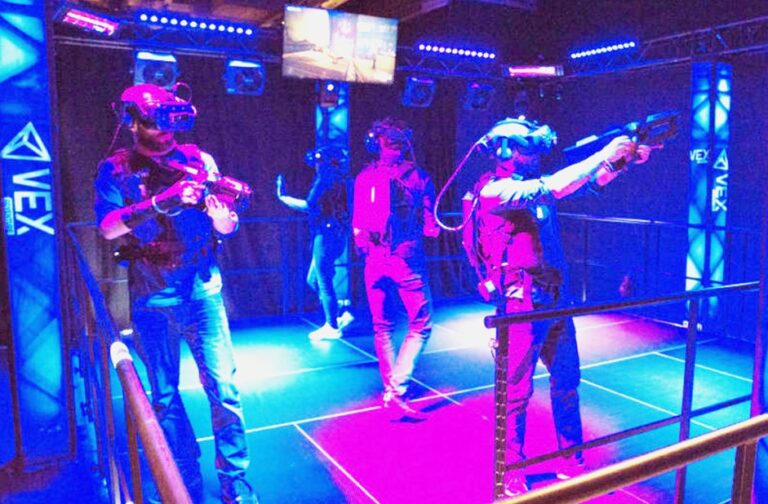
IndoorsThe evolution of virtual reality has transitioned rapidly from seated experiences and home-based headsets to something far more visceral: the free-roam VR arena. Unlike traditional VR, which often tethers a player to a specific spot or limits movement to a confined “guardian” boundary in a living room, free-roam VR (also known as warehouse-scale VR) allows users to physically walk across a vast, open space. As they move, their digital avatars move in perfect synchronization within the virtual world. This technology effectively removes the invisible walls of the physical environment, creating an immersive experience that blurs the line between reality and simulation.
A free-roam VR arena is an expansive, purpose-built facility designed to facilitate untethered movement. These arenas utilize a combination of sophisticated hardware, including high-end VR headsets, lightweight wearable computers (often worn as backpacks to eliminate the risk of tripping over cables), and advanced optical tracking systems.
The core principle behind these arenas is “full-body tracking.” Infrared cameras mounted around the ceiling capture the precise location of the player and their equipment in real-time. This data is fed into a game engine that renders the virtual environment, ensuring that when the user takes a step forward in the physical arena, they move forward in the game world. Because the physical boundaries of the arena are mapped to the digital world, players can navigate through sprawling virtual landscapes, climb digital mountains, or explore alien planets without ever bumping into a wall. It is the closest humanity has come to achieving the “holodeck” concept popularized in science fiction.
The versatility of free-roam VR lies in its ability to transport players into virtually any timeline, dimension, or climate. Because the environment is entirely digital, the same physical warehouse can transform from a zombie-infested apocalypse to a futuristic space station in seconds.
Popular scenarios range from high-stakes cooperative shooters, where friends must coordinate their tactics to defend a base against waves of invaders, to puzzle-solving escape rooms that require players to manipulate objects in 3D space. Some experiences emphasize exploration, allowing players to walk through hyper-realistic historical recreations or surreal, abstract landscapes where the laws of physics are merely suggestions. Horror scenarios are particularly effective in these arenas; the physical act of walking down a dark, narrow corridor in a virtual haunted house generates a level of adrenaline that a seated experience simply cannot replicate. By enabling users to touch the virtual walls or walk across virtual bridges, these scenarios engage the vestibular system, keeping the brain fully convinced of the reality of the experience.
While early iterations of VR were often seen as a niche interest for tech enthusiasts, free-roam arenas have successfully democratized the technology. Today, the demographics span almost every age and interest group.
One of the most rapidly growing segments is youth engagement. VR for kids has moved beyond simple educational simulations into high-octane, social gaming. Because free-roam VR requires physical activity, it is often viewed by parents as a more active, healthier alternative to traditional console gaming. It promotes teamwork, communication, and spatial awareness. Safety protocols in professional arenas—such as padded walls, constant supervision by trained staff, and age-appropriate content filters—ensure that children can enjoy the experience without the risks associated with unmonitored home VR setups.
The social nature of free-roam VR makes it a premier destination for milestone events. Traditional parties often rely on passive entertainment, but a VR arena places the guest of honor and their friends at the center of the action.
For a birthday party, the arena offers a unique, unforgettable experience that stands out from standard venues like bowling alleys or arcades. It provides a shared bond of adventure that naturally encourages social interaction. Graduation parties have also adopted this trend, as it provides a sophisticated, high-tech environment for young adults to celebrate their transition to a new phase of life.
However, the corporate world has perhaps found the most practical use for these facilities. Corporate team-building exercises in VR are highly effective because they force groups to communicate under pressure. Whether navigating a complex virtual labyrinth or managing a simulated emergency situation, teams must rely on one another to succeed. This breaks down departmental silos and fosters cooperation in a way that tired trust-fall exercises never could. It is an investment in human capital that feels like an exciting reward rather than a mandatory workshop.
The academic and industrial consensus on free-roam VR is overwhelmingly optimistic, though it is tempered by a focus on long-term development and human factors. Scientists studying human-computer interaction (HCI) are particularly interested in the phenomenon of “presence”—the psychological feeling of being in a virtual space despite knowing one is in a simulation. Studies have shown that when physical movement is matched to virtual movement, the brain’s ability to process the environment as “real” increases significantly, leading to faster learning curves and deeper emotional responses.
Industry experts see free-roam VR as a critical building block for the future of the “metaverse.” By standardizing how humans move and interact in digital spaces, these arenas serve as training grounds for the next stage of digital socialization and professional labor. Researchers are currently exploring how to integrate haptic feedback—suits that allow players to “feel” impacts or resistance—into the free-roam experience, which would add yet another layer of realism to the simulation.
Furthermore, medical and psychological researchers are investigating the therapeutic potential of these arenas. Applications range from treating phobias (through exposure therapy) to assisting in physical rehabilitation for patients who have lost certain motor functions. By gamifying physical therapy in a stimulating, free-roam environment, patients are more likely to comply with rigorous exercise routines, leading to better clinical outcomes.
In conclusion, the free-roam VR arena has evolved from a futuristic dream into a tangible, high-impact reality. By bridging the gap between physical exertion and virtual immersion, it has created a new category of entertainment and training that appeals to everyone from children to corporate executives. As the hardware becomes lighter, the graphics more realistic, and the possibilities more expansive, these arenas are set to become as common in our cities as movie theaters, serving as the gateways to the infinite possibilities of the virtual world.


 5918 Brainerd Rd, Chattanooga, TN 37421, United States
