
 El Monte
 Log in
Log in
Log in

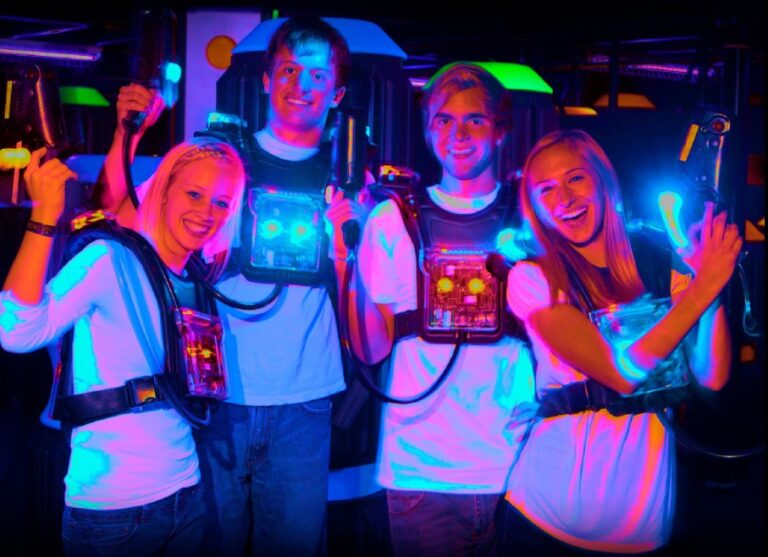
This 50,000-square-foot indoor family fun center is the largest in the Northland, offering multi-level laser tag with multiple game scenarios, a Minnesota-exclusive Omni VR Arena for immersive 360-degree active gameplay, the North Shore 9 mini golf course, three indoor batting cages using the ATEC Major League system, a large video and redemption arcade with over 60 games, and a Kid’s Cove inflatable playground. The center also shares space with Vertical Endeavors rock climbing walls and features an on-site Pizza Cafe for refueling between activities.
Adventure Zone serves as a party headquarters with multiple tiered room locations for birthdays, graduations, lock-ins, and corporate events. Group packages are available for schools (minimum 15 persons), businesses, and sports teams, with team building activities designed to encourage collaboration. The facility can accommodate groups of 45 or more, offers two meeting rooms with on-site catering, and runs community programs like the annual Tickets for Tots toy drive. Daily deals and multi-play passes provide flexible options for casual visitors and regulars alike.
 Indoors
For decades, the promise of virtual reality was tethered to a chair, a controller, and the constant fear of tripping over a tangled power cord. But the landscape of digital immersion has shifted. Enter the free-roam VR arena: a space where the physical walls disappear, and your body becomes the controller. No teleporting, no joysticks—just you, your team, and a world where the only boundary is how far you can run.
A free-roam VR arena (often called “Warehouse-scale VR”) is a large, open-floor space equipped with sophisticated motion-capture technology. Unlike home VR systems that rely on stationary sensors, these arenas use overhead cameras, laser tracking, and high-performance wearable backpacks or standalone headsets to map your movement in real-time within a physical space often spanning thousands of square feet.
The magic lies in 1:1 movement. When you take a step in the real world, you move a step in the simulation. This elimination of “artificial locomotion”—the primary cause of motion sickness—creates a sense of “presence” that is biologically indistinguishable from reality. In these arenas, you don’t just watch a movie; you inhabit a persistent, interactive playground.
The versatility of free-roam VR allows developers to craft scenarios that feel like stepping into a blockbuster film. Because you are physically walking through the environment, the narrative stakes feel exponentially higher. Common scenarios include:
While these arenas were once the domain of hardcore tech enthusiasts, they have become a staple of modern family entertainment.
VR for kids has become a massive draw, provided the equipment is sized correctly. It’s an incredible developmental tool that encourages physical activity, spatial awareness, and problem-solving. Unlike staring at a tablet screen, free-roam VR demands that children move, communicate, and work as a team. For parents, it’s a guilt-free digital experience: it’s screen time that actually requires burning calories and building social bonds.
The “experience economy” has moved away from passive entertainment. People don’t want to just sit and eat; they want to do. This is why free-roam VR has become the premier choice for special events:
The consensus among neuroscientists and tech pioneers is clear: free-roam VR is the “holy grail” of human-computer interaction.
Neuroscientists point to the concept of Proprioception—our body’s ability to sense movement and location. Because free-roam VR aligns our visual input with our actual physical movement, the brain stops trying to “decode” the simulation and simply accepts it. This makes it an incredibly powerful tool not just for play, but for training surgeons, fire departments, and military personnel in high-stress, low-risk environments.
Industry experts believe we are only seeing the tip of the iceberg. As haptic technology (wearable vests that let you feel impacts or wind) and photorealistic rendering continue to advance, the distinction between a “game” and “the real world” will continue to blur. They argue that as these arenas become more accessible and localized, they will eventually replace local bowling alleys and movie theaters as the primary hubs for social, active entertainment.
Free-roam VR is no longer just a gimmick. It is the evolution of the human social experience—a place where we can step out of ourselves and rewrite the rules of reality, one step at a time.


 329 S Lake Ave, Duluth, MN 55802, United States