El Monte
 Log in
Log in
Log in

Laser City Edmonton Indoor Center is located in Edmonton, AB.
Laser City is Edmonton’s newest and best laser tag facility! Laser tag, Mini Paintball (real paintball for ages 8-12), VR Escape Rooms.
Laser City boasts cutting-edge laser tag arenas where players can immerse themselves in futuristic battles. The high-tech equipment and exciting game modes guarantee an unforgettable experience every time. For younger participants aged 8-12, the Mini Paintball offers a safe yet authentic paintball experience. Additionally, Laser City’s VR Escape Rooms transport players into virtual worlds where they must solve puzzles and overcome challenges to escape.
One of the standout features of Laser City is its expertise in hosting a wide range of events. Whether you’re planning a Birthday Party, a Youth Group Event, Corporate Team Building, or a Sport Team Season Wrap-Up, Laser City is the ideal venue. The facility can comfortably accommodate groups ranging from 10 to 100 participants, ensuring that everyone has a blast.
 Indoors
FunnyVrGames Indoor Center is located in Edmonton, AB.
This unique establishment offers a kaleidoscope of excitement, seamlessly blending immersive virtual reality experiences with a range of thrilling arcade games that promise to captivate visitors of all ages.
FunnyVrGames is renowned for hosting unforgettable birthday parties, transforming ordinary celebrations into magical experiences. The dedicated team tailors each party to match the birthday child’s dreams, complete with themed decorations, engaging activities, and exclusive access to the venue’s myriad attractions.
A highlight of this dynamic venue is the vibrant playground, featuring an expansive ball pit and a medley of inflatables that invite kids to jump, climb, and explore to their heart’s content. Summer camps at FunnyVrGames are an exceptional opportunity for children to experience a blend of fun, learning, and adventure. Parent’s Night Out events are another gem in the FunnyVrGames lineup, offering parents a well-deserved break while their kids are fully engaged in safe and supervised fun.
Indoors
The VR VOLT Indoor Center is located in in Edmonton, AB.
Nestled in the bustling heart of Edmonton, Alberta, there exists a marvel of modern entertainment known as The VR VOLT. This cutting-edge venue is a gateway to otherworldly adventures where reality blends seamlessly with the digital frontier.
One of the crown jewels of The VR VOLT is the state-of-the-art F1 simulator. The VR VOLT caters to a wide range of racing preferences, providing exhilarating options from high-octane rallying to breathtaking off-road adventures.
Recognizing the importance of life’s special moments, The VR VOLT also specializes in throwing unforgettable birthday parties and custom events. The venue’s dedicated event planners meticulously tailor each gathering to your needs, ensuring that every detail is perfect. From the excitement of the racing simulators to the enchanting variety of virtual reality experiences on offer, your event at The VR VOLT will leave an indelible mark on all who attend.
The VR VOLT is more than just an entertainment venue; it’s a veritable playground of infinite possibilities.
IndoorsGame OVR Indoor Center is located in Edmonton, AB.
At Game OVR in Edmonton, AB, they strive to reimagine a new reality for guests by offering an array of VR experiences that cater to various tastes and interests. Whether you’re delving into the immersive world of Standard VR, navigating the intricate puzzles of VR Escape Rooms, or exploring the boundless freedom of Free Roam VR, there is something tailored for everyone.
Library of VR options is expansive and designed to enthrall. For those new to the technology, knowledgeable staff is always on hand to provide demos, assisting you in unlocking the true potential of VR.
Game OVR has also become a premier destination for corporate events, having successfully hosted hundreds of groups with varying sizes and skill levels. Vast selection of multiplayer games is particularly well-suited for team-building activities.
So, whether you are seeking a thrilling escape from reality, an engaging team-building exercise, or simply a novel way to spend an afternoon, Game OVR in Edmonton, AB is your gateway to endless virtual adventures.
Indoors
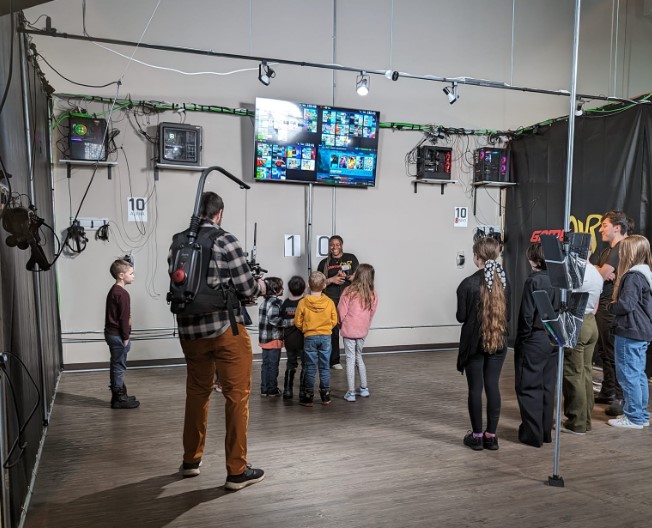
A free‑roam virtual‑reality arena is a purpose‑built physical space where participants can move unhindered while wearing a head‑mounted display (HMD). Unlike seated or tethered VR setups, the arena removes the constraints of cables and limited play areas, allowing users to walk, run, jump, duck, and interact with virtual objects as if they were truly inside the digital world. The environment is typically equipped with a network of motion‑tracking cameras or sensors, floor‑mounted markers, and safety‑netting or padded walls to protect users from collisions. The tracking system constantly relays precise positional data to the VR software, ensuring that the virtual representation of the user mirrors their real‑world motions with sub‑centimeter accuracy.
The design philosophy behind free‑roam arenas is to blur the line between physical and digital spaces. By giving people the freedom to explore a three‑dimensional virtual landscape at their own pace, these venues create experiences that feel more immersive than conventional arcade‑style VR cabinets or home headsets. The result is a compelling blend of physical activity, social interaction, and narrative storytelling that can be tailored for entertainment, education, training, or research.
The flexibility of an open‑space environment lends itself to a wide variety of scenarios, each exploiting the ability to move naturally within a virtual world. Some of the most popular categories include:
| Scenario Type | Typical Experience | Key Technological Requirements |
|---|---|---|
| Adventure/Exploration | Users trek through alien planets, ancient ruins, or deep‑sea caverns, solving puzzles and uncovering hidden artifacts. | High‑resolution world rendering, robust locomotion mechanics, dynamic lighting. |
| Action & Combat | Participants wield laser swords, futuristic firearms, or magical staffs to battle AI opponents or other players in arena‑style matches. | Low‑latency tracking, responsive haptic feedback, real‑time multiplayer networking. |
| Co‑operative Missions | Small teams collaborate to diffuse bombs, rescue virtual civilians, or navigate complex mazes. | Precise avatar synchronization, voice chat integration, shared object manipulation. |
| Educational Simulations | Students walk through a reconstructed Roman forum, dissect a virtual heart, or conduct chemistry experiments without safety hazards. | Accurate scientific modeling, contextual information overlays, assessment tools. |
| Fitness & Sports | Players engage in virtual boxing, obstacle‑course runs, or rhythm‑based dancing that tracks calories burned. | Real‑time body‑tracking, performance analytics, adaptive difficulty scaling. |
| Narrative Storytelling | Immersive theater pieces where the audience becomes part of the plot, making choices that affect the outcome. | Branching narrative engine, dynamic NPC behavior, spatial audio cues. |
These scenarios are not mutually exclusive; many venues blend elements to create hybrid experiences that keep repeat visitors engaged. The underlying common denominator is the freedom to move – a factor that dramatically enhances presence and emotional impact.
Free‑roam VR appeals to a surprisingly diverse audience. Demographic studies from major operators show that visitors typically fall into several broad categories:
The overarching thread linking these groups is a desire for an experience that feels both physically active and mentally stimulating—something that traditional video games or passive attractions cannot deliver.
When it comes to younger audiences, free‑roam VR offers a uniquely safe platform for exploration. Operators typically implement age‑specific safety protocols: lower‑height barriers, padded floor sections, and simplified control schemes that replace complex button combos with intuitive gestures. Content for children emphasizes bright colors, whimsical worlds, and learning outcomes. For instance, a “Dinosaur Safari” adventure lets kids wander through a prehistoric jungle, identifying species and learning facts presented via floating text panels.
Because the arenas are supervised by trained staff, parents can relax knowing that motion sickness is mitigated through short session lengths and gentle locomotion methods (e.g., teleportation or smooth walking with visual cues). Moreover, the social aspect of playing alongside peers fosters cooperative play and communication skills. In educational contexts, teachers have reported increased retention rates when lessons are delivered through immersive VR, as the embodied learning experience creates stronger memory associations.
A birthday celebration in a free‑roam arena transforms a typical party into an unforgettable adventure. Packages often include a themed scenario—such as “Space Rescue Mission” or “Pirate Treasure Hunt”—where the birthday child leads a squad of friends through a narrative quest. The venue handles equipment fitting, safety briefings, and post‑game photo packages, allowing parents to focus on the festivities. Customizable avatars and celebratory visual effects (e.g., virtual fireworks) add a personal touch that extends beyond the physical décor of a conventional party hall.
Graduates seeking a modern twist on the traditional ceremony can host a “Future Vision” event where attendees don VR headsets and walk through a simulated campus of their aspirations—whether that’s a research laboratory, a startup office, or a space colony. The experience can be paired with live streaming of the real‑world ceremony, creating a hybrid celebration that honors past achievements while looking forward to the next chapter. The immersive format encourages networking among attendees, as they interact in a shared virtual environment before returning to the physical venue for speeches and receptions.
Corporate gatherings benefit from free‑roam VR through a blend of entertainment and professional development. Companies often book the arena for holiday parties, product launches, or strategic retreats. Scenarios can be tailored to reinforce brand values—such as “Innovation Lab,” where teams prototype virtual products, or “Mission Critical,” a high‑stakes simulation emphasizing decision‑making under pressure. The physical activity also serves as a wellness perk, offering employees a break from desk‑bound routines and promoting a culture that values innovative technology.
The scientific community has taken a keen interest in the capabilities of free‑roam VR, particularly in fields where spatial cognition, motor control, and human‑machine interaction intersect. Researchers at leading universities have published studies demonstrating that immersive locomotion in these arenas can improve balance and proprioception in elderly participants, suggesting therapeutic applications for fall prevention.
Neuroscientists note that the congruence between visual and vestibular cues in a free‑roam environment activates brain regions associated with place cells and grid cells, which are critical for navigation and memory formation. This alignment is harder to achieve with seated or treadmill‑based VR, where sensory conflicts can lead to motion sickness.
From an industry standpoint, experts highlight several strategic advantages:
Critics, however, caution against over‑reliance on immersive technology without rigorous safety standards. They argue that prolonged exposure to high‑intensity virtual environments could lead to fatigue or disorientation if not properly managed. In response, industry bodies are developing certification guidelines that cover hardware ergonomics, session length recommendations, and emergency stop protocols.
Overall, the consensus among scientists and experts is that free‑roam VR represents a pivotal step toward truly embodied digital experiences. Its potential to bridge the gap between physical movement and virtual interaction positions it as a key technology for the next decade of both consumer entertainment and professional training.
Free‑roam VR arenas have evolved from niche novelty attractions to versatile platforms that accommodate a broad spectrum of users and use cases. By eliminating the physical constraints of traditional VR, they unlock scenarios that demand natural locomotion, collaborative problem‑solving, and immersive storytelling. Whether a child exploring a dinosaur kingdom, a corporate team strategizing in a futuristic command center, or a researcher studying spatial cognition, the arena offers a safe, supervised, and highly engaging environment.
The growing interest from educational institutions, event planners, and scientific communities underscores the technology’s adaptability. As tracking accuracy improves, hardware becomes more ergonomic, and content pipelines expand, free‑roam VR is poised to become a staple of modern entertainment, learning, and professional development. For anyone seeking an experience that feels simultaneously physical, social, and fantastically virtual, stepping into a free‑roam arena may well be the next logical stride.


 5104 67 Ave NW Edmonton, AB T6B 3N9