
 El Monte
 Log in
Log in
Log in

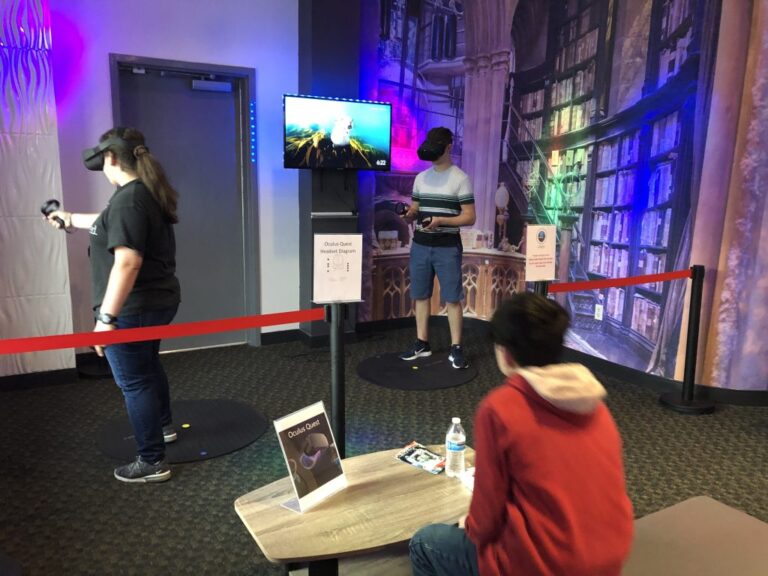
Planet VR is located at 2800 W. Pinhook Rd. in Lafayette, LA, right at the corner of Verot School Road across from Surge Entertainment. This indoor virtual reality amusement park features over 9 attractions and more than 300 games and experiences, including roller coasters, race car simulators, waterslides, flight simulators, hand gliding, a 4-person VR escape room, a motorcycle experience, and full-scale multiplayer rooms. Guests can choose from timed play bands or unlimited access, and the park also offers a mobile VR unit for off-site events.
Beyond the gaming floor, Planet VR provides a private party room, catering options, a lounge and recreation area, and food and drinks on-site. The venue is well-suited for birthday parties, corporate events, team-building activities, and group outings of all kinds. With a friendly and experienced staff, a 4.7-star Facebook rating, and a welcoming atmosphere, it has become a favorite indoor destination for families, friends, and coworkers in the Lafayette area.
 Indoors
For decades, the concept of virtual reality was confined to a stationary experience—a gamer sitting in a swivel chair, tethered to a powerful PC, limited by the length of a cable and the boundaries of a physical room. Today, that limitation has vanished. Enter the free-roam VR arena, a revolutionary evolution in entertainment that allows players to physically walk, run, and interact within a digital world without being hindered by wires or static positions. By turning physical movement into digital action, free-roam VR is redefining how humans play, collaborate, and experience technology.
A free-roam VR arena is a purpose-built physical space designed to allow multiple players to move freely while wearing wireless VR headsets. Unlike traditional home setups, these arenas utilize sophisticated motion-tracking technology, such as optical cameras mounted on ceilings or high-precision sensors, to translate every step, duck, and turn the player makes into the virtual environment.
These arenas are typically large, open-floor spaces cleared of physical obstructions. Because the play area is mapped precisely to the digital landscape, players can walk for miles inside a virtual world while staying within the safety of the physical perimeter. Advanced haptic feedback systems—such as wearable vibration vests or specialized prop weapons—are often integrated to enhance the sensory experience. When a player reaches out to touch a virtual wall or feels a simulated impact, the combination of physical movement and haptic feedback creates a phenomenon known as “presence,” where the brain truly begins to believe it has been transported to another reality.
The power of the free-roam arena lies in its ability to facilitate complex, highly interactive scenarios that home gaming cannot replicate. Developers utilize this technology to offer a diverse range of experiences that cater to different interests and intensity levels.
One of the most popular genres is the “zombie survival” scenario. In these setups, players are placed in a dark, atmospheric environment—such as a ruined city or an abandoned research station—where they must coordinate as a squad to fend off waves of virtual enemies. Unlike a classic arcade game, the player must physically move to find tactical cover, reload their weapon by reaching for a holster on their belt, and physically signal teammates.
Beyond combat, free-roam VR offers immersive escape room experiences. These scenarios emphasize puzzles and exploration rather than adrenaline. Players might find themselves working together to repair a spaceship in orbit, solve ancient riddles in a lost temple, or navigate a surreal, dreamlike fantasy world. Because these scenarios allow multiple people to inhabit the same space, the shared sense of wonder transforms a digital puzzle into a deeply bonding social encounter.
The demographic for free-roam VR is expanding rapidly, moving well beyond the traditional “hardcore gamer” stereotype. Because these arenas prioritize physical intuition—if you see a door, you walk through it; if you see an object, you pick it up—the learning curve is remarkably flat.
Children, in particular, have become enthusiastic participants in the free-roam VR movement. For kids, the technology serves as a bridge between the imagination and reality. Educators and child psychologists have noted that VR can be a powerful tool for developing spatial reasoning and collaborative skills. When children enter a VR arena, they aren’t just staring at a screen; they are engaging in physical activity that requires communication and teamwork. Many arenas have introduced family-friendly content, replacing intense combat scenarios with educational adventures, nature exploration, or lighthearted obstacle courses. When managed with age-appropriate time limits and curated content, free-roam VR provides an active, imaginative outlet that feels far more constructive than passive media consumption.
The social nature of free-roam VR has made it a premier destination for milestone events. Traditional parties often rely on passive activities, but a VR arena forces participants to engage with one another actively.
For birthday parties, it offers a “hero moment.” Whether it is a child’s tenth birthday or an adult’s thirtieth, stepping into an arena allows the guest of honor to become the protagonist of their own movie. It shifts the party from simply eating cake in a room to embarking on a shared adventure that will be the topic of conversation long after the party ends.
For graduations, it serves as a unique way to celebrate a transition into a new chapter, acting as a high-tech “final quest” for a group of friends. However, the most surprising growth has been in the corporate sector. Companies are increasingly turning to free-roam VR for team-building events. Traditional team-building exercises can sometimes feel forced or tedious, but in a VR arena, the challenges are immediate and engaging. A team that must communicate clearly to escape a crumbling virtual environment develops trust and rapport in a way that translates back to the office. It flattens the hierarchy: in the virtual world, the CEO and the intern are equally dependent on each other to survive, fostering a unique sense of camaraderie.
From an academic and industrial perspective, free-roam VR is viewed as a foundational technology for the next generation of human-computer interaction. Scientists are particularly interested in the concept of “kinesthetic learning,” where the physical exertion required in the arena helps users retain information and skills more effectively than traditional digital mediums. Research centers are currently exploring how this form of VR can be used for vocational training, such as preparing firemen for hazardous scenarios or helping surgeons practice complex procedures in a risk-free, room-scale simulation.
Industry experts believe we are currently in the “early adopter” phase of a much wider revolution. They argue that as tracking technology becomes smaller, cheaper, and more accurate, the “arena” will no longer be limited to dedicated facilities. We are moving toward a future of “untethered” spaces where public parks, classrooms, or even living rooms could eventually support high-fidelity, free-roam experiences.
Furthermore, experts highlight that the psychological impact of free-roam VR is profound. By decoupling the sensation of movement from the body’s actual location, users can experience profound empathy—seeing the world through someone else’s eyes or experiencing the environment of a distant climate. While the industry acknowledges challenges—such as the need for better motion-sickness mitigation and the refinement of ergonomic hardware—the consensus is that free-roam VR has successfully moved beyond a gimmick. It is now a legitimate, scalable, and increasingly influential medium that is fundamentally changing how we define play, work, and community in the 21st century.


 2800 W Pinhook Rd Suite 1, Lafayette, LA 70508, United States