
 El Monte
 Log in
Log in
Log in

WE ‘R’ VR is located inside the St. Charles Towne Center mall in Waldorf, Maryland, next to Dick’s Sporting Goods.
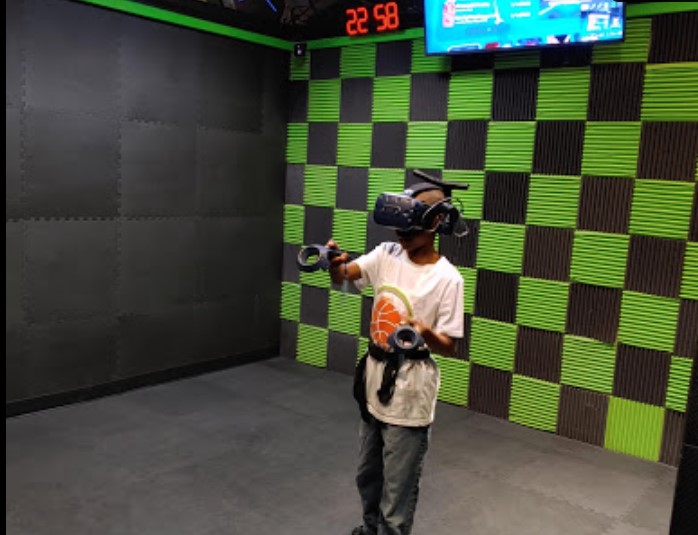
This is a high-end wireless room-scale virtual reality center with four VR booths and headsets. Guests can choose from a wide range of experiences including zombie shooters, underwater adventures, robot battles, and VR escape rooms. The center caters to individuals, families, and groups, with options for single-player and multiplayer gaming. A veteran-owned business, it offers a welcoming atmosphere for both first-timers and experienced gamers, with staff on hand to assist with equipment and game selection.
The venue includes a dedicated party room that can comfortably seat about ten people, making it suitable for birthday parties, corporate events, holiday gatherings, and team-building activities. Guests are welcome to bring their own decorations and food. The center also offers a discount for military service members and law enforcement officers. With its mall location, it is easy to combine a VR session with shopping or dining.
 Indoors
A free‑roam virtual‑reality arena is a physical space that combines the immersive power of head‑mounted displays with a real‑world environment designed for unrestricted movement. Unlike seated or tabletop VR setups, a free‑roam arena removes the tether that normally confines a player to a single spot. The arena is fitted with a network of infrared or optical tracking sensors that monitor every headset, controller, and sometimes even the user’s body in three dimensions. This data is fed to a high‑performance computer or a cluster of machines that render a seamless virtual world in real time.
Because the tracking system knows exactly where each player is, the virtual experience can reflect that location with millimetre precision. Users can walk, duck, jump, and even climb within the confines of the arena, and the virtual environment reacts as though those actions were happening in a true physical space. The result is a level of presence that feels more like stepping into a new world than merely looking at a screen.
Free‑roam arenas often incorporate safety measures such as padded walls, soft flooring, and real‑time collision alerts to protect participants. The space can be scaled from a modest 800‑square‑foot room to a full‑size warehouse, allowing one‑person experiences or multiplayer adventures that involve teams of ten, twenty, or more players simultaneously.
The flexibility of a free‑roam arena lends itself to a broad spectrum of scenarios, each crafted to exploit the freedom of movement. Below are some of the most popular categories:
Story‑driven experiences place participants in a cinematic plot where they must solve puzzles, interact with virtual characters, and make choices that affect the outcome. Because the arena tracks physical gestures, a player might physically pull a lever, open a virtual door with a hand gesture, or crawl through a low tunnel, turning storytelling into kinetic play.
Virtual sports such as sword‑fighting duels, laser tag, or futuristic racetracks translate real‑world athleticism into a digital arena. Players can sprint, dodge, and throw virtual projectiles while the system records scores, leaderboards, and performance metrics. The physical exertion makes these games appealing to fitness‑focused crowds.
Team‑based challenges require groups to collaborate in order to complete objectives. Examples include defusing a virtual bomb, navigating a maze while avoiding hazards, or rescuing virtual hostages. Communication and coordinated movement become crucial, fostering teamwork in a way that static VR cannot.
Academic institutions and corporate trainers employ free‑roam VR for immersive learning. A chemistry class can walk through a molecular lattice, a history lesson can place students inside an ancient city, and a medical training session can let future surgeons practice procedures without risk.
Open‑ended sandbox environments allow users to build, paint, or sculpt in three dimensions. The freedom to walk around a virtual sculpture or step inside a self‑designed house makes creative expression more tactile and intuitive.
Some arenas blend physical props with virtual objects. A real sword may be tracked and appear as a glowing lightsaber in the virtual world, creating a hybrid experience that feels both magical and grounded.
These scenarios are continually expanding as developers discover new ways to integrate movement, haptics, and narrative. The core advantage remains the same: users are not limited to a chair; they can move as naturally as they would in the real world.
The audience for free‑roam VR is remarkably diverse. While early adopters were primarily tech enthusiasts and hardcore gamers, the market has broadened to include families, corporate groups, educational institutions, and even senior citizens seeking low‑impact exercise.
The common thread among these groups is a desire for immersive, interactive experiences that go beyond passive observation. Free‑roam VR satisfies that craving by turning the body itself into a controller.
When it comes to children, free‑roam VR offers several distinct advantages over traditional screen‑based entertainment.
Arena operators typically install soft padding, rounded corners, and low‑height ceilings to protect young explorers. The tracking system can also enforce virtual boundaries, warning a player when they approach a wall or an obstacle. This dual‑layer safety approach allows kids to move freely while minimizing the risk of bumps or bruises.
Content libraries are curated to match developmental stages. For younger children, simple puzzles, interactive storybooks, and colourful animal worlds dominate the lineup. Older kids can tackle more complex missions involving strategy, teamwork, and mild competition.
Free‑roam VR encourages movement that would otherwise be sedentary. A game that requires ducking under virtual arches, stepping over laser grids, or swinging virtual batons translates into genuine aerobic exercise. Parents and educators view this as a healthy alternative to conventional video games.
Because the arena supports multiple users simultaneously, children can play alongside friends or classmates. The shared experience promotes communication, cooperation, and empathy—skills that are often limited in single‑player VR setups.
Learning modules embed curriculum‑aligned objectives. For instance, a virtual archaeology dig teaches geology and history, while a space‑exploration scenario introduces basic physics concepts. The immersive nature of VR helps children retain information by tying abstract ideas to vivid, interactive experiences.
Overall, free‑roam VR provides a safe, engaging, and educational playground that aligns with modern parents’ desire for technology that adds value rather than merely occupies screen time.
The adaptability of a free‑roam arena makes it an increasingly popular venue for a range of celebratory occasions. Whether it’s a birthday party, a graduation ceremony, or a corporate gathering, VR can be tailored to fit the theme, budget, and audience.
For a child’s birthday, the arena can transform into a whimsical realm—perhaps a pirate ship on a digital ocean, a magical forest filled with friendly creatures, or a superhero training ground. Party hosts can schedule a series of short, age‑appropriate missions that keep the excitement high while allowing all guests to participate. The immersive nature of the experience ensures that the birthday child receives a memorable adventure rather than a typical cake‑and‑games routine.
Graduates often seek experiences that symbolize transition and achievement. A free‑roam arena can craft a “future‑city” scenario where participants navigate a skyline representing their career aspirations, or a time‑travel adventure that revisits pivotal moments from their academic journey. Group challenges can foster camaraderie among the graduating class, and custom branding—such as school colors or logos—can be projected onto virtual elements, turning the arena into a living tribute.
Businesses leverage free‑roam VR for both festive and functional purposes. A corporate party might feature a themed tournament (e.g., “Space Mission: Company Quest”) where employees compete in teams, earning points that translate into real‑world rewards. On the team‑building side, facilitated sessions can focus on problem‑solving, communication, and leadership. The physicality of the arena breaks down hierarchical barriers, as executives and staff alike share the same virtual space, forced to collaborate on equal footing.
Companies can integrate their branding directly into the virtual environment. Logos appear on virtual billboards, product prototypes can be showcased as interactive objects, and promotional messages can be woven into the storyline. This creates a memorable marketing touchpoint that resonates more deeply than static advertisements.
Event organizers typically book the arena for blocks ranging from a couple of hours to a full day. Packages often include a dedicated facilitator, equipment setup, and post‑event analytics (e.g., number of participants, average playtime). Catering, decorations, and music can be arranged in the physical space surrounding the arena, allowing the VR experience to blend seamlessly with traditional party elements.
By offering a venue that merges physical presence with digital wonder, free‑roam VR adds a distinctive, forward‑thinking dimension to any celebration. Guests leave not only with photographs and souvenirs but also with vivid memories of an adventure they actually lived through.
Free‑roam virtual‑reality arenas have evolved from niche tech curiosities into versatile spaces that cater to a broad spectrum of users and events. Their defining feature—unrestricted physical movement within a meticulously tracked virtual world—opens the door to storytelling, competition, education, and celebration in ways that static VR cannot achieve.
From narrative quests that plunge participants into fantastical realms, to cooperative missions that sharpen teamwork, to kid‑friendly adventures that combine safety with active learning, the possibilities are limited only by imagination. The audience now spans teenagers, families, corporations, educators, and health professionals, each finding unique value in the immersive, kinetic experience.
For special occasions, the arena transforms into a customizable stage where birthdays become epic voyages, graduations turn into symbolic journeys, and corporate events blend fun with functional team‑building. As technology continues to advance—improving tracking precision, haptic feedback, and content creation—the allure of free‑roam VR is set to grow even stronger.
In an era where experiential entertainment is prized above passive consumption, free‑roam VR arenas stand out as a compelling medium that invites participants not just to watch a story, but to step inside it, move through it, and shape it with their own bodies. The future of immersive entertainment, education, and social interaction may well be found in these dynamic, boundary‑less spaces.


 11110 Mall Cir, Waldorf, MD 20603, United States