El Monte
 Log in
Log in
Log in

VR Oversea Indoor Game Room is located in Montreal, QC.
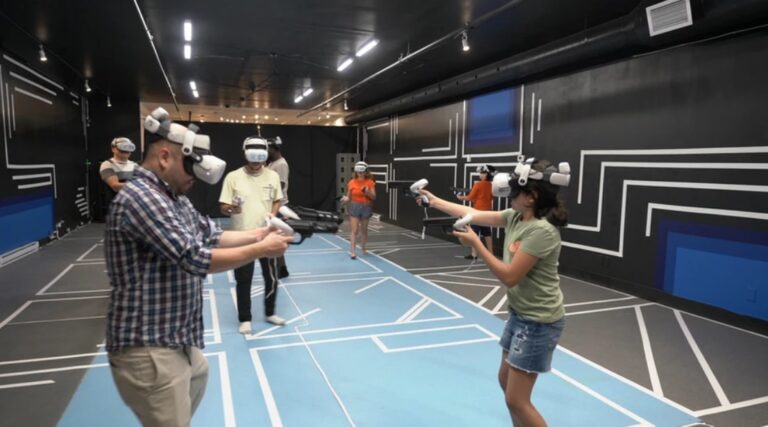
Nestled in the vibrant city of Montréal, QC, VR Oversea is a cutting-edge startup that has gone beyond the traditional boundaries of gaming to redefine what virtual reality can offer. Specializing in free-roaming multiplayer virtual reality experiences, VR Oversea opens up an entirely new realm of sports competition, pushing both the technology and its participants to their limits. Unlike the solitary nature of most gaming experiences, VR Oversea immerses players in a shared, hyper-realistic world where they can engage in thrilling competitions with friends, family, or even colleagues. Whether you’re the lone wolf looking for a free-for-all challenge or someone who thrives in a team setting, this innovative startup has something to offer.
At the heart of VR Oversea’s groundbreaking approach is its state-of-the-art equipment and arena. Every element has been meticulously designed to ensure that participants experience a world as lifelike as possible while adhering to stringent safety standards. One of the most remarkable features of VR Oversea is its ability to host multiplayer groups of up to ten people within a sprawling play space that exceeds 110 square meters (1200 square feet).
 Indoors
Zone 15 Indoor Amusement Centre for Laser Tag in Laval, QC, not fare from Montreal, Quebec
Welcome to Zone 15 in Laval, Quebec, the premier destination for the most exhilarating laser tag experience in the Greater Montréal area. At Zone 15, they pride ourselves on offering an unparalleled adventure that pits UP TO 40 PLAYERS against each other in an all-out war of strategy, skill, and excitement.
Zone 15 stands out as the LARGEST AMUSEMENT CENTRE FOR LASER TAG in the Greater Montréal area. Their state-of-the-art facility spans a massive 9,500 square feet and includes a multi-level playing surface designed to challenge players of all skill levels. The environment is carefully crafted to immerse you in a world of excitement with dark zones, strategic vantage points, and intricate layouts that keep the gameplay dynamic and unpredictable.
IndoorsiVR Amusement Indoor Center is located in Saint-Eustache, QC, not fare from Montréal, QC.
Located in the heart of Saint-Eustache, QC, iVR Amusement is a premier destination for anyone in search of an unforgettable virtual reality experience. Situated not far from Montréal, QC, this state-of-the-art venue offers over 16 captivating VR attractions that cater to a diverse range of interests and preferences. Whether you’re into action-packed games, thrilling races, or intricate escape rooms, iVR Amusement has something to captivate your imagination and adrenaline.
One of the standout features of iVR Amusement is its extensive library of popular VR games, each designed to provide a unique and immersive experience.
In conclusion, iVR Amusement in Saint-Eustache, QC, just a short drive from Montréal, QC, is a haven for anyone looking to dive into the exhilarating world of virtual reality. With its extensive range of attractions, affordable pricing, and group packages, it promises a day filled with adventure and fun. So gather your friends, family, or colleagues, and head over to iVR Amusement for an experience like no other – where reality meets imagination, and the thrill is just a headset away.
IndoorsMontVR Indoor Center is located in Montréal, QC.
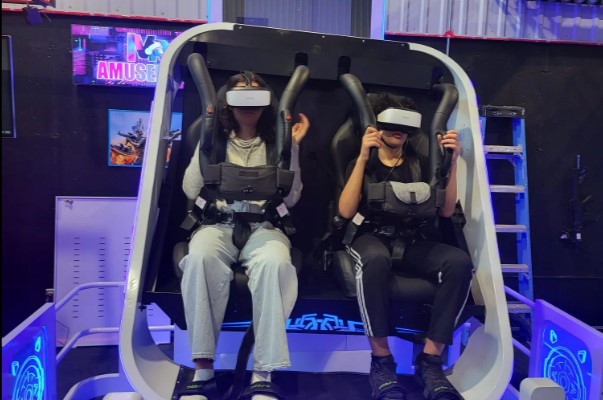
Nestled in the bustling region of Brossard, just a short drive from downtown Montreal, lies MontVR DIX30—a premier entertainment hub that promises a riveting experience for visitors of all ages. A bar, over 70 modern arcade games where you can win prizes, axe throwing, billiards, electronic dart machines, and naturally, the best in virtual reality with multiplayer games and escape games.
VR Gaming Station, Free Roaming Experience, VR Escape Room.
MontVR DIX30 is also a premier location for hosting memorable events: Birthday Parties, Corporate Events
It is more than an entertainment center—it’s a destination that promises exhilaration, socialization, and unforgettable experiences. With its blend of traditional and futuristic attractions, MontVR DIX30 caters to everyone’s sense of adventure and ensures that every visit is nothing short of spectacular.
IndoorsGOGO-VR Indoor Center is located in Montréal, QC.
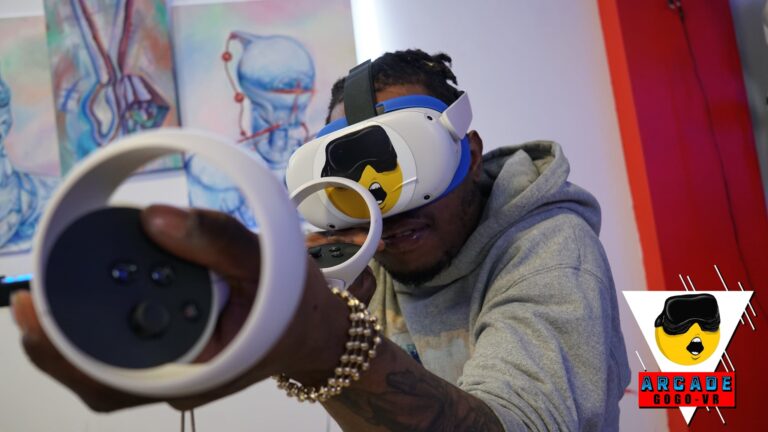
Welcome to GOGO-VR, the first virtual reality arcade in Montreal, where the boundaries between the real and the virtual blur to create unforgettable gaming experiences. Whether you’re an avid gamer or a curious newcomer, GOGO-VR invites you to dive into immersive worlds where only your imagination sets the limits.
At GOGO-VR, they cater to every gamer’s preference. Step into one of their state-of-the-art VR stations and gear up for an adventure like no other. For just $9.99 per person, you can enjoy a quick, exhilarating game lasting 15 to 20 minutes. If you’re in the mood for an extended virtual journey, our hourly rate of $29.99 per person lets you dive deeper into your favorite games.
IndoorsNemesis Indoor Video Game Lounge is located in Montréal, QC.
One of the standout features of Nemesis is its embrace of Virtual Reality (VR) events. The lounge hosts regular VR events that allow participants to dive into immersive experiences, whether it’s battling waves of zombies, exploring fantastical realms, or even participating in VR e-sports tournaments. These events are meticulously organized, featuring cutting-edge equipment and facilitated by knowledgeable staff, ensuring an experience that is as seamless as it is memorable.
INemesis in Montréal, QC, is not just a video game lounge; it is a modern gaming arena that offers an unparalleled experience through its virtual reality events, tailor-made video game birthday parties, and private gaming nights. Its commitment to providing a top-tier gaming environment, coupled with its community-focused initiatives, makes it a standout destination in the heart of Montréal. Whether you’re looking to immerse yourself in the latest VR adventures, celebrate a special occasion in a unique way, or simply enjoy a night of gaming with friends, Nemesis delivers an experience that is second to none.
IndoorsZero Latency Montreal Indoor Center is located in Montreal, QC.
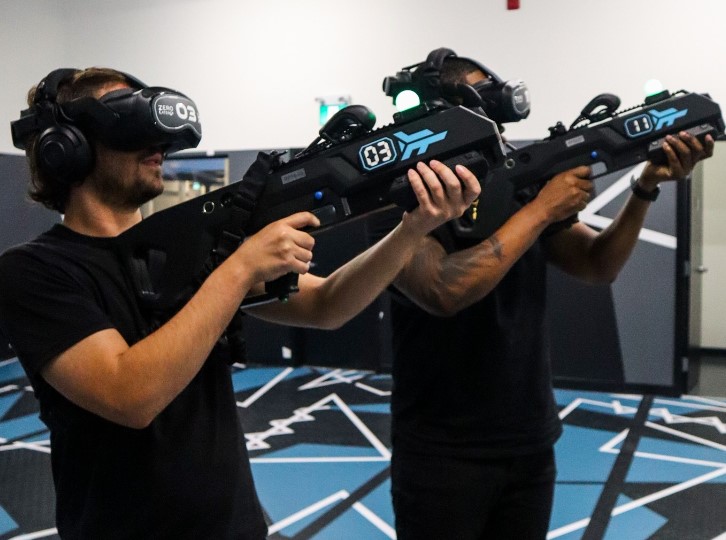
Zero Latency Montreal in Montréal, QC: The Pinnacle of Free Roam Multiplayer Virtual Reality. Nestled in the vibrant heart of Montréal, QC, Zero Latency Montreal offers an unparalleled virtual reality (VR) experience.
The crowning jewel of Zero Latency Montreal’s setup is its expansive playing field. Spanning over 200 square meters (approximately 2200 square feet), the VR arena is a vast playground for adventure seekers. Zero Latency takes multiplayer gaming to an entirely new level. The Montreal location can accommodate groups of up to eight players, making it an ideal activity for friends, family, or corporate team-building events
IndoorsSandbox VR Indoor Center is located in Pointe-Claire, QC, not fare from Montréal, QC.
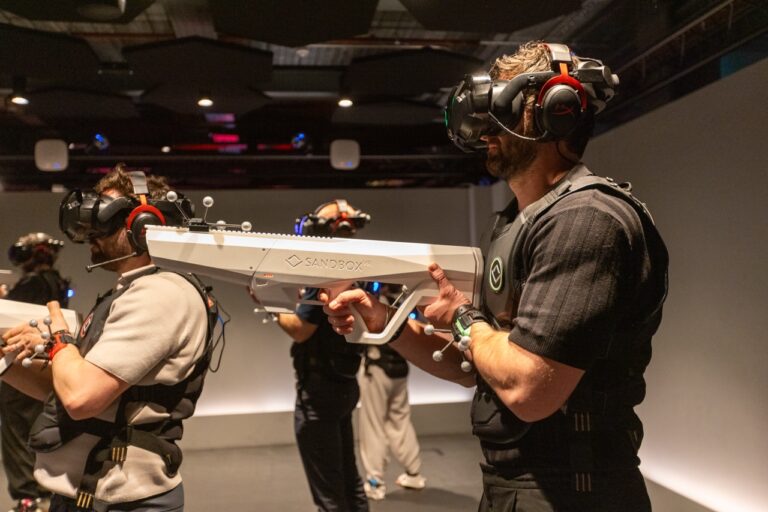
Sandbox VR in Montréal, QC: Immersive Full-Body Experiences. Sandbox VR is a step into the future, offering experiences that are as close as possible to the realms we’ve only imagined in our wildest science fiction fantasies. The magic lies in its ability to transform your real body into your virtual body, creating an uncanny sense of presence and immersion. When fully immersed, the lines between what’s real and what’s virtual blur, creating an experience that is unlike any other.
Sandbox VR isn’t just for individual adventurers looking to escape reality for a few moments. It’s also a fantastic venue for various parties and events that can leave a lasting impression on attendees. The facility is meticulously designed to accommodate a wide range of functions, making it the perfect destination for team-building exercises, birthday parties, and private events.
IndoorsFree‑roam virtual‑reality (VR) arenas are large, purpose‑built spaces where participants can move freely while wearing untethered head‑mounted displays (HMDs). Unlike tabletop or seated experiences that keep the user confined to a small play area, a free‑roam arena removes the physical limits of a traditional living‑room setup. The floor is mapped with motion‑capture sensors, infrared cameras, or lidar systems that constantly track the exact position and orientation of each headset and controller. The arena’s walls are often padded or constructed from soft‑impact materials to keep the environment safe, while the ceiling may be fitted with additional tracking rigs to eliminate blind spots.
The technology behind a free‑roam arena blends high‑fidelity graphics with precise spatial awareness, allowing the virtual world to react in real time to a participant’s steps, jumps, squats, and gestures. Because the HMDs are wireless, users are not tethered to a nearby computer, and the on‑site server rack processes the data and streams the visual feed with latency low enough to maintain immersion. In practice, this means a player can sprint across a digital battlefield, duck under virtual obstacles, or climb a towering structure—all while the real‑world space safely mirrors those movements.
The flexibility of an open‑area environment makes free‑roam VR ideal for a wide range of scenarios. Game designers and experience curators have taken advantage of the technology to create experiences that would be impossible—or at least highly impractical—in a confined room.
Adventure Quests – Participants embark on narrative‑driven journeys that span several minutes of virtual terrain. A prehistoric expedition might have users trekking through a dinosaur‑infested valley, while a sci‑fi odyssey could involve navigating a zero‑gravity space station with full‑body thruster packs.
Sports Simulations – From virtual basketball courts to futuristic hover‑board races, the ability to run, jump, and change direction in real space adds a kinetic realism that traditional console sports games cannot match.
Educational Expeditions – History buffs can walk the streets of ancient Rome, biology enthusiasts can explore the circulatory system from inside a beating heart, and astronomy lovers can roam a simulated Martian landscape while a guide explains geological features.
Team‑Building Challenges – Escape‑room‑style puzzles are reimagined in three dimensions, requiring groups to collaborate physically—handing off virtual objects, synchronizing movements, and solving spatial riddles that rely on real‑world positioning.
Art Installations – Artists use the arena as a canvas for immersive installations, projecting abstract visuals that respond to a visitor’s motion, creating a dance between body and light that blurs the line between observer and artwork.
Each scenario leverages the core advantage of free‑roam: the seamless integration of physical movement with digital response. The result is a deeper sense of presence, a stronger emotional connection to the virtual narrative, and a higher level of physical engagement.
The audience for free‑roam VR is surprisingly diverse. While early adopters were primarily adult gamers seeking a more visceral version of the genre, the demographic has broadened dramatically as the technology has become more accessible and content has diversified.
Hard‑Core Gamers – Enthusiasts who crave the next evolution in interactive entertainment flock to arenas for the sheer thrill of moving through a fully realized game world without the constraints of a stationary play area.
Fitness Buffs – With the rise of “exergaming,” many users treat free‑roam sessions as high‑intensity workouts. The physical exertion required to dodge virtual projectiles or sprint across an imagined battlefield provides cardio benefits while still feeling like play.
Families and Children – Parents appreciate the safety of a padded environment that lets kids experience immersive storytelling without the fear of tripping over cords or furniture.
Corporate Teams – Companies book arenas for employee development programs, using collaborative challenges to teach communication, problem‑solving, and leadership in a memorable format.
Researchers and Educators – Universities and research labs employ arenas to study human motion, spatial cognition, and the psychological effects of immersion, creating a feedback loop that influences future design.
Event Organizers – From birthday parties to product launches, event planners incorporate free‑roam VR as a headline attraction that differentiates their offering from more conventional entertainment options.
The common thread linking these groups is a desire for experiences that combine physicality with digital storytelling—a hybrid that static VR setups simply cannot deliver.
When it comes to children, the appeal of free‑roam VR is twofold: the novelty of stepping into a fantastical world and the reassurance that the environment is purpose‑built for safety. Developers have begun to tailor content specifically for younger audiences, focusing on themes that stimulate imagination while encouraging learning.
Educational modules, for instance, let kids explore ecosystems—walking through a rainforest while interacting with animated animals that provide facts about habitat and diet. Language‑learning adventures place children in a bustling market where they must buy items using a foreign language, reinforcing vocabulary through context and action. Even simple “sandbox” modes let kids manipulate virtual blocks, paint murals in the air, or design their own obstacle courses, fostering creativity and fine‑motor coordination.
Safety protocols are stringent. Headsets are fitted with soft straps, and the software includes “guardian” systems that warn users when they approach the arena’s physical boundaries. Sessions are generally limited to 10‑15 minutes for younger participants to prevent eye strain and motion sickness. Parental dashboards allow guardians to monitor usage, select appropriate content ratings, and even schedule sessions in advance.
The result is a controlled, immersive playground where children can explore, learn, and expend energy—all under the watchful eye of trained staff. Schools and after‑school programs are increasingly adopting free‑roam VR as a supplement to traditional curricula, recognizing its potential to make abstract concepts tangible.
The versatility of free‑roam VR makes it an attractive centerpiece for a variety of celebrations, each benefiting from the arena’s ability to turn a standard gathering into an unforgettable adventure.
Imagine a ten‑year‑old’s birthday where the guests don headsets and become explorers hunting for hidden treasure in an ancient temple, or warriors defending a castle from mythical beasts. The arena can be re‑themed on the fly, allowing multiple short experiences that keep the energy high. Because the space is enclosed and monitored, parents can relax knowing the children are safe while still feeling the excitement of a high‑tech party.
For graduating classes, free‑roam VR offers a symbolic journey. A cohort might walk through a virtual tunnel representing the years of study, emerging on the other side into a celebratory landscape filled with fireworks and personalized messages from faculty. Group challenges can be designed to echo teamwork lessons learned during the academic program, reinforcing bonds as graduates collaborate one final time before stepping into the next chapter.
Corporate events often aim to blend networking with entertainment. A free‑roam arena can host a “virtual hackathon” where teams compete to solve a simulated crisis, or a “future‑of‑work” showcase where employees test prototypes of upcoming products in a realistic environment. The physical movement component encourages mingling; participants naturally gravitate toward one another when tasks require coordinated actions. Moreover, the data gathered from these sessions—such as team dynamics and decision‑making speed—can be analyzed (with consent) to inform organizational development initiatives.
In each of these contexts, the arena’s modular nature means the same hardware can support wildly different themes, making it a cost‑effective investment for venues that host recurring events.
The academic and commercial communities have taken notice of free‑roam VR’s potential, often emphasizing its implications for research, training, and future consumer markets.
Neuroscientists point out that free‑roam VR provides a unique platform for studying spatial navigation and embodiment. Because participants can physically move, researchers can differentiate between brain activity tied to visual perception versus proprioceptive feedback. Studies have shown that the hippocampal activation patterns observed during real‑world navigation are more closely replicated in free‑roam VR than in seated simulations, suggesting higher ecological validity for memory and learning experiments.
Industrial engineers use the technology to evaluate ergonomics and workflow design. By placing workers in a virtual replica of a factory floor, they can observe how people naturally move, locate tools, and avoid obstacles, then iterate designs before committing to costly physical prototypes. The ability to collect precise motion data in real time accelerates the design process and reduces the risk of injury in actual work environments.
Surgeons and emergency responders are experimenting with free‑roam VR for procedural rehearsal. A surgeon can practice a complex operation while physically moving around a simulated operating table, gaining a sense of depth and angle that flat screen or stationary VR cannot provide. In disaster response training, participants navigate chaotic, three‑dimensional virtual rubble, learning to assess hazards and coordinate rescues under realistic physical constraints.
Analysts predict that the free‑roam market will experience compound annual growth rates exceeding 30 % over the next five years. The drivers include decreasing costs of wireless HMDs, advances in inside‑out tracking that reduce the need for extensive external sensor arrays, and a burgeoning library of content that serves both entertainment and enterprise sectors. However, experts also caution that widespread adoption hinges on solving challenges related to scalability—particularly the need for larger, more affordable arena spaces and the development of standards that ensure interoperability across hardware vendors.
Overall, the consensus among scientists and industry leaders is that free‑roam VR is more than a novelty; it represents a convergence point where entertainment, education, and professional training intersect, opening pathways to experiences that are simultaneously immersive, physically engaging, and data‑rich.
Free‑roam VR arenas have evolved from experimental labs into vibrant venues that attract gamers, families, corporations, and researchers alike. By marrying untethered headsets with precise spatial tracking, these arenas break the physical shackles of traditional VR, allowing users to sprint, crouch, and collaborate within richly rendered digital worlds. The breadth of scenarios—from adventure quests and sports simulations to educational journeys and artistic installations—demonstrates the medium’s adaptability.
Children benefit from specially designed, safe experiences that blend learning with movement, while adults find value in immersive fitness, team‑building, and high‑octane entertainment. Event planners leverage the arena’s modularity to transform birthdays, graduations, and corporate gatherings into memorable, interactive spectacles. Meanwhile, scientists and industry experts recognize free‑roam VR as a powerful research tool and a catalyst for next‑generation training solutions.
As hardware becomes more affordable and content libraries expand, the free‑roam VR arena is poised to become a staple of modern entertainment and professional development. The technology invites us to reconceptualize what it means to “step into” a virtual world—no longer a metaphor but a literal, exhilarating reality.


 5777 Boul. Saint-Laurent, Montreal, QC H2T 1S9, Canada