El Monte
 Log in
Log in
Log in

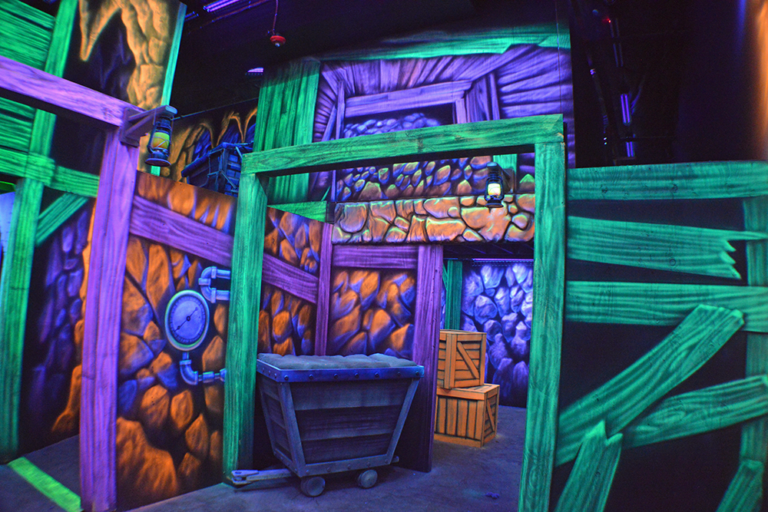
Gresham Cinema & Wunderland sits in the Rockwood area of Gresham, Oregon, along NW Burnside Road, a short drive east of Portland. It is a family-run entertainment center that combines a discount movie theater, a classic nickel arcade with roughly 100 games, and a two-level, 5,500-square-foot laser tag arena themed as an old western town and lost mine. Guests can also enjoy Hologate VR, an XD Dark Ride, a black-light mini golf course, go-karts, and escape rooms, all under one roof.
Beyond the attractions, the venue offers a dedicated party area and an online booking system, making it a natural fit for birthdays, school groups, and corporate team-building events. The staff are known for being patient with younger players, and a comfortable game room and lounge area lets guests relax and grab a snack between activities. With everyday low pricing and a movie admission that includes general admission to the rest of the venue, it is an affordable outing for families of all ages.
 Indoors
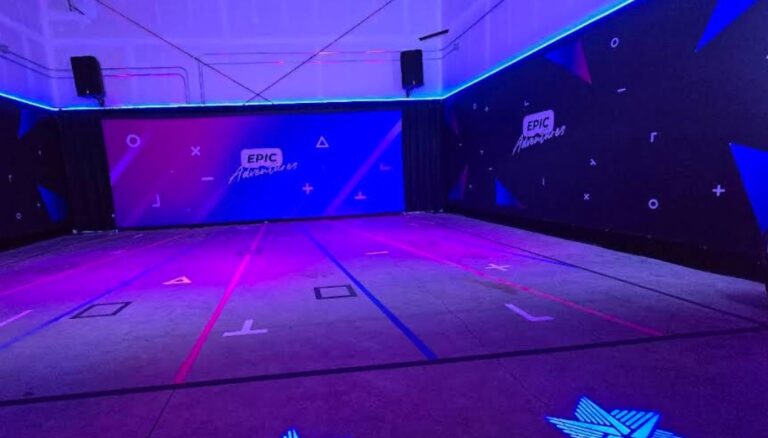
Epic Adventures is located in East Vancouver, Washington, in the Portland/Vancouver metropolitan area, just minutes from Portland, Oregon.
The venue is a free-roam virtual reality arena where up to six players physically walk and interact together in the same virtual world, with more than 40 multiplayer games spanning zombie shooters, family party games, horror, puzzles, and PVP. It also offers a growing collection of VR escape adventures set in space stations, haunted mansions, and ancient temples. Every session is private and guided by a dedicated game host who curates games to the group’s ages and skill level.
Beyond the arena, Epic Adventures is a full party venue with a retro Nintendo 64 area, spectator seating, dining space, a kitchenette, and dance-club lighting. It hosts birthdays, bachelor and bachelorette parties, graduations, family reunions, date nights, and corporate team-building events for groups up to 25, with a mobile VR arena available for off-site events. Guests bring their own food and decorations, and the whole venue is exclusively yours for the duration of your event.
IndoorsKingPins Family Entertainment Center sits in the Lents neighborhood of Southeast Portland, at 3550 SE 92nd Ave, and serves as the eastside home of the KingPins brand. The venue centers on 32 state-of-the-art bowling lanes plus eight lounge-style TapHouse lanes, a roughly 4,000-square-foot arcade with more than 50 games, and virtual reality experiences like Virtual Rabbids and King Kong of Skull Island. Guests can enjoy cosmic bowling, league play, and a pro shop, while the TapHouse Bar & Grill provides lane-side dining and 24 rotating local craft beers.
The venue is well set up for birthdays for kids and teens, with full-service packages that include a party host, reserved space, pizza, and unlimited soft drinks. It also handles corporate events, team builders, graduations, and holiday parties, accommodating groups from 10 up to 500 guests with on-site catering and customizable entertainment. A dedicated events team and attentive party staff make it a comfortable spot for family nights, date nights, and group gatherings alike.
IndoorsCipher Solver Escape Games is located in East Vancouver, Washington, at 11011 NE Fourth Plain Blvd, Suite 120, in the Vancouver Mall area of the city.
The venue offers 100% private traditional escape rooms — including the horror-themed “Experimentation of Dr. West,” the archaeology mystery “Mystery of the Mystical Mask,” and the playful “Candy Caper” — plus a seated tabletop experience called “The Inheritance.” A free-roam VR Arena lets up to five players explore digital worlds together in a 20′ x 20′ wireless space, with titles ranging from space stations to dragon towers.
Beyond the games, the club hosts birthdays, bachelor and bachelorette parties, graduations, retirements, and corporate team-building events. A dedicated party space with professionally made cake and balloons can be rented after a game, and the team handles decor and details. The venue is owned by Julie Hills, with event planners available for special requests, and parking is conveniently available on site.
IndoorsFor decades, the concept of virtual reality was confined to living rooms, limited by tangled wires, small play spaces, and the constant fear of tripping over a coffee table. However, the emergence of free-roam VR arenas has fundamentally shifted the paradigm. By combining expansive physical warehouses with cutting-edge tracking technology, these arenas allow participants to abandon the joystick and use their own bodies as the primary controller.
At its core, a free-roam VR arena is a large, open-plan physical space—often repurposed from industrial warehouses or dedicated commercial facilities—that has been mapped into a digital environment. Unlike home VR, which often relies on “stationary” or “room-scale” setups, free-roam VR removes the physical boundaries of a cable or a small mat.
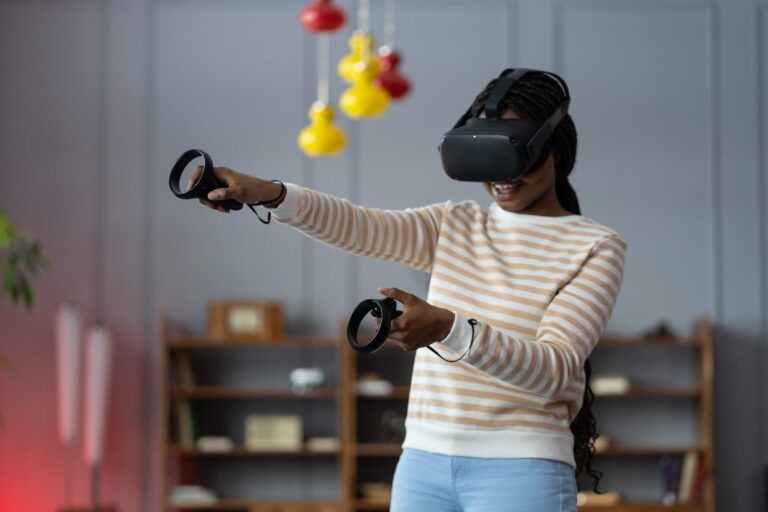
Players are equipped with a lightweight backpack computer, a high-fidelity head-mounted display, and haptic accessories. Through advanced motion-tracking cameras or infrared sensors mounted throughout the arena, every step, duck, and reach of the player is translated into the virtual world in real-time. Because the physical floor plan of the arena is carefully synchronized with the digital environment, users can walk freely across hundreds of square feet without ever bumping into a wall. It is the closest technology has come to the “Holodeck” experience, providing a sense of presence and spatial awareness that is impossible to replicate in a confined space.
The versatility of free-roam VR is perhaps its most compelling feature. Developers have moved beyond simple gaming to create experiences that span genres, catering to different emotional and psychological desires.
In the horror genre, free-roam VR acts as a high-stakes psychological thriller. Players are often placed in dimly lit, claustrophobic corridors where the spatial freedom encourages them to back away from digital threats instinctively. This physical reaction heightens the sense of immersion, as the brain struggles to distinguish between the artificial environment and physical reality.
Conversely, exploration and puzzle-solving scenarios utilize the space to foster teamwork. In these settings, players might find themselves in the heart of an ancient temple or on the deck of a marooned spaceship. Because the arena supports multiple users simultaneously, these scenarios are designed for collaboration. One player might need to physically hold a virtual lever while another inputs a code on a digital console, requiring literal, real-world communication and movement.
While initially targeted at hardcore gamers, the demographic for free-roam VR has expanded rapidly. Today, these arenas are becoming a staple of recreational entertainment for a wide variety of ages.
One of the most rapidly growing segments is the youth market. VR for kids has evolved from a novelty to a legitimate form of active play. Because these games require full-body movement, they offer a kinetic alternative to sedentary video games. Parents are increasingly favoring these environments because the experiences are overseen by staff, and the physical walls of the arena act as a safety barrier. For children, the appeal is simple: the ability to step inside their favorite animated worlds is a transformative experience. Programs are often adapted to be less frightening and more focused on cooperative play, ensuring that the technology is accessible and age-appropriate for younger users who are still developing their spatial reasoning skills.
The “event industry” has identified free-roam VR as a premium experience for social gatherings. Replacing the traditional bowling alley or arcade birthday party with a free-roam VR session provides a shared memory that is inherently transformative.
For birthday parties, it offers a “hero moment” for the guest of honor. Instead of watching a screen, the entire group becomes the protagonists of an adventure. For graduations, it serves as a high-tech celebration, appealing to teens and young adults who have grown up in a digital-first world but crave tangible, social experiences.
Perhaps the most surprising shift has been in the corporate sector. Companies are booking arenas for team-building exercises that move far beyond the mundane “trust fall.” In a free-roam VR environment, a team must effectively communicate under pressure. Whether they are defusing a virtual bomb or navigating a complex landscape, the simulation highlights leadership dynamics, communication styles, and collaborative problem-solving. By removing the corporate office setting, these arenas allow employees to interact on a level playing field, effectively bypassing traditional hierarchy through the shared absurdity and excitement of being in a virtual world.
The rapid adoption of free-roam VR has captured the attention of researchers in psychology, human-computer interaction, and ergonomics. From a scientific perspective, the primary interest lies in the concept of “proprioception”—the body’s ability to sense its own position. Researchers have observed that when physical movement is perfectly mapped to virtual movement, the brain’s “sense of presence” is significantly stronger than in seated or stationary VR. This makes free-roam VR an ideal candidate for training simulations, such as those used for emergency responders or tactical military teams, where muscle memory is critical.
Industry experts also point to the psychological benefits of “embodied cognition.” By allowing users to interact with the world through their own limbs, the learning process becomes more intuitive. While traditional software requires users to memorize keyboard shortcuts, VR allows users to “learn by doing.”
However, experts also acknowledge the challenges that remain. The primary hurdle is latency—the delay between a user’s movement and the system’s reaction. Even a millisecond of delay can break the illusion of reality, leading to what is colloquially known as “simulation sickness.” As tracking technology advances, the industry is moving toward “zero-latency” environments, which are expected to make the experience indistinguishable from reality for the average user.
Furthermore, the industry is currently focusing on content longevity. While the “wow” factor is high for a first-time user, developers are working to create experiences that have enough narrative depth to encourage repeat visits. By integrating RPG-like progression systems and seasonal updates, arenas are shifting from one-off attractions to “third places”—social hubs where people return as frequently as they might visit a movie theater or a sports complex.
As the technology continues to mature, free-roam VR is poised to become a standard component of urban entertainment. By successfully bridging the gap between the digital and physical worlds, these arenas have proven that the future of gaming and social interaction is not just found on a screen, but through the freedom to walk through one.


 140 NW Burnside Rd, Gresham, OR 97030, United States