El Monte
 Log in
Log in
Log in

Max Action Arena sits inside the Grand Sierra Resort & Casino in Reno, Nevada, on the resort’s spa level at 2500 E 2nd Street.
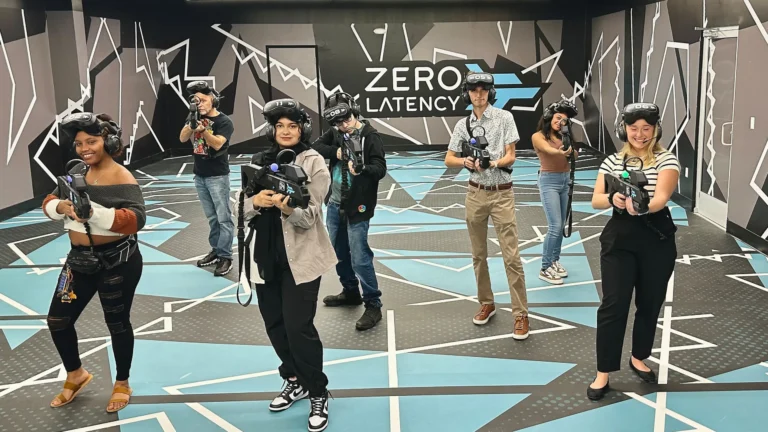
The venue centers on free-roaming Zero Latency virtual reality, where players move untethered through a large arena across more than seven game titles, from zombie shooters to alien worlds. It also offers standing VR experiences, VR rides and racing simulators, a real axe throwing lane, and a multi-sensory 5D XD Theater with five cinematic rides. Guests can choose from combo tickets, weekday specials, and family packs that bundle several attractions into one price.
Beyond the games, Max Action Arena hosts birthday parties, corporate team building, and company events, with packages ranging from small groups to full venue buyouts. Its location inside the Grand Sierra Resort places it close to restaurants, bars, and other family entertainment, making it a convenient stop for a full day of fun. The staff guide beginners through VR and axe throwing, keeping sessions safe and easy to learn.
 Indoors
In The Game Reno sits inside the South 40 entertainment complex in southern Reno, Nevada. It’s a family entertainment center built around a massive free-roaming EXTREME Virtual Reality arena powered by Zero Latency VR, where up to eight players move freely in a tennis-court-sized space with no cables. The venue also features a multi-level laser tag arena with interactive guns and a second-level ramp, plus a large arcade packed with modern and classic games, crane machines, and prize tickets.
Beyond the core attractions, the club offers mini-bowling lanes, ride-on pals for younger kids, video play passes, and Play Cards loaded with credits. It hosts birthday parties with three package tiers and a dedicated Party Captain, and welcomes youth groups, adult groups, and corporate events. Because it’s part of South 40, visitors can easily pair gaming with dining and other entertainment in a single outing.
IndoorsVirtual Reality has long been associated with being tethered to a desk, wearing a heavy headset, and accidentally punching your living room lamp while trying to swing a virtual sword. But a new era of immersive entertainment has arrived, stripping away the cables and the walls. Welcome to the Free-Roam VR Arena—a space where reality ends, and your physical movement becomes the controller.
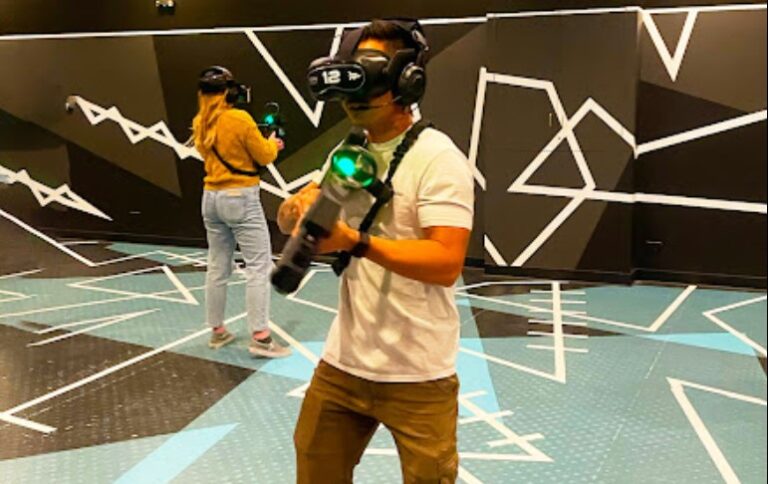
At its core, a free-roam VR arena is a large-scale, dedicated physical space—often ranging from 1,000 to several thousand square feet—designed for “untethered” gameplay. Unlike home VR systems, which rely on stationary sensors or limited boundaries, free-roam arenas utilize sophisticated motion-tracking technology, such as optical cameras located on the ceiling or high-precision pressure sensors in the floor.
Players wear lightweight, wireless headsets and often carry haptic gear or prop weapons that map perfectly to the virtual environment. Because the physical arena floor matches the virtual map you see inside your goggles, you can walk, run, duck, and dodge without the fear of bumping into a wall. It is the closest thing humanity has created to a functional “Holodeck.”
The magic of free-roam VR lies in the diversity of its scenarios. Developers are no longer restricted to stationary experiences; they are designing sprawling worlds that invite exploration.
The demographic for free-roam VR is expanding rapidly. While early adopters were tech enthusiasts and core gamers, the technology has become increasingly intuitive.
Regarding the question of VR for kids, the consensus is generally positive, provided the content is age-appropriate. Because free-roam VR uses natural human movement (walking, reaching, grabbing) rather than complex button-mashing, children often adapt to these systems faster than adults. It is an incredibly active form of play that keeps kids moving rather than sitting on a couch. Most facilities have age minimums—typically starting around age 7 or 8—to ensure the headset fits properly and the child can follow instructions.
Free-roam VR is rapidly replacing the traditional bowling alley or arcade as the go-to destination for high-impact celebrations.
The academic and professional response to free-roam VR is overwhelmingly optimistic, citing benefits that extend well beyond entertainment.
Cognitive Engagement: Neuroscientists point out that free-roam VR engages the brain’s spatial navigation systems in a way that flat screens cannot. Because the body is moving through a physical space, the brain fully “believes” in the presence of the simulation, which leads to heightened engagement and improved motor coordination.
Training Applications: Industry experts in fields like aviation, emergency response, and medicine are increasingly adopting free-roam technology. Studies suggest that “muscle memory” developed in a free-roam environment is significantly more transferable to real-world tasks than training done through a mouse and keyboard.
The Future of Human Interaction: Sociologists observe that we are witnessing the birth of a new medium of human connection. By sharing a virtual physical space, groups experience “presence”—the profound psychological sensation of being “there” with another person. As the technology continues to shrink in price and size, experts believe these arenas will become as common as movie theaters, serving as hubs for both professional training and social interaction.
The transition from “viewing” media to “inhabiting” it is complete. The free-roam VR arena isn’t just a place to play—it’s a window into the future of how we will work, learn, and celebrate together.


 Spa level, 2500 E 2nd St, Reno, NV 89595, United States