El Monte
 Log in
Log in
Log in

Sandbox VR Indoor Center is located in San Diego, CA.
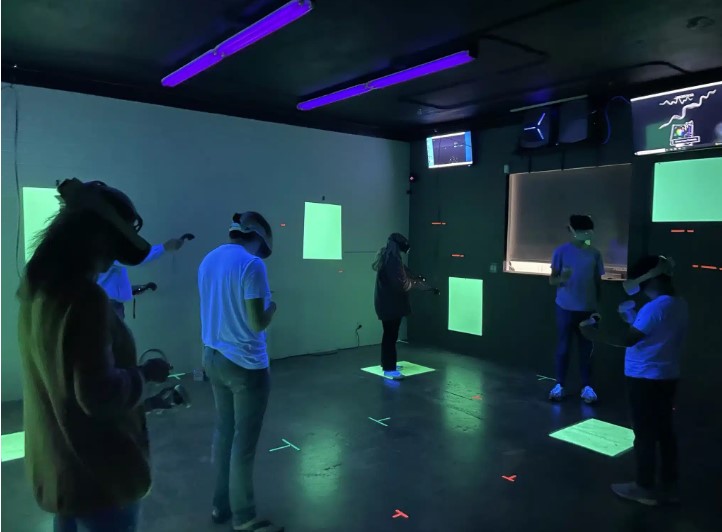
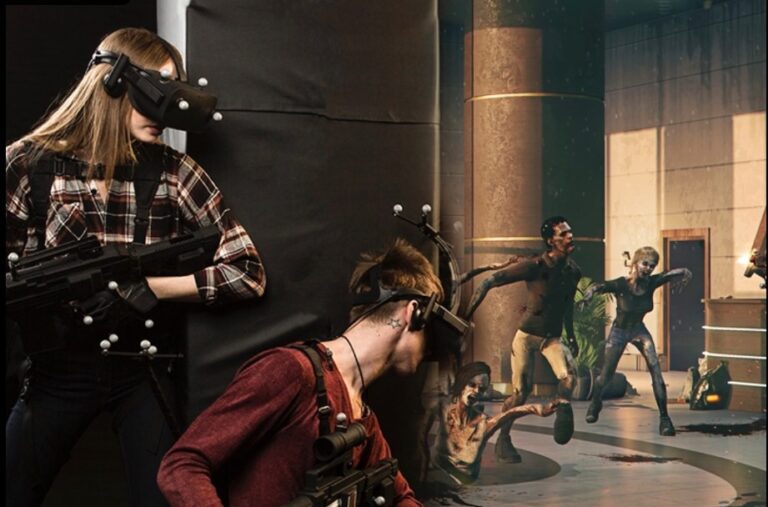
Sandbox VR is an immersive virtual reality experience in San Diego, CA. Using cutting-edge technology, guests can enter a fully realized virtual world and embark on a variety of adventures, including battling zombies, exploring underwater worlds, and solving puzzles. Up to six players can participate in each experience, working together to overcome challenges and achieve their goals. The state-of-the-art equipment and stunning visuals make for a truly immersive and unforgettable experience, perfect for birthdays, team building events, or just a fun night out with friends.
 Indoors
The GRID VR is located in downtown Oceanside, California, just off South Coast Highway near the Oceanside Pier.
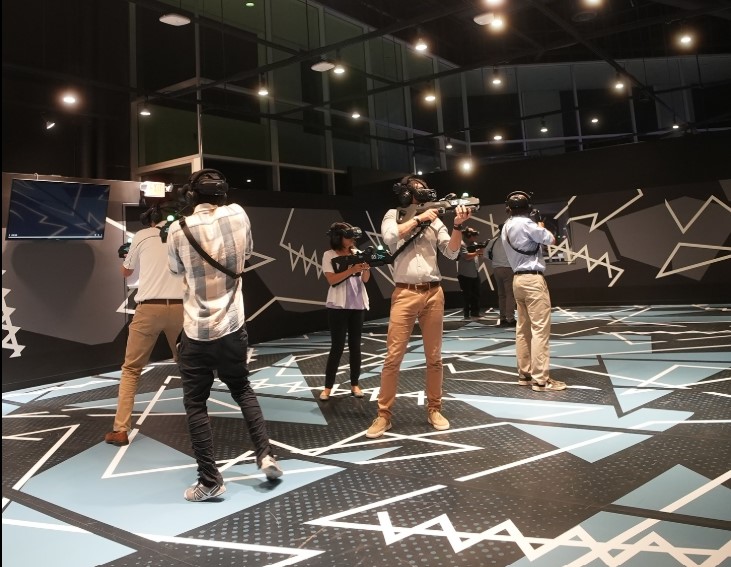
The venue specializes in HyperTag, a custom-built virtual reality laser tag experience where up to six players compete in a digital arena using Oculus Quest headsets and 11 different weapons. They also offer MetaBrush, a multiplayer VR art program that allows groups to paint in three-dimensional space, with a Sip and Paint option for adults 21 and over. Birthday party packages include two HyperTag games per guest, a gift pass for the guest of honor, and free game lounge play, with the option to add a private party room. Corporate team-building events are built around HyperTag tournaments and can accommodate up to 18 players on-site.
The GRID also offers after-hours venue rentals from 9 a.m. to 11 p.m., a weekday discount of 25% on private events, and summer camps for children focused on VR art creation. The staff is consistently praised for being friendly, patient, and knowledgeable, and the venue is wheelchair accessible with a lounge area for relaxation between rounds. It is well-suited for birthday parties, corporate team-building, date nights, creative workshops, and family outings.
IndoorsANVIO VR Indoor PARK is located in National City, CA.
ANVIO VR is a virtual reality gaming experience located in National City, CA. The facility offers a range of virtual reality experiences, including escape rooms and games that transport players to different worlds. ANVIO VR uses top-of-the-line VR technology and equipment to provide an immersive and interactive gaming experience. Whether you’re looking for a fun activity with friends or a unique team-building experience, ANVIO VR has something for everyone. With their friendly staff and state-of-the-art facilities, ANVIO VR is a must-visit for any fan of virtual reality gaming.
IndoorsEscape To VR is located in Carlsbad, California, inside The Shoppes at Carlsbad shopping center on El Camino Real.
The venue offers two distinct VR experiences: four seated escape rooms (The Heist, Curse of the Mummy, The Lost City, and The Haunted Mansion) for 2–6 players, and a wireless free-roam arena where up to six players move freely through virtual worlds. The escape rooms focus on puzzle-solving and teamwork, while the free-roam arena features cooperative shooters, adventure games, and fantasy quests. The club is well-suited for birthday parties, corporate team building, and group outings, with party packages that include a private party room, a dedicated Game Master, and the option to bring outside food and decorations. The staff sanitizes all equipment between uses and accommodates guests who wear glasses.
IndoorsSan Diego VR is located in the Miramar neighborhood of San Diego, California, at 8604 Miramar Road.
The venue centers around a Zero Latency free-roam arena where up to eight players move without wires through zombie survival, sci-fi, and fantasy scenarios. Additional experiences include VR Cave escape rooms and Hologate/HeroZone arcade-style shooters. Game time is structured through tiered packages — MVP, Elite, and Deluxe — ranging from 45 minutes to 1.5 hours, with options for ages 8–11 and 11+. The club is well-suited for birthday parties, corporate team building, and private events, with a dedicated Game Master per session, an event room for catering and cake cutting, and on-site beer and wine options. Outside food is permitted, and pizza or sandwiches can be ordered starting at $12 per person.
Indoors
San Diego, California, is an ideal weekend destination for tech-savvy visitors. The city boasts an impressive list of attractions for thrill-seekers, including nontraditional activities like virtual reality (VR) arenas.
These arenas offer an exciting and immersive way to experience all the thrills of virtual reality without the cumbersome hardware associated with VR at home. One of the most popular and accessible of these immersive venues is located in California’s fourth largest city.
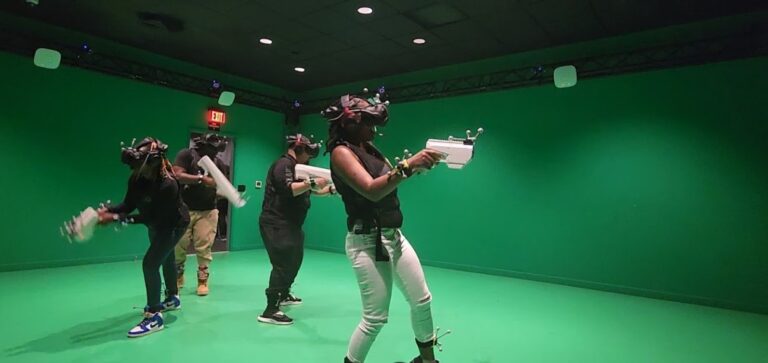
Free‑roam virtual‑reality (VR) arenas are physical spaces that combine the immersive power of head‑mounted displays with a large, obstacle‑free environment where users can move unencumbered. Unlike seated or tabletop VR, where motion is simulated by a controller, free‑roam venues employ external tracking systems—often a network of infrared cameras, lidar sensors, or ultra‑wide‑angle optical trackers—to capture a participant’s exact position and orientation in real time. The data is fed to the headset’s rendering engine, which updates the digital world in lockstep with the user’s steps, turns, and gestures.
The result is a seamless blend of the real and the virtual: a person can sprint down a digital canyon, duck under a collapsing bridge, or reach out to grab a holographic artifact, and the arena’s safety nets, padded walls, and motion‑capture markers ensure that the physical movement stays within a safe, clearly defined boundary. Because the space is designed for unrestricted locomotion, the experience feels far more “real” than the limited range of a living‑room setup, and it opens the door to game designs and training scenarios that would be impossible on a couch.
The flexibility of a free‑roam arena fuels an ever‑growing catalog of scenarios, ranging from entertainment to education and professional training.
Adventure and Storytelling – Game developers craft narrative‑driven quests where participants become protagonists in sprawling fantasy realms. Players might explore a haunted mansion, navigate an alien planet’s surface, or solve riddles inside a rotating clock tower, all while physically walking, climbing, or crouching. The tactile feedback of stepping onto a simulated wooden floor or feeling a virtual wind gust adds layers of immersion that static VR cannot match.
Fitness and Wellness – Exercise‑focused applications transform the arena into a cardio playground. Rhythm‑based dance battles, obstacle‑course sprint drills, and martial‑arts sparring sessions encourage participants to burn calories while having fun. Because the body is already moving, the perceived exertion often feels lower than traditional workouts, increasing adherence for users seeking a novel fitness regimen.
Education and Exploration – Museums and science centers deploy free‑roam setups to let visitors walk through reconstructed historical sites, travel inside a human cell, or experience the scale of the solar system. The ability to physically walk around a dinosaur skeleton or float among nebulae provides a kinesthetic learning experience that improves retention compared with passive observation.
Professional Training – High‑risk industries—aviation, emergency response, construction—use free‑roam VR to rehearse procedures in a safe, repeatable environment. Trainees can practice a crane operator’s hand‑signals, a firefighter’s navigation through a smoke‑filled structure, or a surgeon’s precise instrument handling without jeopardizing real‑world safety. The accurate motion tracking captures performance metrics for post‑session analysis, enabling data‑driven coaching.
Social and Collaborative Play – Multiplayer modes let groups cooperate or compete across the same physical space. Team‑based puzzle rooms, laser‑tag style shooters, and cooperative construction challenges encourage communication, strategic planning, and shared laughter—elements that translate into stronger social bonds and team cohesion.
These scenarios illustrate why free‑roam VR is not just a novelty but a versatile platform that can be tailored to any audience seeking an embodied, interactive experience.
The demographic landscape of free‑roam VR is surprisingly broad. While early adopters were predominantly adult gamers and tech enthusiasts, today the user base includes families, school groups, and corporate teams.
Children and Adolescents make up a substantial portion of visitors, especially in urban centers where dedicated VR arcades serve as modern playgrounds. Kids enjoy age‑appropriate adventures—such as treasure hunts in whimsical forests or space‑exploration missions that blend educational content with playful challenges. The physical nature of free‑roam VR aligns well with developmental needs, promoting gross‑motor coordination, spatial awareness, and problem‑solving skills. Operators typically enforce strict hygiene protocols and limit session lengths to ensure safety and prevent motion fatigue in younger participants.
Teenagers and Young Adults are drawn by competitive multiplayer titles and high‑intensity action games. The social aspect of gathering with friends in a shared virtual space resonates strongly with this group, making free‑roam arenas popular destinations for weekend outings and birthday celebrations.
Adults and Professionals frequent the venues for team‑building exercises, stress‑relief breaks, and immersion in cutting‑edge simulations. Corporate clients often schedule private sessions that combine lighthearted gameplay with scenario‑based training, leveraging the arena’s ability to foster trust and communication under a shared, low‑stakes pressure environment.
Overall, the versatility of content and the safety measures built into arena design make free‑roam VR appealing across age groups, while operators tailor experiences to match the cognitive and physical capabilities of each cohort.
When it comes to marking milestones, free‑roam VR offers an unforgettable alternative to conventional party venues.
Birthday Parties for children and teens can be transformed into narrative adventures. A birthday group might be invited to become “space cadets” tasked with repairing a malfunctioning starship, or explorers racing against a clock to retrieve a hidden artifact. The arena’s staff typically handle set‑up, equipment sanitation, and game moderation, allowing parents to focus on celebration. Packages often include themed decorations, photo‑capture stations that blend real‑world poses with virtual backdrops, and optional catering.
Graduation Celebrations benefit from the arena’s capacity to accommodate large groups while providing a unique shared experience. Graduates can choose from competitive team challenges—such as futuristic laser tag—or collaborative escapades where they must solve a series of puzzles to “unlock” their future. The immersive setting creates a strong sense of camaraderie, turning a once‑in‑a‑lifetime moment into a collective memory that participants will recount for years.
Corporate Parties and Team‑Building Events leverage the arena’s ability to simulate high‑stakes yet low‑risk scenarios. Companies may design custom modules that mirror brand values—perhaps a sustainability quest where teams collect virtual recyclables, or a problem‑solving mission that reflects a product‑launch timeline. Because participants move together within the same physical space, non‑verbal communication (gestures, body language) becomes a natural part of the interaction, revealing leadership styles and collaboration habits that are harder to observe in a traditional conference room.
In each of these contexts, the blend of physical activity, narrative immersion, and social interaction makes free‑roam VR a compelling venue for celebrations that demand both excitement and meaningful engagement.
From a research perspective, free‑roam VR is regarded as a powerful tool for studying human perception, cognition, and motor behavior. Scientists note that the correlation between visual input and proprioceptive feedback in an unrestricted environment yields data that more accurately reflects real‑world performance than seated or treadmill‑based VR. Experiments investigating spatial navigation, for instance, benefit from participants being able to walk natural paths, thereby eliminating the confounding effects of artificial locomotion schemes.
Industry experts highlight several strategic advantages. First, the technology’s scalability—modular tracking rigs and interchangeable physical layouts—allows venues to expand capacity without prohibitive cost increases. Second, the emerging ecosystem of cross‑compatible software platforms encourages developers to create content that can run on multiple arenas, fostering a healthier market for both publishers and operators. Third, the safety standards that have evolved alongside the hardware—such as padded walls, real‑time collision alerts, and automated emergency stop mechanisms—are reducing liability concerns, making it easier for investors to fund new locations.
Critics, however, caution that the high upfront capital expense for tracking infrastructure and venue construction can be a barrier for smaller businesses. They also emphasize the importance of rigorous user‑experience testing to prevent motion sickness, which can still arise when visual motion cues conflict with vestibular input, especially in inexperienced users.
Overall, the consensus among researchers and professionals is that free‑roam VR sits at the intersection of entertainment, education, and applied science. Its capacity to deliver embodied experiences at scale positions it as a catalyst for innovation across sectors ranging from health care—where therapeutic exposure therapy can be delivered in a controlled, walkable environment—to aerospace, where astronauts can rehearse EVA (extravehicular activity) tasks without leaving Earth. As tracking fidelity improves and content libraries diversify, the expectation is that free‑roam VR will transition from a niche attraction to a mainstream medium for immersive interaction.
In summary, free‑roam VR arenas represent a convergence of cutting‑edge motion‑capture technology, thoughtfully designed physical spaces, and a growing catalog of immersive scenarios. They serve a wide audience—from curious children to seasoned professionals—by offering experiences that are physically active, socially engaging, and cognitively stimulating. Whether celebrating a birthday, honoring a graduation, strengthening corporate ties, or advancing scientific knowledge, these arenas provide a versatile platform that redefines what virtual reality can achieve when the body is allowed to move freely within the digital world.


 1640 Camino Del Rio N #116, San Diego, CA 92108, United States