El Monte
 Log in
Log in
Log in

Main Event Indoor Laser Tag arena is located in Tulsa, OK.
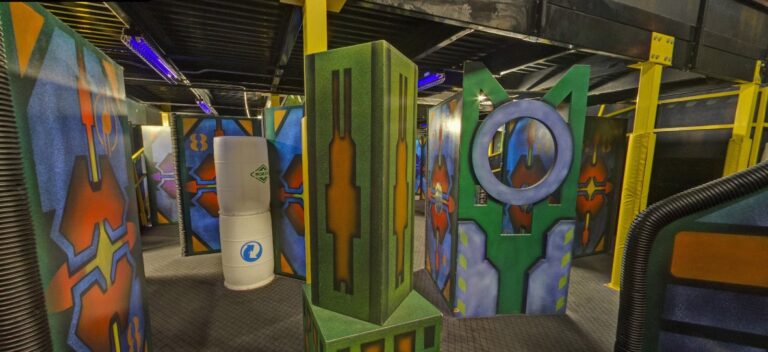
Main Event is a huge entertainment hub where you can spend your weekend or throw a birthday party. These laser-tag battles take place in a multi-story arena with fantasy-like decorations, neon lights, and laborious obstacles. Climb up the towers and rain fire on unsuspecting enemies.
There is also a large recreation area with snacks and drinks to chill after the game. There’s also bowling, pool, VR, mini-golf, a story room, and a ropes course – all available at one single place!
 Indoors
Urban Air Trampoline and Adventure Indoor Park is located in Tulsa, OK.
The Urban Air Trampoline and Adventure Park in Tulsa, OK offers a range of exciting activities for all ages. The park features trampolines, obstacle courses, climbing walls, a ninja warrior course, and more. Visitors can also enjoy virtual reality experiences and an arcade. Additionally, the park is available for birthday parties and group events. With its exciting attractions and fun atmosphere, the Urban Air Trampoline and Adventure Park is sure to provide a memorable experience for all who visit.
IndoorsUrban Air Trampoline and Adventure Indoor Park is located in Moore, OK.
Urban Air Trampoline and Adventure Park in Moore, OK is a popular destination for families and thrill-seekers alike. With over 10 attractions ranging from trampolines to ropes courses, there’s something for everyone. The park also offers birthday party packages and private events. Visitors rave about the friendly staff and clean facilities. Overall, Urban Air Trampoline and Adventure Park is a fun and exciting place to spend a day bouncing, climbing, and soaring through the air.
Indoors
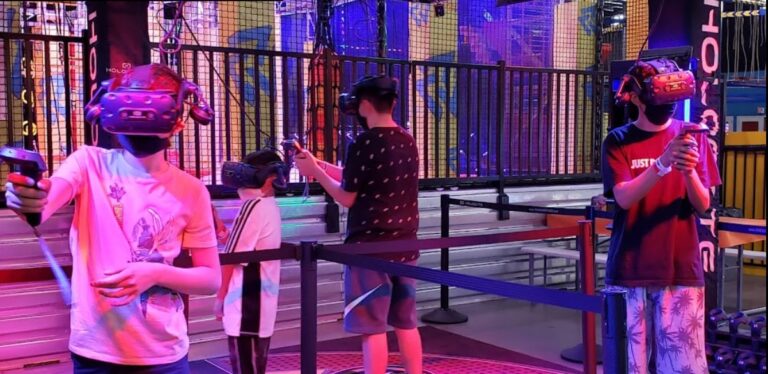
Virtual reality has leapt from the solitary headset on a couch to sprawling, sensor‑filled spaces where you can walk, run, and interact with friends—or strangers—in a fully three‑dimensional world. This evolution is embodied in the free‑roam VR arena, a physical venue that blends cutting‑edge technology with real‑world movement to create immersive experiences that were once only possible in science‑fiction. In this article we’ll explore what free‑roam VR arenas are, the scenarios they enable, who’s using them, how they’re reshaping celebrations and corporate events, and what scientists and industry experts think about this rapidly growing medium.
A free‑roam VR arena (sometimes called a “walk‑in VR lab,” “immersive motion space,” or “VR playground”) is a dedicated indoor environment equipped with a suite of tracking hardware—infrared cameras, lidar sensors, or inside‑out tracking rigs—paired with a large‑scale physical layout of walls, props, and obstacles. Participants don a wireless head‑mounted display (HMD) and, unlike traditional seated or room‑scale VR, they can move freely across the entire floor area, often ranging from 500 sq ft to several thousand square feet.
| Component | Typical Implementation | Why It Matters |
|---|---|---|
| Tracking System | Overhead motion‑capture cameras (OptiTrack, Vicon), or ultra‑wide‑angle inside‑out cameras on the headset | Provides millimeter‑accurate position data, allowing avatars to line up perfectly with physical objects. |
| Wireless HMDs | Meta Quest 3, HTC Vive XR Elite, Pimax Crystal (with wireless adapters) | Eliminates cables that would otherwise restrict movement or cause safety hazards. |
| Safety Mesh & Z‑Space | Transparent safety netting or virtual “boundary walls” displayed in‑headset | Prevents collisions with walls, equipment, or other users while preserving immersion. |
| Physical Set Dressing | Modular walls, foam props, motion‑responsive furniture, haptic floor panels | Gives tactile feedback (e.g., feeling a door handle), reinforcing the brain’s sense of presence. |
| Interactive Backend | Game engine (Unity, Unreal) integrated with real‑time physics and multi‑user networking | Powers the shared virtual world, synchronising actions across participants. |
When you step into a free‑roam arena, the first thing you notice is the sense of scale. The virtual world can be vastly larger than the physical space because the system “re‑maps” your movements, stretching or compressing the virtual distance while keeping your real‑world safety intact. You can sprint down a virtual canyon, duck under a low‑hanging bridge, or collaborate with teammates to solve a puzzle—all while your body is genuinely moving, breathing, and sweating.
Free‑roam VR isn’t just a novelty; it’s a versatile platform that can host a wide variety of scenarios. Below are some of the most popular and innovative use‑cases.
The ability to blend physical movement with digital interaction opens up an endless menu of possibilities, limited only by imagination, budget, and safety considerations.
Free‑roam VR has a surprisingly broad audience. Below we break down the principal user groups and what draws them in.
These are the early adopters who crave the next level of immersion. For them, a free‑roam arena is the ultimate “hard‑core” gaming experience—think of it as the real‑world counterpart to an esports stadium. They appreciate high‑fidelity graphics, low latency, and the physicality of moving like in a sport.
Parents see free‑roam VR as a safe, supervised environment where children can explore futuristic worlds without the headaches of cables or cramped spaces. The tactile props make the experience feel more like a playground than a screen, encouraging active play.
Teachers integrate free‑roam sessions into curricula to teach subjects ranging from physics (visualizing forces) to literature (immersive storytelling). Students benefit from experiential learning, which improves retention and engagement.
HR departments book arenas for retreats, leadership development, and product demos. The physical aspect drives stronger kinesthetic memory, making training more memorable.
Academic labs use free‑roam arenas to study human perception, locomotion, and social interaction in controlled yet realistic settings. Their findings feed back into improving the technology itself.
One of the fastest‑growing market segments for free‑roam VR is event hosting. Because the technology can be customized, venues now offer turnkey packages for celebrations. Here’s a look at how each type of event can be amplified.
Logistics: Most arenas provide a dedicated event coordinator, on‑site technical support, catering options (often with VR‑themed menus), and post‑event analytics (e.g., participation heat maps, average session duration). This makes the planning process painless for hosts.
Free‑roam VR sits at the intersection of multiple research fields—neuroscience, human‑computer interaction (HCI), biomechanics, and even psychology. Below we synthesize the perspectives of leading voices.
Dr. Maya Patel (Neuroscience Institute, Stanford)
“Free‑roam VR triggers a stronger sense of ‘presence’ because it aligns vestibular, proprioceptive, and visual cues. This multimodal stimulation can be harnessed to rehabilitate patients with vestibular disorders, as the brain receives realistic feedback while remaining in a safe, controllable environment.”
Key Finding: Functional MRI studies reveal increased activation in the hippocampus (spatial memory) during free‑roam sessions compared to seated VR.
Prof. Luis Ortega (MIT Media Lab)
“The biggest challenge is designing intuitive interaction paradigms that scale with the number of participants. Gestural interfaces combined with haptic feedback can reduce cognitive load, allowing users to focus on the narrative rather than the mechanics.”
Takeaway: Open‑source frameworks like “OpenXR‑FreeRoam” are gaining traction, promoting standardization across hardware vendors.
Karen Liu, Senior Engineer at Bosch Sensortec
“From an engineering standpoint, ensuring sub‑10 ms latency in a large tracking volume is non‑trivial. Recent advances in edge‑computing and AI‑based predictive tracking have pushed us into the sub‑5 ms realm, which is essential for preventing motion sickness.”
Safety Insight: Redundant tracking (dual‑camera setups) combined with automatic emergency stop protocols have reduced incident rates to less than 0.02% per hour of operation.
Dr. Ethan Russo (University of Toronto, Social Psychology Lab)
“Group free‑roam experiences foster a unique blend of cooperation and competition, mirroring real‑world social structures. This makes it an excellent testbed for studying leadership emergence and group decision‑making under pressure.”
Application: Companies are using these insights to refine virtual onboarding programs, ensuring new hires feel socially integrated from day one.
Overall, the consensus among experts is that free‑roam VR is not a fleeting fad—it represents a maturing technology with concrete scientific validation, industrial scalability, and a clear path toward broader adoption.
The trajectory of free‑roam VR points toward even richer integration with the physical world. Anticipated developments include:
As these innovations converge, free‑roam VR arenas will become multifunctional hubs for entertainment, education, health, and enterprise—a physical‑digital nexus where imagination meets kinetic reality.
Free‑roam VR arenas are reshaping how we play, learn, celebrate, and collaborate. By freeing the user from the constraints of a stationary headset, they unlock the full potential of virtual reality—making the virtual world feel palpably real. Whether you’re a gamer chasing the next adrenaline rush, a parent seeking an unforgettable birthday adventure, a teacher looking to ignite curiosity, or a corporate leader hunting innovative team‑building tools, there’s a free‑roam experience waiting to be explored.
The next time you step into a shimmering portal of light, hear the faint hum of tracking cameras overhead, and feel the floor vibrate beneath your boots, remember: you’re not just wearing a headset—you’re entering a new frontier of embodied digital experience. And that frontier is only just beginning.


 7830 S Santa Fe Ave, Tulsa, OK 74132, United States