TOP 10 best of the best Free-roam VR in Waco, TX – Battleonix
El Monte
Log in
0

Advanced Search:

City

Rating

Playground


Price:

Main / Catalog / VR / Texas, US / Waco, TX

The best Free-roam VR near me in Waco, TX

img
from $16
Laser tagVR

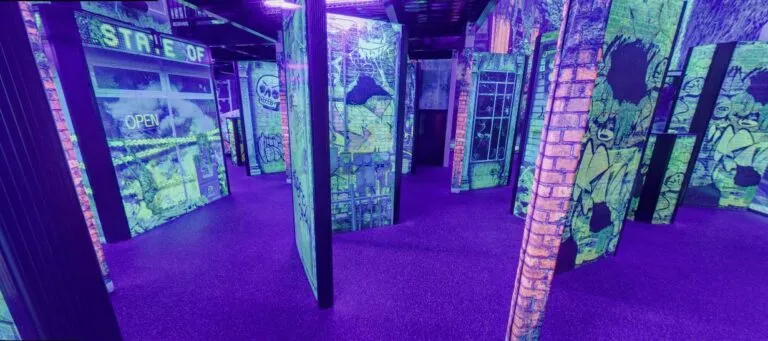
Main Event Indoor Laser Tag arena is located in Waco, TX.


Main Event is a huge entertainment hub where you can spend your weekend or throw a birthday party. These laser-tag battles take place in a multi-story arena with fantasy-like decorations, neon lights, and laborious obstacles. Climb up the towers and rain fire on unsuspecting enemies. 


There is also a large recreation area with snacks and drinks to chill after the game. There’s also bowling, pool, VR, mini-golf, a story room, and a ropes course – all available at one single place!

Indoors

Best of the best Free-roam VR in Waco, TX


What Is a Free‑Roam VR Arena?

Free‑roam virtual‑reality (VR) arenas are purpose‑built physical spaces where users can move freely while wearing head‑mounted displays. Unlike seated or standing VR setups that confine motion to a limited area, free‑roam arenas blend sophisticated tracking technology with spacious, obstacle‑free interiors, allowing participants to walk, run, crouch, and interact with the virtual world as if it were an extension of the real one.

The core components of a free‑roam arena include a motion‑capture system—often a combination of infrared cameras, lidar sensors, or inside‑out tracking on the headset—paired with a robust safety net of padding, low‑friction flooring, and sometimes harnesses for added security. The arena’s software maps the physical dimensions onto a virtual environment in real time, synchronising the user’s position, orientation, and gestures with the digital world. The result is an immersive experience that feels tangible, where the boundary between the player’s body and the virtual avatar dissolves.

Because the technology tracks the user’s whole body rather than just head movements, developers can design experiences that demand full‑body engagement: dodging obstacles, climbing virtual ladders, or collaborating with teammates in a shared space. This freedom of movement expands the narrative possibilities of VR and makes it suitable for entertainment, education, training, and corporate events.


Free‑Roam VR Scenarios

The versatility of free‑roam arenas lends itself to a wide array of scenarios, each exploiting the unshackled mobility of participants. Some of the most popular categories include:

  1. Adventure and Exploration – Players embark on quests that take them across sprawling fantasy landscapes, alien planets, or historical reconstructions. Because they can physically walk through corridors, forests, or ruins, the sense of discovery is heightened, and spatial memory becomes a part of the gameplay.

  2. Competitive Sports and E‑Sports – Free‑roam setups replicate sports such as sword fighting, archery, paintball, or futuristic arena combat. The ability to physically dodge and aim adds a kinetic intensity that traditional screen‑based e‑sports cannot match.

  3. Co‑Operative Puzzles – Teams solve environmental challenges that require coordinated movement, such as moving large virtual objects, aligning holographic symbols, or navigating mazes that shift in response to collective actions.

  4. Educational Simulations – Scenarios recreate scientific laboratories, archaeological digs, or medical procedures. Students can practice delicate manipulations, such as handling fragile specimens or performing virtual surgeries, while the system records performance metrics for later analysis.

  5. Narrative Storytelling – Immersive theatre experiences place participants inside a story where they become protagonists. Actors blend with virtual characters, and the narrative adapts based on the players’ choices and physical actions.

  6. Therapeutic and Wellness Activities – Guided meditation journeys, low‑impact fitness routines, and neuro‑rehabilitation exercises leverage the free movement to promote physical health and mental well‑being.

Each scenario is built around a core design principle: the virtual world must respect the physical limits of the arena while encouraging the player to use their whole body as an instrument of interaction. Designers therefore incorporate safety buffers, dynamic obstacle avoidance, and intuitive visual cues that keep participants aware of real‑world boundaries.


Who Plays on Free‑Roam VR Arenas? VR for Kids

Free‑roam VR is not an exclusive domain for hardcore gamers or adult enthusiasts; it attracts a broad demographic that includes children, families, and educational institutions. For younger users, the technology offers a safe, supervised environment where imaginative play can unfold without the constraints of a couch or a limited play area.

Age‑Appropriate Content

Developers produce a spectrum of kid‑friendly experiences that range from whimsical treasure hunts in enchanted forests to interactive science labs where children can experiment with virtual chemicals that never spill. These titles are curated to avoid intense horror or excessive violence, focusing instead on exploration, problem‑solving, and collaborative play.

Physical Benefits

Because kids naturally enjoy moving, free‑roam VR channels that energy into purposeful activity. Running, jumping, and reaching in a controlled arena helps improve balance, coordination, and spatial awareness. Many programs incorporate subtle fitness goals, such as tracking steps taken or calories burned, turning playtime into a light workout.

Social Interaction

Multi‑player modes encourage teamwork and communication. Children learn to negotiate roles, share objectives, and celebrate collective successes. The shared physical space also reduces the sense of isolation that can occur with head‑mounted displays, as participants can see each other’s silhouettes or avatars projected onto a communal screen.

Safety Measures

Parents and operators rely on strict safety protocols. The arena floor is padded, and a real‑time “guardian” system alerts users when they approach the edge of the tracked zone. Staff members monitor the session, ready to intervene if a child becomes disoriented or overly excited. These safeguards have made free‑roam VR a trusted venue for school field trips, after‑school clubs, and birthday celebrations.


Free‑Roam VR for a Birthday Party, Graduation, or Corporate Event

The adaptability of free‑roam VR makes it an attractive option for a variety of special occasions. Organisers can tailor the experience to match the theme, audience, and objectives of the event, turning a standard gathering into an unforgettable adventure.

Birthday Parties

For children’s birthdays, venues often offer themed packages—such as “Space Explorer,” “Jungle Quest,” or “Superhero Academy.” Each package includes a curated storyline, custom avatars, and a set duration that fits typical party lengths. Birthday guests can compete in friendly challenges, earn virtual badges, and receive physical mementos like printed photos of their in‑game avatars. The immersive nature of the arena ensures that the excitement extends beyond the usual cake‑and‑games routine.

Graduation Celebrations

Graduates seeking a modern twist on traditional ceremonies can host a collective VR experience that commemorates their journey. A custom scenario might take participants through a virtual campus, highlighting memorable landmarks, followed by a symbolic “launch” where avatars ascend a digital sky, representing new beginnings. The shared physical motion adds a sense of unity, while the digital component provides a lasting video recording that can be shared with families and alumni.

Corporate Parties and Team‑Building

Businesses increasingly view free‑roam VR as a powerful tool for employee engagement. Corporate events can incorporate:

  • Team‑Building Challenges – Scenarios that require cross‑functional collaboration, such as solving a virtual heist or escaping a simulated disaster zone.
  • Product Showcases – Companies can embed their prototypes or brand narratives into a virtual environment, allowing participants to interact with digital twins of new products.
  • Wellness Sessions – Guided movement classes or mindfulness journeys that promote health while showcasing the company’s commitment to employee well‑being.

Because the arena tracks performance data, organizers can generate post‑event analytics, revealing how teams communicated, the time spent on tasks, and individual participation levels. These insights help HR departments refine future training and development programs.


Scientists and Industry Experts View on Free‑Roam VR

Academic researchers and industry leaders have been closely monitoring the evolution of free‑roam VR, evaluating its potential across multiple disciplines. Their assessments converge on several key observations.

Cognitive and Perceptual Research

Neuroscientists recognize that free‑roam VR provides a more authentic sensorimotor loop than stationary setups. By aligning visual, vestibular, and proprioceptive feedback, the technology reduces the “sensory mismatch” that can cause motion sickness. Studies indicate that participants retain spatial information more accurately after navigating a virtual environment with full‑body movement, suggesting applications in navigation training and memory research.

Human‑Computer Interaction (HCI)

HCI experts highlight the importance of ergonomic design in free‑roam arenas. The placement of cameras, lighting conditions, and the weight distribution of headsets all influence user comfort and immersion. The consensus emphasizes iterative testing with diverse user groups to refine interaction models, especially for users with limited mobility or visual impairments.

Industrial Training

Engineers and safety professionals cite free‑roam VR as a cost‑effective alternative to traditional on‑site training. Simulating hazardous environments—such as oil rigs, nuclear plants, or high‑rise construction sites—allows trainees to practice emergency procedures without exposing them to real danger. The ability to repeat scenarios with instant performance feedback accelerates skill acquisition and reduces the likelihood of accidents in the field.

Market Outlook

Analysts in the technology sector project steady growth for free‑roam VR installations. While initial capital expenditures for arena construction and tracking infrastructure are significant, the recurring revenue from event bookings, corporate contracts, and educational licensing offsets the cost over time. Forecasts predict a diversification of business models, including subscription‑based access for schools and franchised “VR adventure parks” in major metropolitan areas.

Ethical Considerations

Bioethicists raise questions about prolonged exposure to highly immersive environments, especially for children. Recommendations include establishing session time limits, implementing debriefing protocols, and ensuring that the virtual content adheres to age‑appropriate standards. Researchers also stress the need for transparent data handling practices, as the tracking systems collect detailed movement patterns that could be sensitive if mishandled.

Overall, the scientific community views free‑roam VR as a multidisciplinary catalyst—one that bridges entertainment, education, health, and industry. The technology’s capacity to replicate real‑world physics while offering infinite creative flexibility is seen as a stepping stone toward more sophisticated mixed‑reality ecosystems.


Free‑roam VR arenas represent a convergence of advanced motion tracking, immersive storytelling, and flexible spatial design. By liberating users from the confines of a chair or a small play area, these venues unlock new possibilities for adventure games, collaborative puzzles, educational simulations, and wellness experiences.

The appeal spans age groups: children enjoy safe, kinetic play that bolsters physical development; teenagers and adults seek competitive or narrative‑driven challenges; professionals leverage the medium for team building, product demos, and high‑risk training. Special events—from birthday parties to graduations and corporate gatherings—benefit from customizable scenarios that turn ordinary celebrations into shared journeys through virtual worlds.

Scientists and industry experts collectively recognize free‑roam VR’s unique capacity to align sensory inputs, improve spatial learning, and reduce training costs while also cautioning against overuse and advocating for ethical data practices. As the technology matures and costs decline, free‑roam arenas are poised to become a staple of modern entertainment, education, and corporate culture, reshaping how people move, learn, and interact in both digital and physical realms.