TOP 10 best of the best Free-roam VR in Waldorf, MD – Battleonix
El Monte
Log in
0

Advanced Search:

City

Rating

Playground


Price:

Main / Catalog / VR / Maryland, US / Waldorf, MD

The best Free-roam VR near me in Waldorf, MD

img
from $25
VR

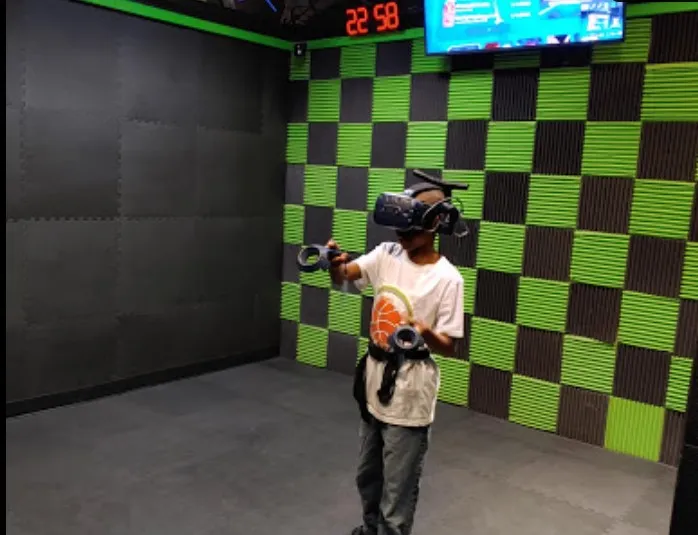
WE ‘R’ VR Indoor Center is located in Waldorf, MD.


 WE ‘R’ VR is a virtual reality arcade located in Waldorf, MD. Customers can experience a variety of VR games and experiences on high-end VR equipment. The arcade caters to individuals, groups, and events, and offers a variety of packages to fit different needs and budgets. Customers have the option to choose from single-player or multiplayer games, and the staff is available to assist with equipment setup and game selection. WE ‘R’ VR is a popular destination for birthday parties, corporate events, and team-building activities.

Indoors

Best of the best Free-roam VR in Waldorf, MD


The Future of Play: Unlocking the Immersive World of Free-Roam VR Arenas

The landscape of entertainment is undergoing a seismic shift. Gone are the days when virtual reality (VR) was confined to a stationary headset tethered to a high-end PC in a bedroom. Today, the cutting edge of digital entertainment is defined by the free-roam VR arena—a sprawling, physical space where the boundaries between the physical world and the digital metaverse dissolve entirely. This evolution in technology allows users to step out of their chairs and into the heart of the action, utilizing their own bodies to navigate, combat, and explore impossibly large environments.


What is a Free-Roam VR Arena?

At its core, a free-roam VR arena is a large-scale, open-floor-plan facility designed to accommodate multiple players simultaneously. Unlike traditional home-based VR, which often suffers from the “tether problem” or spatial limitations, free-roam arenas utilize sophisticated tracking systems—typically overhead cameras, infrared sensors, or high-precision motion capture technology—to map a player’s exact position within a dedicated physical room.

Participants are equipped with a lightweight, standalone VR headset and, in many cases, a backpack computer or high-speed wireless streaming device. This set-up eliminates wires, granting the user complete freedom of movement. When a player walks ten feet forward in the real world, their digital avatar does the exact same thing in the virtual one. This 1:1 motion ratio is the “holy grail” of immersion. It tricks the brain into full acceptance of the digital environment, turning a simple warehouse space into a sprawling alien landscape, a haunted asylum, or a zero-gravity space station.


Free-Roam VR Scenarios

The versatility of free-roam VR is limited only by the imagination of game developers. Because the hardware tracks human movement, the scenarios are designed to facilitate intense, full-body engagement.

In high-octane action scenarios, players become protagonists in a cinematic narrative. One common genre is the “zombie survival” experience, where players must physically back away from digital hordes, duck behind invisible crates, and aim their physical laser-tag-style controllers to fend off waves of attackers. Because the environment reacts to every step, the tension is palpable; the fear of being “surrounded” is far more visceral when one must physically turn around to check their six.

Beyond combat, there are puzzle-solving and exploration scenarios. These might involve navigating a fantasy labyrinth where players must physically reach out to pull levers, slide heavy stones, or traverse narrow bridges. Educational scenarios also exist, allowing groups to walk through scale-accurate recreations of historical sites, such as the surface of Mars or the ruins of ancient Rome. In these instances, the free-roam aspect encourages collaborative learning, as participants can point at, walk toward, and inspect digital artifacts together in real-time.


Who Plays on Free-Roam VR Arenas? VR for Kids

While early VR adopters were primarily hardcore gaming enthusiasts and tech-savvy adults, the accessibility of modern free-roam arenas has widened the demographic significantly. The technology has become intuitive enough that it no longer requires technical expertise to operate.

For children, these arenas offer a unique form of “active play.” In an era where sedentary screen time is a growing concern for parents, free-roam VR encourages physical exertion. Kids are not just tapping a screen; they are lunging, dodging, and coordinating with friends to achieve a common goal. Safety protocols, such as virtual boundaries that prevent players from colliding with real-world walls, ensure that even the most energetic children can engage safely. It turns the act of gaming into a kinetic sport, providing a sense of agency and physical involvement that traditional video games simply cannot match.


Free-Roam VR for Birthdays, Graduations, and Corporate Parties

The “social” element is perhaps the strongest selling point for free-roam VR. It is no longer a solitary experience; it is a shared spectacle. This has made these arenas an increasingly popular choice for event hosting.

For birthday parties, it provides a “wow” factor that creates lasting memories. Whether it’s a group of kids celebrating a tenth birthday or an adult milestone, the ability to “enter the game” together creates a bond that sitting on a couch cannot replicate. Everyone is in the same digital space, laughing, shouting, and strategizing side-by-side.

Graduation parties have also begun to embrace this technology. It serves as a sophisticated, modern alternative to traditional venues, offering a thrill that marks a transition into adulthood with a memorable experience.

Corporate events and team-building exercises are perhaps the most strategic beneficiaries of the technology. HR departments and managers are constantly looking for ways to break the ice and improve team dynamics. Free-roam VR forces players to communicate clearly and collaborate under pressure. If a team is tasked with defending a digital base, they must divide responsibilities, provide feedback, and support each other’s movements. It is an excellent way to identify natural leaders and foster camaraderie in a neutral, high-excitement environment.


Scientists and Industry Experts’ View on Free-Roam VR

The consensus among scientists and industry experts is that free-roam VR is the natural next step in human-computer interaction. From a psychological perspective, researchers are intrigued by “presence”—the sense of actually being inside a simulated space. Studies have shown that when a user’s physical movement matches their visual perception, the brain’s threshold for suspension of disbelief is significantly lowered. This creates a state of heightened emotional response that researchers use to study everything from phobia therapy to stress management.

Industry experts view free-roam VR as a critical component of the “Spatial Internet.” As the transition from 2D screens to 3D interfaces continues, these arenas act as the training ground for the public. Experts note that as hardware becomes smaller, lighter, and more powerful, we are moving toward a future where our physical surroundings will be augmented by digital overlays.

Furthermore, economists and business analysts see the “out-of-home” VR market as a resilient industry. While home VR headsets are becoming more common, they often lack the space and the tracking precision of a multi-thousand-square-foot arena. Thus, the industry is viewed as a “premium experience” category—similar to the way cinema offers a better experience than watching a movie on a phone. The professional consensus is clear: as long as humans have a desire to explore impossible worlds together, free-roam VR will continue to evolve, moving from a niche novelty to a staple of modern entertainment and training infrastructure.

In conclusion, free-roam VR arenas represent the ultimate merging of digital art with physical vitality. By demanding that players use their whole bodies, these spaces turn passive entertainment into an active, social, and deeply personal adventure. Whether for a child’s birthday or a corporate retreat, the ability to step inside the screen is a transformative experience that is only just beginning to show its potential.