El Monte
 Log in
Log in
Log in

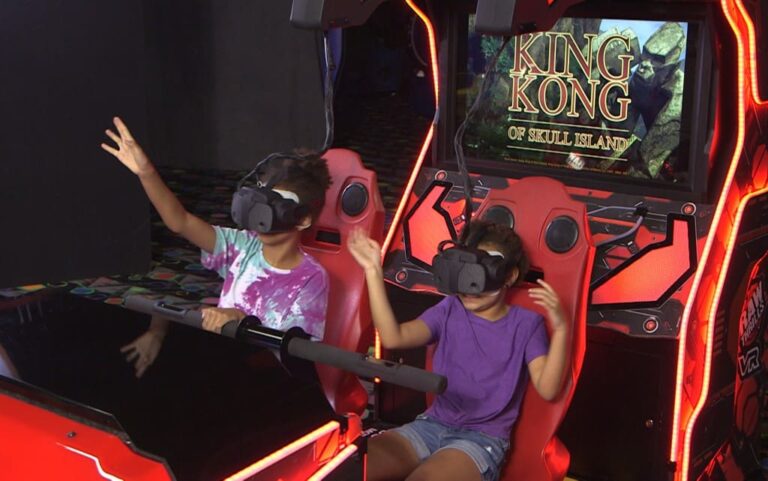
VR ZONE DC Washington DC Indoor VR arcade is located in Washington, DC
VR ZONE DC is a virtual reality arcade located in Washington, DC. They offer an immersive experience with various VR games and activities, including racing, shooting, and exploring different worlds. It is a popular attraction for families, friends, and gamers looking for a unique entertainment option. The arcade also offers birthday party packages and corporate events. VR ZONE DC is a great way to escape reality and immerse yourself in a virtual world.
 Indoors
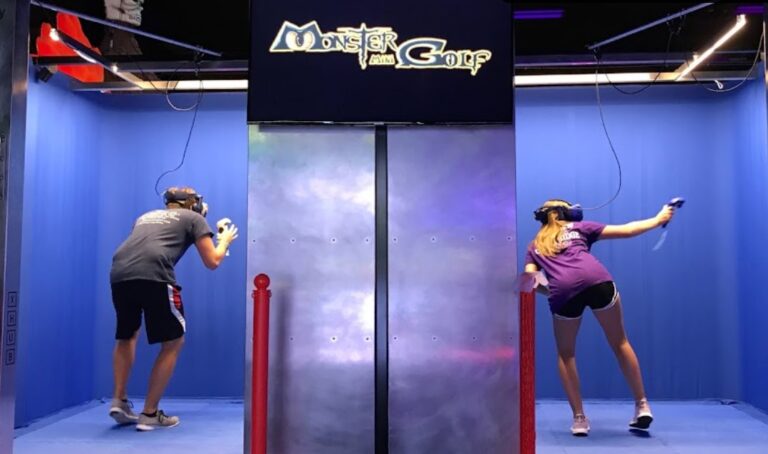
Monster Mini Golf Gaithersburg Indoor Center is located in Gaithersburg, MD.
Monster Mini Golf Gaithersburg is a popular indoor entertainment center in Gaithersburg, MD. It features an 18-hole glow-in-the-dark mini-golf course with spooky and unique monster-themed holes. The center also has an arcade and a laser maze, making it a perfect destination for families, friends, and date nights. The ambiance is spooky and fun with colourful lights and creepy monsters throughout the course. The center offers birthday party packages and corporate events as well. The venue is open seven days a week, and tickets are reasonably priced.
IndoorsAnother World Virtual Reality Arena is located in Bel Air, MD.
Step into Another World Virtual Reality Arena, a premier destination in Bel Air, Maryland, where the boundaries of reality blur and the world of virtual immersion comes to life. This isn’t just a gaming center; it’s a portal to unforgettable adventures for individuals of all ages, promising an experience unlike any other.
Spacious Gaming Arena for Team-Based VR Battles. Prepare to be transported to the heart of the action within a sprawling 200 ft2 gaming arena. Comfortable Lounge Zone for Relaxation and Celebration. Diverse VR Attractions to Suit Every Taste
Another World specializes in creating unforgettable events tailored to your specific needs. Whether you’re planning a birthday party, a corporate teambuilding exercise, or any other special gathering, their team is equipped to handle every detail. They offer customized packages, catering options, and dedicated support to ensure that your event is a resounding success. They strive to create lasting memories for every guest, transforming ordinary occasions into extraordinary experiences.
IndoorsSandboxVR Tysons is located in Tysons, VA.
SandboxVR Tysons: Step Into the Future of Immersive Entertainment
Located in Tysons, VA, SandboxVR Tysons offers an unparalleled virtual reality experience that blurs the lines between the digital and physical realms. This venue specializes in crafting immersive adventures for groups, accommodating up to six participants simultaneously, allowing them to visually perceive and interact with each other within the virtual environment, much like in the real world.
A pivotal element of the SandboxVR experience lies in its ability to seamlessly integrate the participant’s physical body into the virtual world. Through the use of Hollywood-grade motion capture cameras, high-precision 3D body trackers, bespoke hardware, and haptic suits, users undergo a compelling sense of transformation. They might even find that they forget they have left the real world.
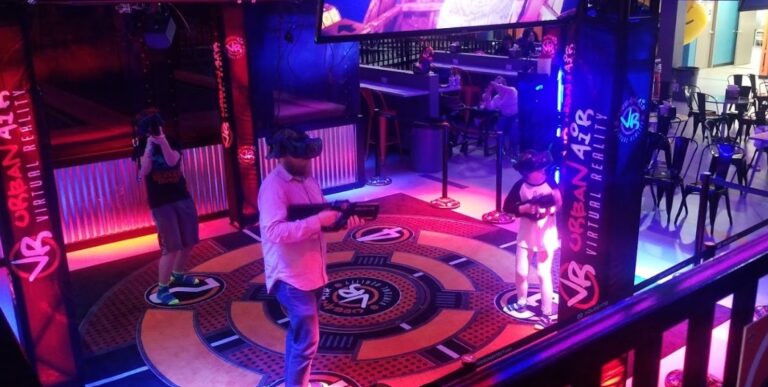
IndoorsUrban Air Trampoline and Adventure Indoor Park is located in Laurel, MD.
Urban Air Trampoline and Adventure Park in Laurel, MD is a go-to place for families and friends looking for a fun and thrilling experience. The park features a variety of attractions, including trampolines, ropes courses, zip lines, climbing walls, and virtual reality games. Visitors can also enjoy the park’s arcade games and food options. Urban Air offers special packages for birthday parties, corporate events, and fundraisers. The park is open seven days a week and provides a safe and enjoyable environment for people of all ages and skill levels.
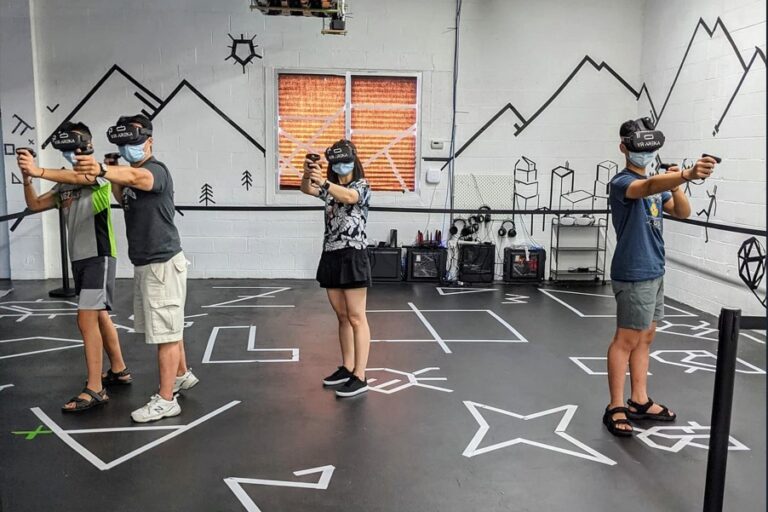
IndoorsTeam Tactics Indoor Laser tag & VR is located in Woodbridge, VA.
Located right in the heart of Woodbridge, Team Tactics offers a unique blend of high-tech weaponry, dynamic arena environments, and objective-based missions that will push your skills and teamwork to the limit. Whether you’re looking for a fun outing with family and friends, a team-building exercise with coworkers, or a competitive showdown with rivals, Team Tactics delivers an unforgettable adventure.
One of the key elements that sets Team Tactics apart is its impressive selection of arenas. Beyond the captivating arenas, Team Tactics boasts an impressive array of weaponry, allowing you to tailor your experience to your individual playing style. Team Tactics elevates the experience beyond simple free-for-all matches with a diverse selection of over 25 objective-based missions.
Beyond Laser Tag: VR Experiences and More. While combat simulation is at the heart of Team Tactics, they also offer other exciting attractions to enhance your visit.
After an intense battle, refuel and recharge at the on-site cafe. Whether you’re looking for a quick snack or a more substantial meal, the cafe provides a convenient and comfortable space to relax and strategize for your next mission.
IndoorsVR ZONE Indoor VR arcade is located in Rockville, MD
VR ZONE in Rockville, MD is an immersive virtual reality entertainment center that offers a range of experiences for all ages. Guests can choose from a variety of games and adventures, including first-person shooters, racing simulators, and puzzle games. The facility features state-of-the-art VR equipment and a spacious play area, allowing visitors to move around freely and fully engage with the virtual world. In addition to individual play, VR ZONE also offers group packages and private parties. Whether you’re a seasoned gamer or new to the world of VR, VR ZONE provides a thrilling and unforgettable experience.
IndoorsMonster Mini Golf Stafford Indoor Center is located in Stafford, VA.
Monster Mini Golf Stafford is an indoor miniature golf course that provides fun and excitement to all ages. Featuring themed holes and black lights, players can enjoy a unique experience while playing a round of golf. The facility also includes an arcade, laser maze, and private party rooms for events and celebrations. With affordable pricing and friendly staff, Monster Mini Golf Stafford offers a great entertainment option for family outings, birthday parties, and group gatherings.
IndoorsMain Event Indoor Laser Tag arena is located in Columbia, MD.
Main Event is a huge entertainment hub where you can spend your weekend or throw a birthday party. These laser-tag battles take place in a multi-story arena with fantasy-like decorations, neon lights, and laborious obstacles. Climb up the towers and rain fire on unsuspecting enemies.
There is also a large recreation area with snacks and drinks to chill after the game. There’s also bowling, pool, VR, mini-golf, a story room, and a ropes course – all available at one single place!
IndoorsFree‑roam virtual‑reality (VR) arenas are purpose‑built spaces where users can move unhindered while wearing a headset that tracks their position in real time. Unlike seated or tethered experiences that confine a player to a single spot, free‑roam arenas combine high‑precision motion‑capture cameras, infrared sensors, and sometimes wireless power stations to create a 360‑degree playground. The result is an immersive environment that mirrors the physical world: participants walk, crouch, jump, and even interact with props while the digital scenery updates instantly around them.
Designers typically line the walls with reflective markers or embed sensors in the floor, allowing the system to maintain sub‑centimeter accuracy. Safety is built into the architecture; padded walls, clear signage, and real‑time collision alerts keep users from bumping into obstacles. Because the arena is a self‑contained ecosystem, multiple participants can share the same virtual world without risk of entanglement or loss of signal—an advantage that sets free‑roam apart from home‑based VR setups.
The versatility of a free‑roam arena stems from the breadth of scenarios it can host. Developers craft experiences ranging from adrenaline‑pumping action games to educational journeys, each taking full advantage of unrestricted movement.
Adventure Questing – Players assume the role of explorers navigating ancient ruins, alien planets, or mythic forests. The ability to physically climb ladders, duck under low arches, or sprint across chasms adds a visceral dimension that flat, controller‑only games cannot replicate.
Team‑Based Combat – Tactical shooters and battle‑royale style matches thrive in free‑roam settings. Teams coordinate in real space, using hand gestures to reload weapons or issue commands, while the arena’s tracking system ensures every shot lands where the player aims.
Simulated Sports – From futuristic zero‑gravity soccer to archery in a medieval courtyard, sports simulations let participants feel the kinetic feedback of real movement. The arena can even incorporate haptic floor panels that vibrate on impact, deepening the sense of immersion.
Narrative Storytelling – Interactive dramas place users at the center of a plot, prompting them to search rooms, solve puzzles, or converse with virtual characters. Because the environment reacts to bodily actions, the storytelling feels personal and immediate.
Educational Expeditions – Museums and science centers use free‑roam to transport visitors to the depths of the ocean, the surface of Mars, or the inner workings of the human body. Learners can walk through a coral reef, manipulate virtual molecules, or observe a dinosaur skeleton from every angle, turning abstract concepts into tactile experiences.
The common thread across these scenarios is the removal of physical constraints, which encourages users to engage their whole body, heightening both excitement and retention.
The demographic landscape of free‑roam VR is surprisingly broad. Early adopters were primarily tech enthusiasts and gamers, but the accessibility of wireless headsets and the safety of arena environments have expanded the user base dramatically.
Gamers and Competitive Players – Hardcore gamers gravitate toward free‑roam for its high skill ceiling. The physicality of the medium introduces new strategies and reflex demands, turning virtual competitions into true sport‑like events.
Families and Casual Visitors – Parents seeking novel entertainment for their children find arenas appealing because the monitored space reduces the risk of injury. The shared experience also fosters bonding, as families can cooperate on puzzles or compete in friendly duels.
Educational Institutions – Schools, universities, and research labs employ free‑roam to create immersive labs. Biology students can dissect a virtual frog, while history majors walk through a reconstructed Roman forum, making abstract curricula concrete.
Corporate Teams – Companies use the arenas for team‑building exercises, leadership training, and product demos. The collaborative nature of many scenarios encourages communication, problem‑solving, and empathy among participants.
Event Organizers – Birthday parties, graduation celebrations, and corporate galas increasingly incorporate free‑roam VR as a headline attraction, offering guests a memorable, interactive focal point that stands out from traditional catering and music.
By catering to both serious users and casual explorers, free‑roam arenas have become a cross‑generational hub for experiential entertainment.
When it comes to younger audiences, free‑roam VR introduces a unique blend of fun and learning that aligns with developmental goals. The physical movement required by the platform supports motor‑skill development, while the immersive visuals stimulate imagination and curiosity.
Designers tailor kid‑friendly experiences with simplified controls, bright color palettes, and narratives that encourage cooperation rather than competition. Safety remains paramount: arenas enforce lower speed limits for younger participants, provide adjustable harnesses, and staff each session with trained supervisors who can intervene if a child becomes disoriented.
Beyond amusement, educational modules leverage the medium to teach scientific principles, language skills, and social-emotional lessons. For example, a space‑exploration scenario might require children to locate and label constellations, reinforcing astronomy concepts in a hands‑on way. Because the virtual world reacts to the child’s gestures, learning feels like play, fostering intrinsic motivation and deeper knowledge retention.
Integrating free‑roam VR into celebrations adds an element of novelty that transforms ordinary gatherings into unforgettable experiences. Organizers can select from a menu of themed packages tailored to the occasion.
Birthday Parties – A “Superhero Training Camp” lets the birthday child and guests complete obstacle courses, practice virtual laser‑tag, or solve mystery riddles—all while donning themed headsets. The arena can be decorated with custom graphics, and the event staff can record highlight reels for families to keep as souvenirs.
Graduations – For milestone ceremonies, a “Future‑World” scenario enables graduates to explore career‑related simulations—engineering labs, medical operating rooms, or creative studios—providing a playful glimpse of post‑school life. Group photo booths within the virtual space capture avatars in graduation caps, merging tradition with technology.
Corporate Parties – Companies often choose competitive team‑based games that mirror real‑world challenges, such as virtual escape rooms that demand cross‑departmental collaboration. Product launches can be staged inside the arena, allowing attendees to interact with a 3D prototype as if it were physically present. After‑hours, a relaxed “virtual lounge” mode offers casual networking in a stylized digital environment.
Logistics for these events are streamlined by arena operators who handle equipment sanitation, participant onboarding, and session scheduling. The result is a turnkey solution that adds a high‑tech wow factor without burdening the host with technical minutiae.
Researchers across multiple fields have examined the impact of free‑roam VR on cognition, physiology, and social dynamics. Their findings suggest that the technology offers benefits beyond entertainment.
Cognitive Enhancement – Studies indicate that spatial navigation tasks performed in free‑roam environments improve memory retention and mental mapping abilities more effectively than desktop simulations. The combination of visual immersion and proprioceptive feedback appears to engage hippocampal processes associated with learning.
Physical Activity – Compared with sedentary VR experiences, free‑roam sessions increase heart rate and calorie expenditure, positioning the medium as a viable supplement to traditional exercise regimes. Some health‑focused programs now incorporate short, gamified VR bouts into rehabilitation protocols for patients recovering from injuries.
Social Interaction – Experiments involving cooperative tasks demonstrate that participants exhibit higher levels of empathy and trust when collaborating in a shared virtual space. The embodied avatars, coupled with real‑time gestures, foster a sense of presence that rivals face‑to‑face meetings.
Industrial Training – Engineers and safety officers endorse free‑roam VR for high‑risk training scenarios such as hazardous material handling or emergency response. The ability to practice complex procedures without real-world consequences reduces training costs and improves skill transfer.
Future Directions – Experts caution that scalability and cost remain challenges. While large urban centers boast dedicated arenas, broader adoption will hinge on portable, modular setups and advances in wireless tracking technology. Nonetheless, the consensus underscores a trajectory toward integrating free‑roam VR into mainstream education, healthcare, and workplace learning.
Collectively, these perspectives reinforce the notion that free‑roam VR is not merely a novelty but a versatile tool with measurable impacts on human performance and well‑being.
Free‑roam virtual‑reality arenas represent a convergence of cutting‑edge hardware, inventive software, and thoughtful design. By liberating users from the constraints of stationary play, they unlock a spectrum of scenarios that span thrilling adventure, collaborative competition, and immersive education. The audience for these experiences has evolved from niche gamers to families, schools, corporations, and event planners, each finding unique value in the medium’s ability to engage the body and mind simultaneously.
For children, the technology offers a safe, active playground that blends learning with fun, while adults discover novel ways to celebrate milestones or boost team cohesion. Scientific research validates many of the anecdotal benefits, highlighting improvements in cognitive function, physical activity, and social connection.
As tracking fidelity improves and costs decline, free‑roam VR is poised to become a staple of public spaces, educational institutions, and workplaces alike. The arena’s promise lies not only in the spectacular experiences it can deliver today but also in the untapped potential it holds for shaping how society learns, collaborates, and celebrates in the years to come.


 2300 Wisconsin Ave NW suite g-101, Washington, DC 20007, United States