El Monte
 Log in
Log in
Log in

SandboxVR Tysons is located in Tysons, VA.
SandboxVR Tysons: Step Into the Future of Immersive Entertainment
Located in Tysons, VA, SandboxVR Tysons offers an unparalleled virtual reality experience that blurs the lines between the digital and physical realms. This venue specializes in crafting immersive adventures for groups, accommodating up to six participants simultaneously, allowing them to visually perceive and interact with each other within the virtual environment, much like in the real world.
A pivotal element of the SandboxVR experience lies in its ability to seamlessly integrate the participant’s physical body into the virtual world. Through the use of Hollywood-grade motion capture cameras, high-precision 3D body trackers, bespoke hardware, and haptic suits, users undergo a compelling sense of transformation. They might even find that they forget they have left the real world.
 Indoors
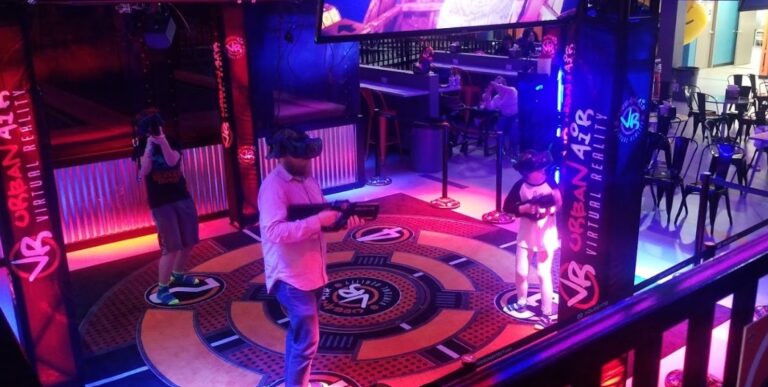
Urban Air Trampoline and Adventure Indoor Park is located in Laurel, MD.
Urban Air Trampoline and Adventure Park in Laurel, MD is a go-to place for families and friends looking for a fun and thrilling experience. The park features a variety of attractions, including trampolines, ropes courses, zip lines, climbing walls, and virtual reality games. Visitors can also enjoy the park’s arcade games and food options. Urban Air offers special packages for birthday parties, corporate events, and fundraisers. The park is open seven days a week and provides a safe and enjoyable environment for people of all ages and skill levels.
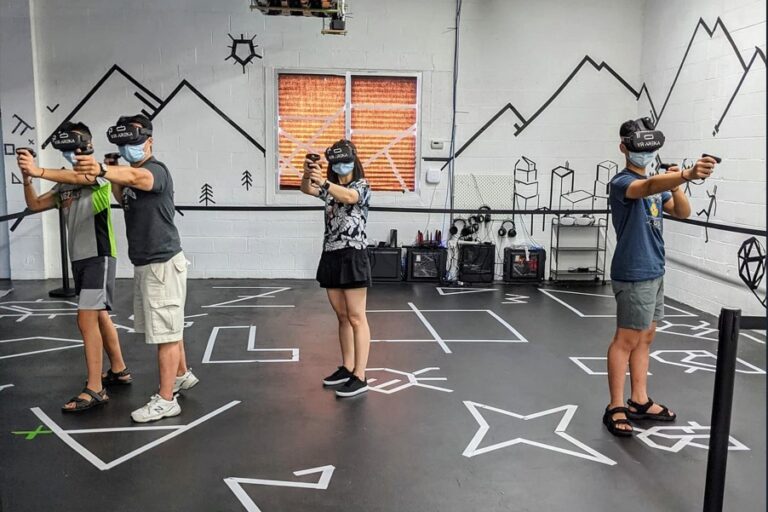
IndoorsAnother World Virtual Reality Arena is located in Bel Air, MD.
Step into Another World Virtual Reality Arena, a premier destination in Bel Air, Maryland, where the boundaries of reality blur and the world of virtual immersion comes to life. This isn’t just a gaming center; it’s a portal to unforgettable adventures for individuals of all ages, promising an experience unlike any other.
Spacious Gaming Arena for Team-Based VR Battles. Prepare to be transported to the heart of the action within a sprawling 200 ft2 gaming arena. Comfortable Lounge Zone for Relaxation and Celebration. Diverse VR Attractions to Suit Every Taste
Another World specializes in creating unforgettable events tailored to your specific needs. Whether you’re planning a birthday party, a corporate teambuilding exercise, or any other special gathering, their team is equipped to handle every detail. They offer customized packages, catering options, and dedicated support to ensure that your event is a resounding success. They strive to create lasting memories for every guest, transforming ordinary occasions into extraordinary experiences.
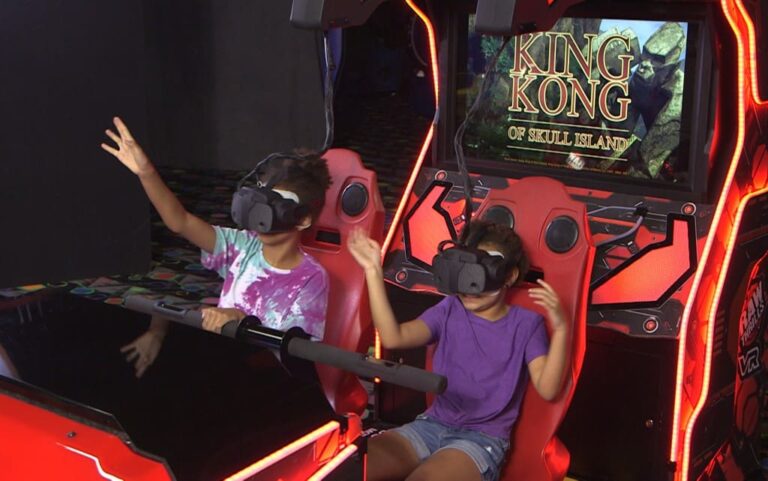
IndoorsVR ZONE DC Washington DC Indoor VR arcade is located in Washington, DC
VR ZONE DC is a virtual reality arcade located in Washington, DC. They offer an immersive experience with various VR games and activities, including racing, shooting, and exploring different worlds. It is a popular attraction for families, friends, and gamers looking for a unique entertainment option. The arcade also offers birthday party packages and corporate events. VR ZONE DC is a great way to escape reality and immerse yourself in a virtual world.
IndoorsVR ZONE Indoor VR arcade is located in Rockville, MD
VR ZONE in Rockville, MD is an immersive virtual reality entertainment center that offers a range of experiences for all ages. Guests can choose from a variety of games and adventures, including first-person shooters, racing simulators, and puzzle games. The facility features state-of-the-art VR equipment and a spacious play area, allowing visitors to move around freely and fully engage with the virtual world. In addition to individual play, VR ZONE also offers group packages and private parties. Whether you’re a seasoned gamer or new to the world of VR, VR ZONE provides a thrilling and unforgettable experience.
IndoorsTeam Tactics Indoor Laser tag & VR is located in Woodbridge, VA.
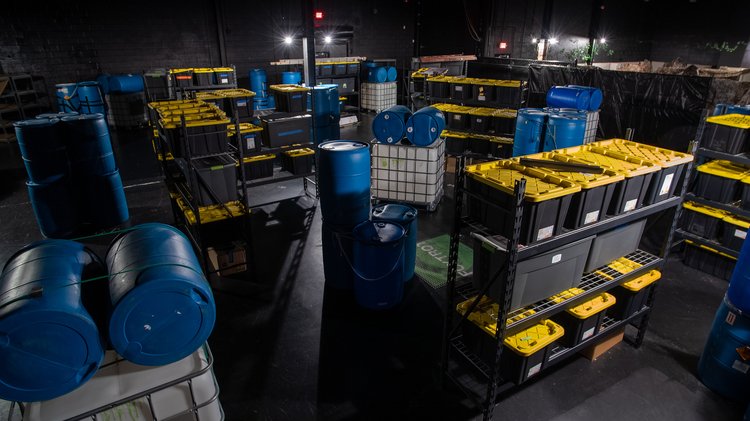
Located right in the heart of Woodbridge, Team Tactics offers a unique blend of high-tech weaponry, dynamic arena environments, and objective-based missions that will push your skills and teamwork to the limit. Whether you’re looking for a fun outing with family and friends, a team-building exercise with coworkers, or a competitive showdown with rivals, Team Tactics delivers an unforgettable adventure.
One of the key elements that sets Team Tactics apart is its impressive selection of arenas. Beyond the captivating arenas, Team Tactics boasts an impressive array of weaponry, allowing you to tailor your experience to your individual playing style. Team Tactics elevates the experience beyond simple free-for-all matches with a diverse selection of over 25 objective-based missions.
Beyond Laser Tag: VR Experiences and More. While combat simulation is at the heart of Team Tactics, they also offer other exciting attractions to enhance your visit.
After an intense battle, refuel and recharge at the on-site cafe. Whether you’re looking for a quick snack or a more substantial meal, the cafe provides a convenient and comfortable space to relax and strategize for your next mission.
IndoorsMain Event Indoor Laser Tag arena is located in Columbia, MD.
Main Event is a huge entertainment hub where you can spend your weekend or throw a birthday party. These laser-tag battles take place in a multi-story arena with fantasy-like decorations, neon lights, and laborious obstacles. Climb up the towers and rain fire on unsuspecting enemies.
There is also a large recreation area with snacks and drinks to chill after the game. There’s also bowling, pool, VR, mini-golf, a story room, and a ropes course – all available at one single place!
IndoorsMonster Mini Golf Stafford Indoor Center is located in Stafford, VA.
Monster Mini Golf Stafford is an indoor miniature golf course that provides fun and excitement to all ages. Featuring themed holes and black lights, players can enjoy a unique experience while playing a round of golf. The facility also includes an arcade, laser maze, and private party rooms for events and celebrations. With affordable pricing and friendly staff, Monster Mini Golf Stafford offers a great entertainment option for family outings, birthday parties, and group gatherings.
IndoorsMonster Mini Golf Gaithersburg Indoor Center is located in Gaithersburg, MD.
Monster Mini Golf Gaithersburg is a popular indoor entertainment center in Gaithersburg, MD. It features an 18-hole glow-in-the-dark mini-golf course with spooky and unique monster-themed holes. The center also has an arcade and a laser maze, making it a perfect destination for families, friends, and date nights. The ambiance is spooky and fun with colourful lights and creepy monsters throughout the course. The center offers birthday party packages and corporate events as well. The venue is open seven days a week, and tickets are reasonably priced.
Indoors
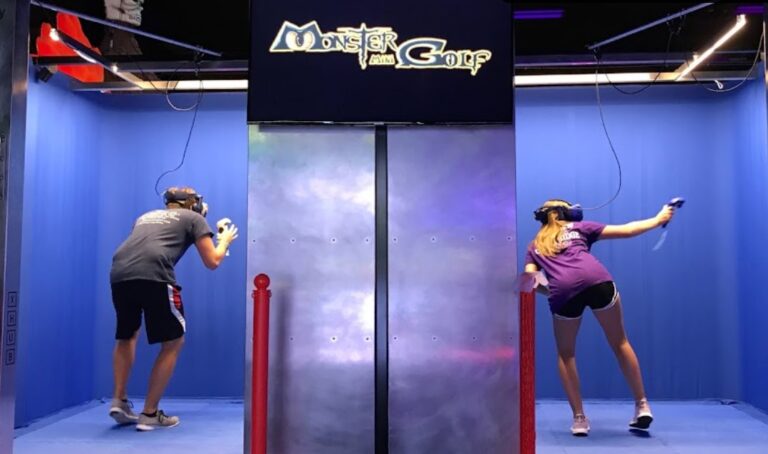
A free‑roam virtual‑reality (VR) arena is a purpose‑built physical space where participants can move about unhindered while wearing head‑mounted displays (HMDs) and, in many cases, full‑body tracking suits. Unlike seated or tabletop VR experiences, which limit motion to a small play area, free‑roam arenas map a much larger footprint—often ranging from a modest 500 sq ft room to a multi‑level warehouse. The environment is instrumented with motion‑capture cameras, infrared beacons, or lidar sensors that continuously triangulate the user’s exact position and orientation. This data is fed to the game engine in real time, allowing the virtual world to stay perfectly aligned with the player’s movements.
Because the arena is a self‑contained ecosystem, external hazards are eliminated: walls are padded, cables are recessed, and safety nets are often installed overhead. The result is a seamless blend of physical freedom and digital immersion, where a user can duck behind a virtual wall, sprint across a futuristic battlefield, or climb a virtual tower, all while staying safe within a clearly defined real‑world boundary.
The technology behind free‑roam VR has matured rapidly. Advances in inside‑out tracking, low‑latency wireless video streaming, and compact, high‑resolution HMDs have made it possible to deliver cinematic‑quality graphics without the tethered constraints that once plagued the medium. Operators can now run multiple simultaneous sessions, each with its own distinct scenario, while the underlying hardware—high‑performance PCs, robust networking, and automated sanitation stations—runs largely unsupervised after the initial setup.
The flexibility of a mapped, movement‑enabled space opens the door to a diverse library of scenarios. Developers design experiences that take advantage of the arena’s three‑dimensional freedom, crafting narratives and gameplay loops that would be impossible in a traditional seated setup.
| Category | Typical Experience | Key Interaction |
|---|---|---|
| Adventure & Exploration | Trek through a lush alien rainforest, navigate a sunken city, or explore a medieval castle. | Walking, crouching, reaching out to manipulate objects, environmental puzzles that require physical positioning. |
| Action & Combat | Team‑based shooters, laser‑tag style battles, or sword‑fighting duels with haptic feedback weapons. | Sprinting, dodging, vaulting over obstacles, precise aiming with hand‑tracked controllers. |
| Simulation & Training | Flight simulators, emergency‑response drills, or industrial equipment operation. | Full‑body gestures, hand‑over‑hand tool usage, real‑time feedback on posture and technique. |
| Social & Party Games | Rhythm dance floors, collaborative building games, or mystery‑solving escape rooms. | Group coordination, shared gestures, large‑scale gestures that affect the shared environment. |
| Educational Journeys | Time‑travel tours of ancient civilizations, microscopic voyages inside a human cell, or planetary exploration. | Interactive learning stations, “grab‑and‑examine” objects, guided narration synced with physical movement. |
These scenarios often incorporate haptic peripherals—vibration‑enabled vests, exoskeleton gloves, or weighted weapons—to deepen the sense of presence. Because the arena tracks the player’s entire body, designers can embed subtle cues such as wind gusts from a virtual storm or resistance when pushing against a virtual gate, turning the environment into a responsive, multisensory stage.
Free‑roam VR has attracted a surprisingly broad demographic, with usage patterns that differ considerably by age group and purpose.
For younger audiences, the arena offers a playground where imagination can run as fast as the body. Games that center on storytelling—such as a pirate treasure hunt or a superhero training camp—allow kids to embody characters in a safe, supervised setting. Because the hardware can be sanitized quickly and the space is physically padded, operators can maintain hygiene standards while letting children engage in vigorous activity.
Parents appreciate that free‑roam VR reduces the “screen fatigue” associated with handheld devices. The requirement to move physically encourages exercise, improves coordination, and offers a tactile learning experience. Many venues provide age‑appropriate content filters and adjustable difficulty levels, ensuring the experience remains challenging without becoming overwhelming.
High school and college students gravitate toward the competitive and social aspects of free‑roam VR. Team‑based shooters, e‑sports style tournaments, and collaborative puzzle rooms satisfy the desire for both adrenaline and camaraderie. The novelty of playing in a space where every jump, duck, and slide translates directly into the virtual world creates a social magnet that often draws friends together for repeat visits.
Corporate groups use free‑roam arenas for team‑building exercises, leadership training, and immersive brainstorming sessions. The medium’s capacity for rapid role‑playing and scenario testing lets professionals practice crisis management, safety protocols, or creative ideation in a risk‑free environment. Even after hours, adult enthusiasts may visit the arena for pure entertainment—immersive concerts, rhythm dances, or narrative adventures that provide a break from screen‑based media.
Overall, the free‑roam VR user base is defined less by age and more by the desire for physically engaging, socially connective experiences that go beyond the capabilities of traditional gaming or passive entertainment.
When it comes to celebrations, free‑roam VR offers a fresh alternative to conventional party venues. The technology can be tailored to fit the theme and scale of any gathering, turning a standard event into an unforgettable adventure.
A birthday party in a free‑roam arena can be structured around a chosen storyline—think “Space Cadet Training” for a budding astronaut or “Wizard Academy” for a fantasy fan. The birthday child becomes the protagonist, while friends join as teammates or rivals. Packages often include themed decorations, customized avatars, and a dedicated “photo‑capture” zone where participants can record short videos of their in‑world achievements. Because the arena is a controlled environment, parents can relax knowing that the activities are safe, supervised, and free of external hazards.
Graduates seeking a memorable milestone experience can opt for a “Future‑World” scenario, where they navigate a cityscape that symbolizes their upcoming professional journey. Group challenges that require cooperation—such as building a virtual bridge or solving a timed puzzle—reinforce the notion of teamwork that graduates will carry into the workforce. Many venues provide commemorative digital trophies and personalized avatars reflecting the graduating class’s colors and insignia.
Corporate events benefit from the scalability and versatility of free‑roam VR. Companies can schedule a series of mini‑competitions—laser‑tag tournaments, escape‑room challenges, or collaborative design games—to foster interdepartmental interaction. The immersive setting encourages employees to step out of their usual roles, break down hierarchical barriers, and engage in informal problem‑solving. Post‑event analytics, supplied by many arena operators, can even track team performance metrics, offering insights for future team‑building initiatives.
In each case, the arena’s ability to quickly reconfigure the virtual environment means that the same physical space can host wildly different celebrations, all while delivering a high‑impact, shareable experience that attendees will recount long after the event concludes.
The scientific community and industry thought leaders have begun to assess free‑roam VR not only as entertainment but also as a platform with broader implications for research, education, and health.
Neuroscientists point out that the embodied interaction in free‑roam VR activates sensorimotor networks more robustly than seated VR. Studies using functional MRI and EEG have shown heightened activation in the parietal cortex—responsible for spatial awareness—and the cerebellum, which coordinates movement. This suggests that free‑roam experiences could serve as valuable tools for studying body‑schema integration, spatial navigation, and the effects of immersive environments on memory consolidation.
Physical therapists are exploring free‑roam arenas as adjuncts to traditional rehabilitation programs. By gamifying repetitive motion tasks, patients recovering from strokes or orthopedic injuries can achieve higher engagement levels, resulting in more consistent exercise adherence. The precise tracking available in these arenas allows clinicians to monitor joint angles, balance, and gait in real time, providing immediate feedback and objective progress metrics.
HCI researchers emphasize that free‑roam VR pushes the boundaries of interface design. The medium forces designers to consider three‑dimensional affordances, haptic feedback, and spatial audio as integral components of the user experience. Industry experts argue that lessons learned from free‑roam interactions will inform the next generation of mixed‑reality devices, where users may transition fluidly between physical and virtual spaces in everyday life.
With greater freedom comes heightened responsibility. Scholars caution that prolonged immersion in physically active VR could lead to fatigue, motion sickness, or disorientation if sessions are not carefully managed. Ethical guidelines are being drafted to address data privacy—especially the collection of biometric movement data—and to ensure that content remains inclusive and accessible across diverse populations.
Analysts predict that the free‑roam VR market will experience double‑digit growth over the next five years, driven by falling hardware costs, increasing consumer appetite for experiential entertainment, and the expanding corporate adoption for training and team‑building. Investment is flowing into modular arena designs that can be installed in malls, amusement parks, and even university campuses, suggesting a future where free‑roam VR becomes a staple of public and private spaces alike.
Free‑roam VR arenas have evolved from niche tech demos into fully realized venues that blend physical freedom with digital immersion. Their ability to host a wide array of scenarios—from adventurous storytelling to high‑stakes combat—makes them appealing to children, teens, adults, and corporate groups alike. By offering safe, customizable environments, these arenas have become popular choices for birthdays, graduations, and professional celebrations, providing experiences that are both memorable and socially connective.
Beyond entertainment, the technology is gaining recognition from scientists and industry experts as a valuable platform for cognitive research, rehabilitation, and the evolution of human‑computer interaction. While safety and ethical considerations remain paramount, the trajectory of free‑roam VR points toward broader integration into everyday life, reshaping how people learn, play, and collaborate.
As the hardware continues to shrink, tracking becomes more precise, and content libraries expand, free‑roam VR arenas are poised to become a cornerstone of immersive experiences—inviting anyone who steps inside to move beyond the screen and truly walk into another world.


 1656 Silver Hill Dr, 1656 Silver Hill Dr, Tysons, VA 22102, United States