El Monte
 Log in
Log in
Log in

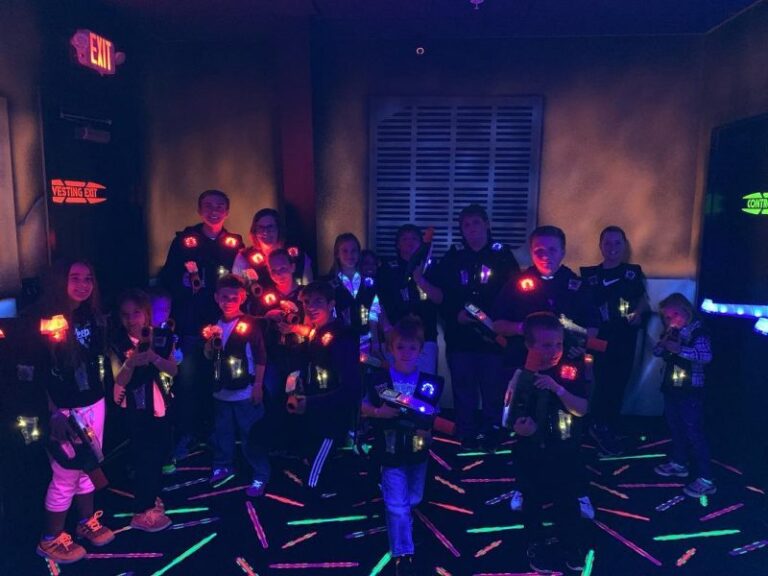
Scallywag Tag sits in the western reaches of Cincinnati, on Glencrossing Way in the West Side neighborhood near Delhi Township. It’s a pirate-themed family entertainment center with a two-story laser tag arena that holds up to 40 players per game, an 18-hole blacklight mini golf course, and a large arcade floor with ticket games. Each laser tag mission includes a briefing and runs about 20 minutes, and the venue has run special seasonal scenarios like a zombie outbreak mission.
Beyond the games, the on-site Topsail Tavern serves food and drinks, including in-house pizza, and can be reserved for events. The venue is built around celebrations and groups — birthday packages with reserved tables and arcade cards, corporate team-building events, private facility rentals, and overnight events — with friendly staff who guide groups through a structured itinerary. It’s a versatile spot for birthdays, corporate parties, team outings, and family days out.
 Indoors
The Place Cincy is a working family entertainment center in Cincinnati, Ohio, located at 3211 Lina Place in the city’s College Hill area. The venue centers on a roller skating rink and adds a two-level neon laser tag arena, a Clip & Climb wall, a ropes course, Spin Zone bumper cars, and more than forty arcade games. Guests can buy single attractions or multi-attraction passes for three hours of unlimited play, and the laser tag arena accommodates groups of up to thirty players.
The center also hosts birthday parties with reserved party space, a party host, pizza and soda, and a Wheel of Prizes spin, plus group events, school outings, corporate gatherings, and fundraisers. A cafe offers a place to relax between rounds, and adult skate nights provide dedicated 18-plus and 30-plus sessions.
IndoorsMain Event West Chester sits just off I-75 between Muhlhauser Road and Cincinnati Dayton Road, south of Union Centre Boulevard, roughly 30 minutes from downtown Cincinnati in the northern suburbs of the metro area.
The center brings together a multi-level laser tag arena, 22 bowling lanes, a gravity ropes course, billiards, and more than 100 arcade games under one roof. Birthday packages come with a dedicated party host, reserved space, and a choice of activities, while laser tag sessions run about 15 minutes each.
Beyond the games, there’s a full-service restaurant and bar with pizza, burgers, wings, and cocktails, plus private party rooms and meeting spaces with big-screen TVs and catering. The venue handles birthdays, corporate events, team building, school outings, graduations, and weddings, and the friendly staff and party hosts help keep everything running smoothly.
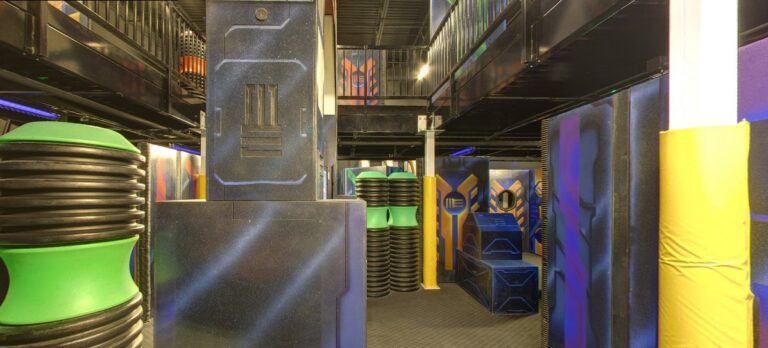
IndoorsScene75 Entertainment Center Cincinnati sits in Milford, Ohio, a short drive northeast of downtown Cincinnati along State Route 28, and ranks among the largest indoor entertainment centers in the country. The venue spans roughly 90,000 to 100,000 square feet and features indoor electric go-karts, a two-story laser tag arena themed as the abandoned District 75, 18 holes of black-light mini-golf, bumper cars, a bouncing inflatable arena, two 4-D theaters, and an arcade with more than 100 games. It was named the Top Family Entertainment Center in North America by the International Association of Amusement Parks and Attractions.
Beyond the attractions, Scene75 Cincinnati is a full event destination with more than eight private and semi-private event spaces, including a banquet hall, a mini-bowling lounge, and dedicated party rooms. The full-service restaurant and two bars serve handcrafted pizza, burgers, and other crowd-pleasing fare, while The Pin Deck adds 16 bowling lanes. The venue hosts birthday parties, corporate events, field trips, youth groups, and holiday gatherings, with packages tailored to different ages and group sizes.
IndoorsThe WEB Extreme Entertainment sits in West Chester Township, Ohio, in Butler County, just north of Cincinnati along Cincinnati-Dayton Road.
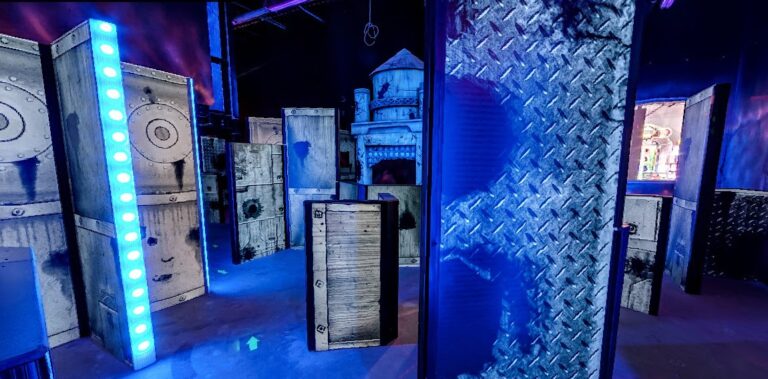
The venue is built around six attractions: a 6,000-square-foot multi-level laser tag arena with eight upper platforms, an indoor electric go-kart track, a wizard-themed mini golf course, a Hawaiian-style mini bowling alley, an augmented climbing wall, and an interactive trampoline. It also has a large arcade with a prize center and an on-site restaurant, with walk-ins welcome and no reservation needed for general admission.
The WEB hosts birthday parties, graduation parties, family reunions, corporate team-building events, youth group lock-ins, and overnight after-hours takeovers with private access and dedicated staff. Event coordinators handle check-in, gameplay flow, food service, and clean-up, and the venue runs daily specials and package deals, making it a popular all-ages destination for families, date nights, and group outings.
IndoorsThe evolution of recreational combat sports has seen many iterations, but few have achieved the widespread popularity and technological sophistication of laser tag. What began as a futuristic concept inspired by cinematic science fiction has transformed into a global phenomenon that bridges the gap between high-intensity physical activity and advanced gaming technology. Today, laser tag stands as a premier choice for group entertainment, offering a safe, non-contact environment where strategy and agility are the primary drivers of success.
At its core, laser tag is a tag-based sport that utilizes cutting-edge infrared technology to track hits and scores. Despite the name, most modern systems do not use actual lasers for the tagging mechanism, as high-powered lasers would pose significant risks to eyesight. Instead, the “phasers” or “taggers” emit a focused beam of infrared light, similar to the signal used by a television remote control. When this light signal is received by sensors worn by an opposing player, the hardware registers a “hit,” often accompanied by sound effects, vibrations, or light displays.
The equipment typically consists of two main components: the tagger and the sensor array. In many indoor facilities, the sensors are integrated into a wearable vest, whereas outdoor or tactical versions may utilize sensors mounted on headbands or the taggers themselves. This equipment is connected to a central computer system that monitors the game in real-time. This allows for complex scoring metrics, such as accuracy percentages, total tags, and objective-based points. The technological sophistication of modern gear allows for varied fire rates, reload simulations, and even specialized “character classes” that change how a player interacts with the game.
One of the factors that keeps laser tag engaging for long-term players is the sheer variety of game scenarios. Gone are the days when every match was a simple free-for-all. Modern facilities and mobile operators offer scripted missions that mirror the objectives found in popular tactical video games. These scenarios require coordination, communication, and a clear understanding of roles within a team.
Common scenarios include “Team Deathmatch,” where two or more squads compete for the highest total score, and “Capture the Flag,” which requires offensive pushes and defensive standoffs. More complex missions include “VIP Escort,” where one team must protect a specific player while moving through the arena, and “Domination,” where teams fight for control of electronic “bases” or “nodes” scattered across the field. There are also “Infection” modes, where a single “zombie” player attempts to tag others and convert them to their side, creating a fast-paced and chaotic environment. These diverse game types ensure that the experience remains fresh and mentally stimulating, forcing players to adapt their tactics based on the objective at hand.
The benefits of laser tag extend far beyond mere entertainment. From a physiological standpoint, it is an excellent form of cardiovascular exercise. Unlike a standard gym workout, the physical exertion in laser tag is “accidental”—players become so immersed in the game that they do not realize they are running, crouching, and sprinting for thirty minutes to an hour. This high-intensity interval training helps improve endurance, agility, and reflexes.
Mentally and socially, the game acts as a powerful tool for developing soft skills. Success in a team-based mission depends heavily on effective communication and the ability to think under pressure. Players must process information quickly, navigate complex environments, and synchronize their movements with their teammates. Furthermore, laser tag provides a healthy outlet for stress relief. The immersive nature of the darkened arena or the sprawling outdoor field allows individuals to disconnect from daily anxieties and focus entirely on the present moment. Because it is a non-contact sport, it offers the thrill of competition without the physical pain or bruising associated with paintball or airsoft, making it accessible to a wider demographic.
In the eyes of behavioral scientists and educational experts, laser tag is often categorized as a “pro-social” activity. Researchers have noted that collaborative gaming environments foster a sense of community and help individuals develop better conflict-resolution skills. Unlike solitary gaming, the physical presence of teammates and opponents creates a social feedback loop that encourages sportsmanship and collective achievement.
Industry experts also point toward the educational potential of the technology behind the game. The integration of sensors, wireless networking, and data analytics makes laser tag a tangible example of the Internet of Things (IoT) in action. Professionals in the amusement industry view laser tag as a leader in the “active entertainment” sector, noting its ability to draw people away from screens and into physical spaces. Furthermore, safety experts consistently rank laser tag as one of the safest recreational combat sports due to its reliance on light rather than projectiles. This lack of physical impact means that the likelihood of injury is significantly lower than in traditional sports, which has led to its broad acceptance in schools and community centers.
The primary demographic for laser tag has historically been children, and for good reason. It provides a safe environment where they can engage in high-energy play. For kids, laser tag is a “rite of passage” for social development. It teaches them how to work as part of a team and how to handle both winning and losing with grace. Because the equipment is adjustable and lightweight, children as young as six or seven can participate effectively.
The safety of the infrared beams is a major selling point for parents. There is no risk of eye damage from the light emitted, and because there are no projectiles, there is no need for heavy protective masks or padding. Most children’s laser tag facilities also employ marshals who supervise the matches, ensuring that rules are followed and that the play remains fair. For a generation that is highly comfortable with digital interfaces, the “live-action video game” aspect of laser tag is incredibly appealing, encouraging them to get active while engaging with technology they enjoy.
Laser tag has become a staple for major life events and professional gatherings due to its versatility. For birthday parties, it offers an all-inclusive solution for parents; the activity is self-contained, high-energy, and usually managed by staff, allowing the hosts to focus on the social aspects of the day. Graduation parties also benefit from laser tag, as it provides a structured yet exciting way for students to celebrate their achievements and burn off energy before moving on to the next chapter of their lives.
In the professional world, laser tag has emerged as a premier tool for corporate team building. Managers often seek out activities that break down traditional office hierarchies and encourage cooperation. On the laser tag field, a junior employee might be the “commander” of a squad that includes senior executives. This shift in dynamics can improve workplace communication and morale. The strategic nature of the missions requires the same types of problem-solving and delegation used in business, making it a practical exercise in leadership and group cohesion.
The environment in which laser tag is played significantly alters the experience. Indoor venues are the most common and are often designed with a specific theme, such as a futuristic spaceship, a post-apocalyptic city, or a jungle labyrinth. These arenas utilize blacklights, fog machines, and neon paint to create a surreal, atmospheric environment. Indoor play is fast-paced and characterized by close-quarters combat. The controlled environment also means that weather is never a factor, making it a reliable choice for year-round entertainment.
Outdoor laser tag, often referred to as “tactical laser tag,” provides a completely different sensation. Played in wooded areas, urban mock-ups, or open fields, these games take place over much larger distances. The equipment used for outdoor play is often designed to work even in bright sunlight and can have a range of hundreds of feet. Outdoor matches emphasize stealth, scouting, and long-range strategy. Players may find themselves hiding behind natural cover like trees or using man-made bunkers and trenches. The fresh air and larger scale of the environment appeal to those who enjoy a more realistic “simulation” style of play.
In summary, laser tag is a multifaceted sport that caters to a vast array of interests and age groups. Whether it is played in a neon-drenched indoor arena or a rugged outdoor field, the game remains a testament to the power of combining physical activity with innovative technology. It serves as a tool for exercise, a platform for social development, and a premier choice for celebrations, proving that the simple joy of high-tech tag is a universal and enduring form of entertainment.



 5055 Glencrossing Way, Cincinnati, OH 45238