El Monte
 Log in
Log in
Log in

Sandbox VR sits in the northwest corner of Liberty Center in Liberty Township, Ohio, next to Agave and Rye and across from Cooper’s Hawk Winery, with four dedicated virtual reality rooms.
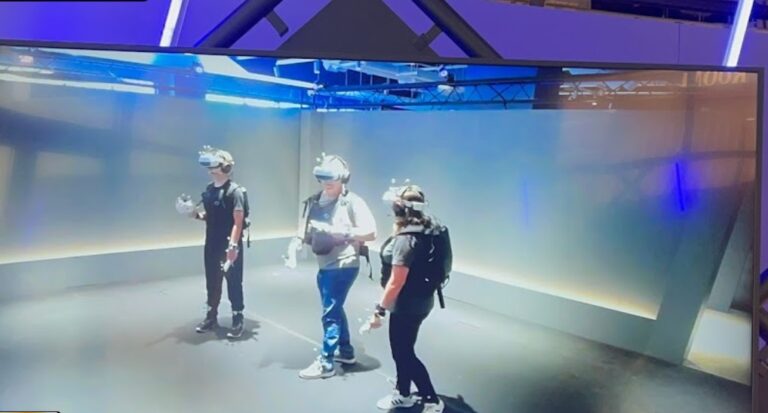
The venue offers full-body, free-roam VR with haptic vests and motion capture, letting groups of two to six play story-driven missions like the Deadwood zombie series, Squid Game Virtuals, Stranger Things: Catalyst, and Age of Dinosaurs. Sessions run about an hour, including gearing up, roughly 30 minutes of active gameplay, and a personalized cinematic highlight reel, with no gaming experience required.
Beyond the games, the staff can create semi-private zones and transform a VR room into a private lounge or meeting space with AV capabilities, making it a strong choice for birthdays, corporate events, team building, and social gatherings. The venue is family-friendly for ages six and up, and its spot inside Liberty Center puts shopping and dining within easy reach.
 Indoors
Main Event West Chester sits just off I-75 between Muhlhauser Road and Cincinnati Dayton Road, south of Union Centre Boulevard, roughly 30 minutes from downtown Cincinnati in the northern suburbs of the metro area.
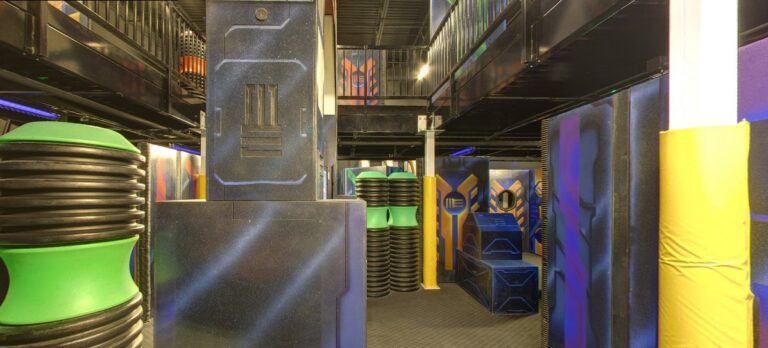
The center brings together a multi-level laser tag arena, 22 bowling lanes, a gravity ropes course, billiards, and more than 100 arcade games under one roof. Birthday packages come with a dedicated party host, reserved space, and a choice of activities, while laser tag sessions run about 15 minutes each.
Beyond the games, there’s a full-service restaurant and bar with pizza, burgers, wings, and cocktails, plus private party rooms and meeting spaces with big-screen TVs and catering. The venue handles birthdays, corporate events, team building, school outings, graduations, and weddings, and the friendly staff and party hosts help keep everything running smoothly.
IndoorsFull Throttle Adrenaline Park sits in Florence, Kentucky, just off I-75 and only minutes from downtown Cincinnati, inside a 46,150-square-foot indoor facility built for groups up to 300.
The park’s main draw is high-speed indoor gas karting with Pro, Junior, and 2-Seater karts, plus a signature two-hour Adrenaline Pass that bundles three kart races, a 30-minute axe lane, and discounted VR. Axe throwing offers six digitally projected lanes, the Omni VR arena uses a multi-directional treadmill for free-roam play, and a rage room lets guests 16 and older smash glass, TVs, and clay pigeons.
Beyond the activities, the venue hosts corporate events, birthdays, bachelor and bachelorette parties, and facility rentals, with two private meeting rooms (Daytona and Bristol), catering from local partners, a full bar, and a concession stand. The crew provides safety briefings, coaching, and race scheduling, while an $8 annual membership covers equipment, liability coverage, and a birthday-month free pass.
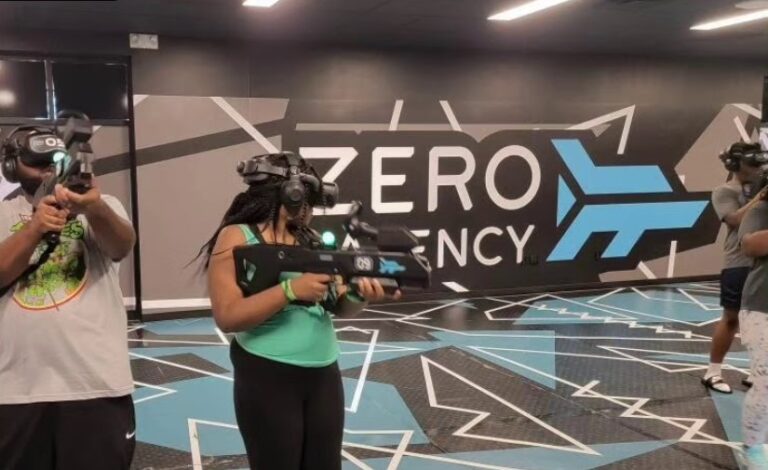
IndoorsZero Latency Cincinnati is located in The Streets of West Chester in West Chester Township, Ohio, just north of Cincinnati and an easy hop off the highway.
This is a warehouse-scale free-roam VR arena where up to eight players walk completely untethered through a space roughly the size of a tennis court, wearing only a headset and controller. The game lineup is built for teams, with cooperative missions like zombie survival and an engineering puzzle game, plus competitive modes, and titles ranging from Far Cry VR to Stranger Things: Catalyst and an Age of Dinosaurs family walk. A typical visit runs about 45 minutes, including a mission briefing and up to 30 minutes of play.
The venue is a natural fit for birthdays, corporate outings, team-building events, and private celebrations, and it can be booked for private events on days when it is closed to the public. Locally owned and operated, it is known for helpful staff who make planning easy, and its location within The Streets of West Chester puts dining and shopping nearby for a fuller outing.
IndoorsFull Throttle Adrenaline Park is located in Springdale, Ohio, minutes from downtown Cincinnati and just off the I-75 and I-275 loop.
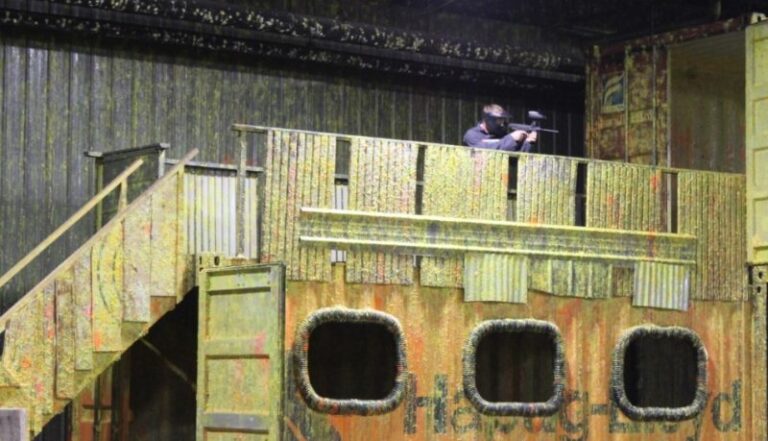
The 115,000 sq. ft. venue centers on high-speed gas go-karting with Junior and Pro karts, plus premium axe throwing with 20+ digital targets, immersive Omni Virtual Reality, and a Rage Room for guests 16 and older. Its signature Adrenaline Pass bundles three kart races with a 30-minute axe lane session into a two-hour block, with discounts on VR and paintball. The park also runs go-kart leagues and features a 20,000 sq. ft. indoor multi-level paintball field offering Paintless Paintball and GellyBall, along with the DETONATE FBI-style scenario game.
The venue is a popular spot for corporate events, team building, birthdays, bachelor and bachelorette parties, and graduations, with five private meeting rooms including the Talladega Room for up to 150 guests. Between activities, guests can relax at the Break Bar, grab snacks or a drink at the full bar, and enjoy catering from award-winning local partners. It’s a well-rounded destination that works for everything from casual racing to full-scale celebrations.
Indoors
The landscape of digital entertainment has undergone a radical transformation over the last decade, transitioning from static, screen-based experiences to fully immersive environments. At the forefront of this evolution is the free-roam virtual reality (VR) arena. Unlike traditional VR, which often confines a user to a small tethered area or a seated position, free-roam technology removes the physical barriers between the player and the digital world. This shift has created a new frontier for social interaction, physical activity, and technological innovation, making it one of the most sought-after experiences in the modern location-based entertainment industry.
A free-roam VR arena is a specialized physical space designed to allow multiple participants to move through a virtual environment without the restriction of wires or hardware boundaries. In a standard home VR setup, users are often limited by the length of a cable or the small dimensions of a living room. In contrast, a free-roam arena provides a large, open floor plan—often ranging from 500 to several thousand square feet—where the digital floor perfectly mirrors the physical floor.
The technology behind these arenas relies on advanced tracking systems. High-precision cameras or internal sensors within the headsets track the exact position of every player in real-time. This ensures that when a player takes a step in the real world, their avatar takes an identical step in the virtual world. To achieve this wireless freedom, participants typically wear lightweight VR headsets paired with “backpack PCs” or utilize high-speed wireless streaming technology. Furthermore, these arenas often incorporate haptic feedback, such as vibrating vests, and physical props that correspond to digital objects. For example, a player might hold a plastic peripheral that feels like a futuristic blaster in their hands, enhancing the tactile realism of the experience. The result is a seamless blend of the physical and digital, commonly referred to as “hyper-reality.”
The versatility of free-roam VR allows for a wide array of scenarios that cater to different interests and skill levels. Because the environment is entirely digital, the same physical room can be transformed into a zombie-infested wasteland one hour and a serene underwater temple the next. One of the most popular genres is the cooperative tactical shooter. In these scenarios, teams must work together to defend a base or navigate through a hostile environment, using the physical space to take cover behind virtual walls and coordinate flanking maneuvers.
Beyond combat-oriented games, free-roam VR has seen a surge in “escape room” style scenarios. These experiences focus on puzzles and environmental storytelling. Players must wander through ancient ruins or space stations, picking up objects, deciphering codes, and physicalizing the act of exploration. There are also educational and “exploration” scenarios where participants can walk through historical recreations, such as ancient Rome or the surface of Mars. The freedom to move naturally makes these scenarios far more impactful than traditional media, as the brain processes the movement as a genuine memory of having “been there.” This variety ensures that the technology remains fresh and repeatable for diverse audiences.
The primary demographic for free-roam VR was initially tech-savvy young adults, but the audience has expanded significantly to include families, seniors, and specifically, children. Because the movement is intuitive—walking is walking—there is no steep learning curve involving complex controller inputs. This makes it highly accessible to children who may struggle with traditional video game mechanics but thrive in an environment where they can use their bodies to interact with the world.
VR for kids has become a major sector of the market, though it is usually governed by age recommendations (typically ages 8 and up) to ensure the hardware fits comfortably and the content is appropriate. For parents, the appeal of free-roam VR lies in its active nature. Unlike traditional gaming, which is often criticized for being sedentary, a 30-minute session in a VR arena is a legitimate physical workout. Children are required to dodge, duck, and walk, turning digital play into physical exercise. Furthermore, the collaborative nature of the games encourages social development. Instead of playing in isolation, children must communicate in real-time with their peers to achieve goals, making it a healthy social outlet that bridges the gap between physical sports and digital entertainment.
The social architecture of free-roam VR makes it an ideal centerpiece for organized events. For birthday parties, it offers a “wow factor” that traditional venues like bowling alleys or movie theaters find difficult to match. The shared adrenaline of a VR mission creates lasting memories, and many facilities provide spectator screens where those not currently playing can watch the action from a third-person perspective, making it an inclusive event for all guests.
Graduation parties also benefit from the high-energy, celebratory atmosphere of a VR arena. It provides a unique “last hurrah” for classmates to bond over a shared adventure before moving on to different life stages. The competitive and cooperative modes allow for mini-tournaments, adding a layer of excitement to the graduation festivities.
Perhaps the most surprising growth area, however, is the corporate sector. Companies are increasingly turning to free-roam VR for teambuilding and corporate parties. Traditional teambuilding exercises can often feel forced or repetitive, but VR forces colleagues to rely on one another in high-pressure, novel situations. Whether it is navigating a complex puzzle or defending a position in a simulated battle, the experience reveals leadership styles, communication breakdowns, and the importance of collective strategy. It levels the professional playing field, as a CEO and a junior intern are equally immersed and must communicate as peers to succeed in the game. This psychological “reset” is highly effective for improving office morale and synergy.
From the perspective of scientists and industry experts, free-roam VR is more than just a gaming gimmick; it is a significant step forward in human-computer interaction. One of the most frequently discussed benefits among experts is the reduction of motion sickness. In traditional “seated” VR, a common issue is the vestibular-ocular mismatch—where the eyes see movement but the inner ear feels the body is stationary. This often leads to nausea. However, in free-roam VR, the physical movement perfectly matches the visual input, largely eliminating the “sim sickness” that has historically hindered VR adoption.
Neurologists are also interested in how these environments affect spatial awareness and neuroplasticity. The requirement to map a large physical space while simultaneously processing a digital overlay engages the brain’s hippocampus and parietal lobe in ways that traditional screens do not. Industry analysts view free-roam as the “bridge” that will eventually lead to the mainstreaming of shared augmented reality (AR) and the broader metaverse. They point to the scalability of the technology and the decreasing cost of hardware as indicators that these arenas will soon become as common as local cinemas.
Furthermore, health experts have highlighted the professional applications of this technology beyond entertainment. The same free-roam principles are being used by first responders and military personnel for high-stakes training. By simulating dangerous environments in a safe, free-roam space, trainees can build muscle memory and situational awareness. This crossover between entertainment technology and practical human development suggests that the free-roam VR arena is merely the starting point for a new era of interactive existence.
The rise of free-roam VR signifies a shift in how society perceives digital engagement. It moves the needle away from passive consumption and toward active, social, and physical participation. As the technology continues to refine—becoming even lighter, more realistic, and more accessible—the boundaries between the physical and the virtual will continue to blur, offering endless possibilities for how people celebrate, learn, and work together.


 7115 Fountain View Dr D-103, Liberty Township, OH 45069, United States