Log in
Scene75 Entertainment Indoor Center Dayton is located in Dayton, OH.
Scene75 Entertainment Center in Dayton, OH offers an exciting and diverse range of activities for all ages. With over 100,000 square feet of indoor space, this entertainment complex boasts a variety of attractions including bowling lanes, laser tag arenas, arcade games, virtual reality experiences, and a movie theater. Whether you’re looking to compete against friends in a game of laser tag, perfect your bowling skills, or simply unwind with a movie, Scene75 has got you covered. The center also features a full-service restaurant and bar, as well as a variety of party packages for birthdays, corporate events, and other celebrations. Come experience the ultimate entertainment destination at Scene75 Entertainment Center in Dayton!
IndoorsLaser Web Dayton is located in Dayton, OH.
Laser Web Dayton: Premier Entertainment and Event Venue in Dayton, OH
Their key attractions include:
Laser Tag
Virtual Reality (VR)
Laser Maze
Arcade
Snack Bar
Birthday Parties and Group Events: Laser Web Dayton specializes in hosting birthday parties and group events. Their recently renovated facility and specially trained party hosts ensure that children and their guests have an enjoyable time. In addition to laser tag and the laser maze, party packages can include fresh made-to-order pizza, soft drinks, and birthday cake. All birthday parties include a brightly colored private party room and tokens for the new arcade games, all at a great value. They strive to provide a seamless and memorable event experience for every group.
IndoorsWoodman Laser Tag is located in Kettering, OH.
Woodman Laser Tag: Experience an Epic Laser Tag Adventure in Kettering, OH
Woodman Laser Tag, located within the Poelking Woodman Bowling Center in Kettering, OH, promises an unforgettable laser tag experience for all ages. They boast the most epic game of laser tag around.
The laser tag arena features two stories and spans 5,000 square feet. They offer weekly specials and group discounts.
Indoors
In an era dominated by digital screens and sedentary entertainment, laser tag has emerged as a powerhouse of active social engagement. It is a game that bridges the gap between the tactical intensity of a video game and the physical demands of a real-world sport. By utilizing infrared technology and light-sensing vests, laser tag allows participants to engage in harmless, high-stakes competition. Whether in a labyrinthine indoor facility or a sprawling outdoor forest, the game fosters adrenaline, camaraderie, and strategic thinking.
At its core, laser tag is a recreational shooting game where players use infrared-emitting light guns to tag designated targets—usually sensors worn by other players or placed on stationary objects. When a player is “tagged,” their vest or sensor typically registers the hit, provides an audio-visual cue, and momentarily deactivates the player, depending on the game’s settings.
Unlike paintball or airsoft, laser tag is entirely painless. There are no projectiles, no welts, and no need for heavy protective goggles. The technology relies on a sophisticated system of line-of-sight infrared beams. Each “phaser” transmits a coded signal to the receiver on the opponent’s gear, ensuring that points are awarded accurately. This safety profile makes it a universally accessible game, allowing for a wide range of ages to participate without the intimidation factor associated with other combat-simulation sports.
The versatility of laser tag lies in its ability to adapt to endless creative scenarios. While basic deathmatch modes—where the objective is simply to tag as many opponents as possible—are common, modern facilities often host complex “mission-based” gameplay:
These scenarios shift the focus from brute force to communication and tactical positioning, ensuring that no two sessions feel the same.
Laser tag is more than just a diversion; it offers a suite of physical and mental benefits. From a cardiovascular perspective, a standard laser tag session is an intensive interval workout. Moving through cover, sprinting across open ground, and crouching to avoid detection engages the entire body. Players often burn hundreds of calories in a single hour without the monotony of a treadmill.
Mentally, the game is an exercise in rapid decision-making. Players must process spatial information, track teammate positions, and react to threats in milliseconds. Furthermore, it is a potent social tool. Because most games require teamwork to win, individuals learn to divide and conquer, delegate roles, and provide covering fire for others. This makes it an effective environment for breaking down social barriers and building genuine rapport among groups.
Behavioral scientists and educational experts have taken note of the impact of structured play like laser tag. Many argue that these games provide “flow states”—a psychological condition where an individual is fully immersed in a task, leading to high levels of focus and enjoyment. By requiring participants to step away from their digital devices and engage in physical, face-to-face cooperation, laser tag promotes pro-social behaviors.
Industry experts also point to the high level of immersion provided by modern equipment. With the integration of haptic feedback, realistic sound effects, and sophisticated arena layouts, the gap between simulation and reality continues to shrink. Experts suggest that as technology like Augmented Reality (AR) begins to bleed into the laser tag sector, the game will evolve into an even more deeply engaging sensory experience, potentially doubling as a training tool for professional teams or emergency service simulations.
While laser tag is often marketed toward families, its demographic is surprisingly broad. For children, the game acts as a vital outlet for energy and curiosity. It teaches the importance of sportsmanship, following rules, and fair play in a controlled environment. Parents often favor laser tag for kids’ birthday parties because the logistics are handled by the facility staff and, unlike traditional play centers, it encourages kids to work toward a common goal rather than simply running in circles.
The adaptability of laser tag makes it a premier choice for milestone celebrations.
The experience of laser tag varies significantly depending on the venue.
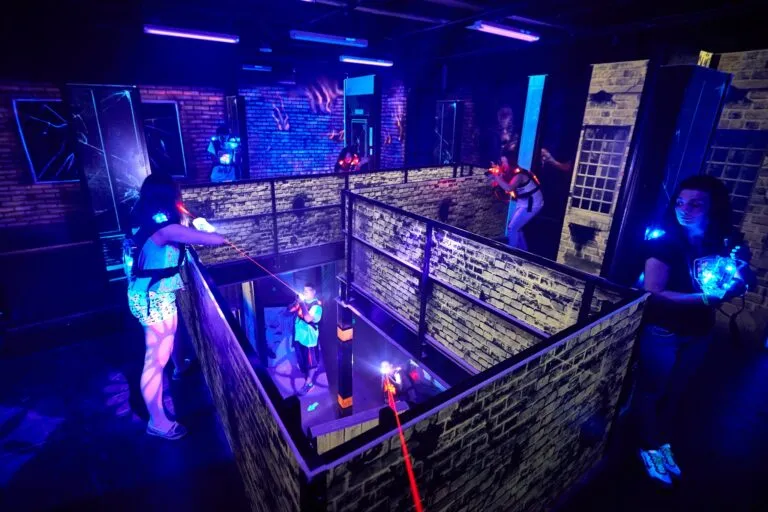
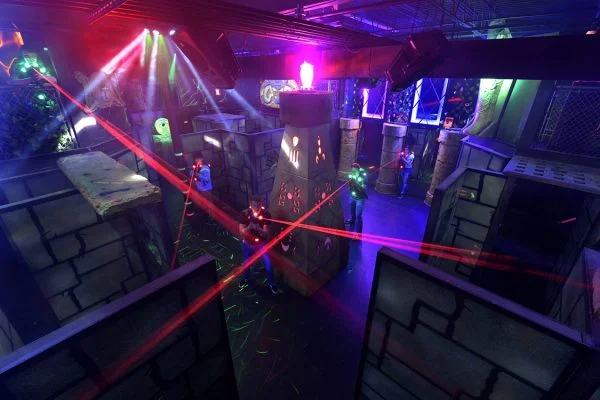
Indoor Venues: Most commonly found in urban centers, indoor arenas are typically dark, illuminated by neon lights, and filled with “fog” to make visible the infrared beams. These venues utilize multi-level mazes, high-tech sound design, and reflective wall art to create a futuristic, high-intensity atmosphere. They are weather-proofed and ideal for year-round play.
Outdoor Venues: Outdoor laser tag mimics the “mil-sim” (military simulation) experience. Often situated in woodlands or parks, these venues use natural terrain—hills, trees, and rock formations—as natural cover. Outdoor gear is often more rugged and powerful, designed to travel longer distances. This format appeals to those who enjoy the fresh air and the tactical challenge of utilizing natural landscapes for stealth and maneuverability.
Ultimately, whether indoors or outdoors, laser tag remains one of the few forms of entertainment that successfully combines technology, physical fitness, and human interaction. It invites participants to put down the controller and step into the game, proving that the most compelling virtual experiences are the ones we play in reality.