TOP 10 best of the best Free-roam VR in Dayton, OH – Battleonix
El Monte
Log in
0

Advanced Search:

City

Rating

Playground


Price:

Main / Catalog / VR / Ohio, US / Dayton, OH

The best Free-roam VR near me in Dayton, OH

img
from $9
VRLaser tag

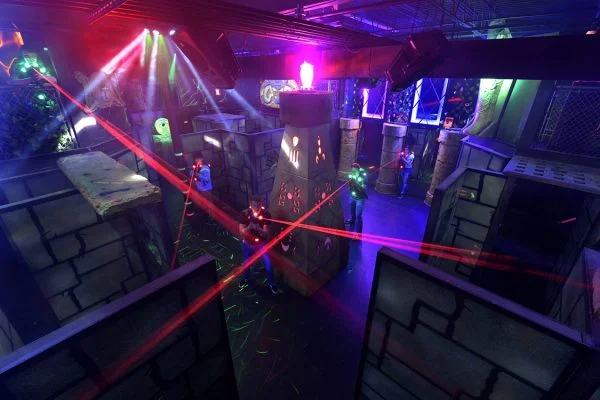
Laser Web Dayton is located in Dayton, OH.


Laser Web Dayton: Premier Entertainment and Event Venue in Dayton, OH

Their key attractions include:

Laser Tag
Virtual Reality (VR)
Laser Maze
Arcade
Snack Bar

Birthday Parties and Group Events: Laser Web Dayton specializes in hosting birthday parties and group events. Their recently renovated facility and specially trained party hosts ensure that children and their guests have an enjoyable time. In addition to laser tag and the laser maze, party packages can include fresh made-to-order pizza, soft drinks, and birthday cake. All birthday parties include a brightly colored private party room and tokens for the new arcade games, all at a great value. They strive to provide a seamless and memorable event experience for every group.

Indoors

Best of the best Free-roam VR in Dayton, OH


Beyond the Screen: The Immersive World of Free-Roam VR Arenas

Virtual Reality has long been associated with the solitary experience of a headset strapped to one’s face, tethered to a desktop computer, or confined to a tiny square of carpet in a living room. However, the landscape of digital entertainment has undergone a massive shift with the arrival of free-roam VR arenas. These expansive, physical play spaces are redefining how humans interact with virtual worlds, turning passive observation into active, full-body exploration.


What is a Free-Roam VR Arena?

At its core, a free-roam VR arena is a purpose-built environment designed to host multiple players moving freely through a physical space while their movements are tracked in real-time within a simulated reality. Unlike home-based VR, which often requires a “guardian boundary” to prevent players from walking into walls, free-roam arenas utilize sophisticated optical tracking, high-end motion capture cameras, and powerful localized servers to map an empty room onto a virtual world.

When a player enters a free-roam arena, they are typically equipped with a lightweight backpack computer, a high-fidelity wireless headset, and specialized haptic peripherals. Because the physical layout of the room—the walls, pillars, and designated “safe zones”—is perfectly synchronized with the digital environment, players can walk, run, and interact with objects without the constant fear of collision. This creates a state of “presence,” a psychological phenomenon where the brain accepts the virtual environment as an actual physical space, leading to heightened immersion that static VR simply cannot replicate.


Free-Roam VR Scenarios

The versatility of free-roam VR allows for a diverse range of scenarios that cater to different thrill levels and interests. Because the “set” is digital, the environment can change instantly from a desolate lunar landscape to an ancient, crumbling ruin, or even a futuristic neon metropolis.

Popular scenarios often revolve around cooperative gameplay. In many arenas, groups of up to eight players are pitted against waves of robotic adversaries or cosmic horrors, requiring them to communicate and move in formation to survive. Others focus on puzzle-solving, where teams must manipulate giant virtual levers or synchronize their movements to unlock ancient doors.

Beyond gaming, there are educational scenarios that transport users into the bloodstream of the human body or allow them to walk through historical reconstructions, such as the streets of Rome or the deck of a sinking ship. The lack of artificial movement—such as using a joystick to walk—is the greatest strength of free-roam VR. By moving their actual legs to traverse a virtual mile, users avoid the common pitfall of motion sickness, making these scenarios accessible to a wider demographic of people.


Who Plays on Free-Roam VR Arenas? VR for Kids

While early VR adopters were primarily tech enthusiasts, the accessibility of free-roam arenas has widened the demographic significantly. These spaces are increasingly becoming a staple of family entertainment.

When it comes to VR for kids, free-roam arenas offer a unique advantage: they are active. Instead of sitting on a couch glued to a monitor, children are encouraged to use their bodies, coordinate with their peers, and solve complex problems in a three-dimensional space. Many arenas provide “kid-friendly” modes with lower difficulty settings and age-appropriate content, ensuring a safe yet thrilling experience. Parents often find that free-roam VR serves as an excellent “controlled” digital experience, where children are socially engaged with their friends rather than being isolated in a sedentary, screen-based environment.


Free-Roam VR for a Birthday Party, Graduation, and Corporate Parties

The “event-hosting” capabilities of free-roam VR arenas have turned them into prime locations for group celebrations. Traditional party venues often struggle to provide a shared experience that is truly interactive; in a bowling alley, for example, participants spend much of their time waiting for their turn. In a VR arena, the entire party is engaged simultaneously.

For a birthday party, it provides an unforgettable, high-tech centerpiece that feels inherently “cool” to participants of all ages. For graduation celebrations, the sense of accomplishment gained from successfully completing a high-stakes mission offers a bonding experience that lasts longer than a typical meal out.

Perhaps the most significant growth, however, is in the corporate sector. Free-roam VR is rapidly becoming the gold standard for team-building exercises. Unlike a series of awkward trust-fall exercises in a conference room, VR requires teams to communicate effectively under pressure. Whether they are navigating a treacherous asteroid field or disarming a virtual bomb, the collaboration required is genuine and high-stakes. Companies are increasingly booking these sessions to break down silos, foster communication, and provide a memorable reward for their teams, proving that virtual reality is a powerful tool for professional development and morale.


Scientists and Industry Experts View on Free-Roam VR

The consensus among scientists and industry experts is that we are currently in the “golden era” of spatial computing. Behavioral scientists have long studied the effects of immersion, and the consensus is that free-roam VR provides a level of cognitive engagement that mirrors real-world learning. By engaging the vestibular system—the feeling of movement and balance—and the visual system simultaneously, the brain encodes virtual experiences with the same intensity as physical ones.

Industry experts point to the scalability of this technology as the next major hurdle. As hardware becomes lighter and wireless bandwidth becomes faster, the “backpack” PC is slowly being phased out in favor of “all-in-one” headsets that can process data via edge computing. This shift will allow for even larger arenas—warehouses the size of soccer fields—where players might eventually experience persistent, open-world environments that evolve as they play.

Furthermore, experts highlight that the social dimension of free-roam VR is its most valuable asset. While home VR has struggled with the feeling of isolation, the arena model prioritizes physical presence. You are not just seeing an avatar of a friend; you are feeling the ambient noise of their movements next to you, hearing their voice in 3D space, and reacting to their physical presence. This social anchoring is what experts believe will drive the future of “location-based entertainment” (LBE), ensuring that even as the world becomes more digital, the human need for shared, physical activity will always have a home in the arena.

In conclusion, free-roam VR arenas are much more than just a place to play games; they are the frontier of human-computer interaction. By breaking the chains of the tether and allowing the user to step into the simulation, these spaces have created a new category of entertainment that is as social as it is technical, and as physically engaging as it is mentally stimulating. Whether for a child’s sixth birthday or a Fortune 500 company’s annual retreat, the arena offers a glimpse into a future where our digital and physical lives are seamlessly integrated.