El Monte
 Log in
Log in
Log in

Ultrazone Family Entertainment is located off Coliseum Boulevard West in Fort Wayne, Indiana, between Lima Road and Goshen Road.
Since opening in 1995, Ultrazone has been Fort Wayne’s go-to destination for multi-level laser tag action. The arena accommodates up to 42 players per game with three-team support, using Zone Helios 2 equipment. Walk-ins are welcome for regular play, while party packages (Standard, Glow, and Ultra-Glow) include a dedicated host, party room, and laser tag games. The “Own the Zone” program offers three hours of unlimited laser tag for groups of 10 to 175, ideal for corporate events, fundraisers, and youth groups.
Beyond laser tag, the venue features a full arcade with games from $0.50 to $2.50 per play, Dragon’s Den Virtual Reality, a concessions counter, and party rooms that double as lounge areas. Pizza from Domino’s can be added to parties and group bookings. The facility also sells merchandise including T-shirts, keychains, and custom player cards. The staff includes dedicated party hosts who manage every aspect of celebrations, from food service to game coordination.
 Indoors
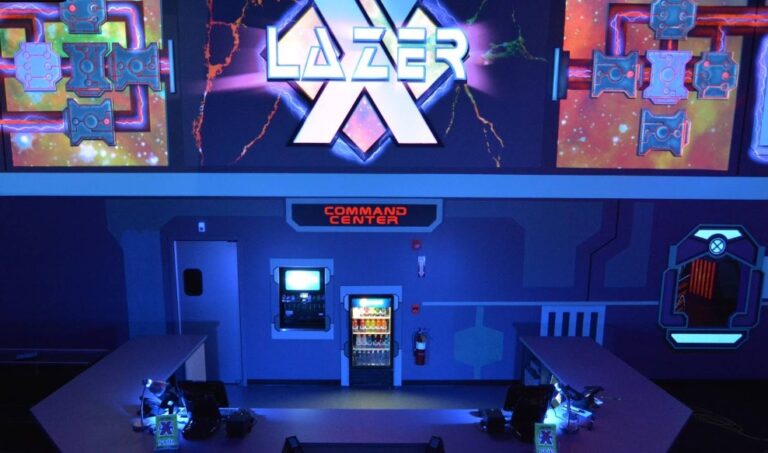
Lazer X is located in Fort Wayne, Indiana, just south of the Glenbrook Square mall next to Target.
The venue boasts the Midwest’s largest laser tag arena — over 9,000 square feet across four levels, filled with UV lights, fog, interactive mines, and themed props. Up to 42 players can battle per game, with detailed scorecards provided after each 16-minute match. The facility also features a full arcade with ticket-redemption games. Group rates make it affordable for parties of any size, with special pricing for 20+ tickets.
Lazer X specializes in birthday parties (with a private party room, free games, arcade tokens, and VIP perks for the birthday person), corporate team building, youth groups, and sports team outings. A $30 annual membership offers free games, monthly perks, and exclusive member events. Locally owned and operated since 1996, the venue is handicap-accessible and can accommodate up to 50 players for group play.
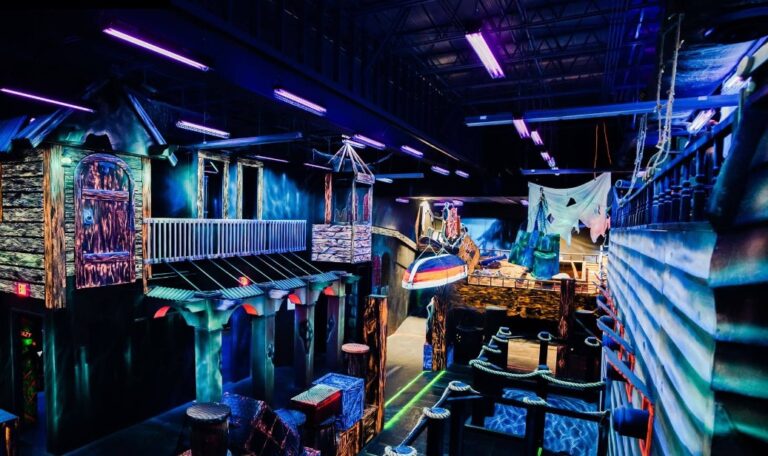
IndoorsCrazy Pinz Entertainment Center is located on the north side of Fort Wayne, Indiana, in a massive 80,000-square-foot facility that has been a family favorite for nearly 20 years. The center offers a wide range of attractions including Piratez Cove laser tag (Fort Wayne’s only fully themed laser tag arena with two pirate ships), Surfside Speedway indoor go-karts, 20 lanes of neon-lit bowling, an 18-hole indoor mini golf course (Maori Falls), the elevated SkyTrail Ropes Course, an augmented reality rock wall, an interactive trampoline game, a three-story ball tent for kids, and the Gilliganz arcade with a redemption store.
Beyond the attractions, Crazy Pinz provides a full-service bar and restaurant (Coconutz) with dine-in and lane-side service, plus a lounge area. The venue specializes in birthday parties, corporate events, team building, and group outings, offering multiple party packages that include a private party area, a dedicated host, sodas, and arcade credits. Catering is available for larger events. The facility also runs weekly specials such as early bird and late-night unlimited bowling, Wednesday happy hour deals, and unlimited laser tag on Tuesdays and Thursdays.
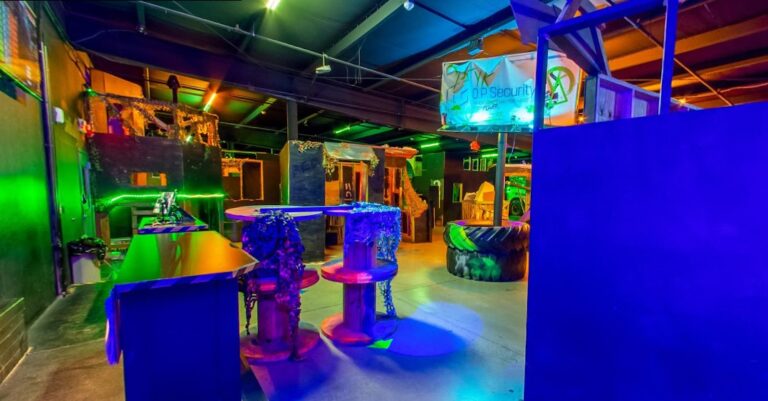
IndoorsCombat Ops Entertainment is located at 702 Ley Road in Fort Wayne, just off I69 and Lima Road. This 33,000-square-foot locally-owned venue features a 10,000-square-foot mission-based laser tag arena with a school bus, tank, and sniper perches, a separate Nerf-style tag arena with soft bunkers, a Gel Blaster Nexus arena, indoor and outdoor axe throwing with digital scoring, a 9-hole mini-golf course, a laser maze, mini-bowling, free-roam VR, and a full arcade. The facility operates on rotating objective-based missions including capture-the-flag, king-of-the-hill, and zombie scenarios, keeping the experience fresh for repeat visitors.
The venue offers four private party rooms, a Caliber Café with pizza and craft beers, and an outdoor pavilion with giant Jenga and cornhole. Birthday packages range from Ambush packs starting at $149 for 6 players to Epic packages at $269+ for 7 players, all including a dedicated party captain, private room time, and player cards. Corporate clients can book private buyouts with unlimited attractions and catering. The facility is well-suited for birthdays, corporate team-building, youth groups, sports teams, and family reunions, with a management team that includes a Purdue Hospitality graduate and a retired Air National Guard veteran who helped design the arena missions.
Indoors
Laser tag is a fast‑paced, team‑oriented game that uses infrared (IR) technology to simulate combat without any physical projectiles. Players wear lightweight vests or harnesses equipped with IR sensors and carry handheld “phasers” that emit encoded light pulses. When a pulse strikes a sensor, the system records a hit, registers points, and often provides immediate audio or visual feedback. Modern laser‑tag arenas are monitored by central computers that track each participant’s score, health status, and game time, allowing for a seamless, real‑time experience.
Unlike traditional paintball, laser tag eliminates mess, reduces the risk of bruises, and can be played in a wider variety of environments—from dimly lit indoor arenas filled with futuristic obstacles to expansive outdoor fields that blend natural terrain with high‑tech props. The game’s flexibility, safety profile, and low barrier to entry have helped it evolve from a novelty attraction in the 1980s into a global leisure activity embraced by families, schools, corporations, and competitive leagues.
The versatility of laser‑tag equipment makes it possible to design a nearly limitless array of scenarios. Below are some of the most popular formats that keep the experience fresh for repeat players.
In a classic free‑for‑all, every player competes against all others. The goal is simple: accumulate the highest personal score before the timer expires. This format is ideal for large groups where splitting into balanced teams would be impractical.
Two or more teams vie for dominance by trying to “tag” opponents while protecting their own members. Points are awarded for hits and deducted for friendly fire, encouraging coordination and strategic positioning.
Each side protects a physical or virtual flag while attempting to infiltrate the opponent’s territory. Successful retrieval of the enemy flag yields a large score bonus, making stealth and quick decision‑making crucial.
Scenario designers craft narrative‑driven missions—such as rescuing hostages, defusing a virtual bomb, or retrieving classified data. Objectives are communicated through the arena’s control system, and players receive real‑time mission updates via their vests.
The arena is divided into several zones that generate points for the team that holds them. Control shifts as players move in and out, creating a dynamic tug‑of‑war that rewards movement and adaptability.
One or a few players start as “infected” and try to tag the remaining “survivors.” Once tagged, survivors become infected themselves, creating an exponential growth curve that tests both defensive tactics and evasion skills.
These scenarios can be combined, tweaked, or entirely reinvented to suit the theme of a birthday party, corporate team‑building session, or school event, ensuring that laser tag never feels stale.
While the primary allure of laser tag is entertainment, the activity also delivers measurable physical, cognitive, and social advantages.
Players are constantly moving—running, ducking, crouching, and sprinting between obstacles. A typical 15‑minute round can burn between 150 and 250 calories, providing a moderate‑intensity workout without the monotony of a traditional gym session.
The need to aim a handheld phaser at moving targets improves fine motor skills and visual tracking. Studies on similar reflex‑based games have shown a measurable increase in reaction speed after repeated play.
Most scenarios depend on coordination. Teams must share information about enemy locations, plan flanking maneuvers, and allocate resources (e.g., “med kits” that restore health in some systems). Such collaborative problem‑solving mirrors real‑world workplace dynamics.
The immersive environment encourages players to focus on the present moment, a principle shared by many mindfulness techniques. The adrenaline surge, paired with the satisfaction of scoring hits, can reduce perceived stress levels after a session.
Because the equipment is lightweight and the impact is purely digital, laser tag is accessible to a wide age range and various fitness levels. Modifications—such as reduced hit sensitivity or slower game pacing—allow individuals with disabilities to participate fully.
Collectively, these benefits make laser tag an attractive option for educators, health professionals, and event planners seeking activities that entertain while promoting well‑being.
Researchers in exercise science, psychology, and human factors engineering have examined laser tag to assess its efficacy as a recreational and training tool. The consensus among experts is cautiously optimistic.
From an exercise physiology perspective, studies indicate that laser tag can achieve heart‑rate zones comparable to brisk walking or light jogging, especially when played in high‑intensity modes. Dr. Elena Martínez, a sports scientist at the University of Barcelona, notes that the intermittent nature of the game mirrors interval training, offering cardiovascular benefits without the monotony of treadmill work.
Cognitive psychologists have explored the impact of fast‑paced decision‑making required in laser‑tag scenarios. Experiments demonstrate improved selective attention and faster response times among regular participants. The technology’s ability to provide instant performance feedback is highlighted as a key factor in reinforcing learning loops.
In the corporate training arena, human‑factors specialists argue that laser tag can serve as a low‑cost, high‑engagement platform for studying team dynamics under pressure. Simulated combat environments allow analysts to collect data on communication patterns, leadership emergence, and risk‑taking behavior without exposing participants to real danger.
However, experts also caution against over‑reliance on laser tag as a substitute for more structured physical education. The activity’s intensity can vary dramatically based on arena design and scenario rules, meaning that outcomes are not uniform across all venues. Moreover, the lack of tangible impact (no paintball or airsoft projectile) may lead some participants to underestimate the importance of safety protocols in other high‑risk activities.
Overall, the scientific community regards laser tag as a promising, multi‑dimensional tool that complements existing fitness, educational, and team‑building programs when implemented thoughtfully.
Laser tag’s universal appeal stems from its ability to adapt to different age groups, skill levels, and interests. For children, the activity often serves as a gateway to active play and social interaction.
Most commercial laser‑tag systems feature adjustable sensitivity settings. For younger children (typically ages 5–9), the sensors are calibrated to register hits from a broader area, reducing frustration and encouraging confidence. The equipment is also built to be durable and lightweight, ensuring comfort during prolonged sessions.
Schools incorporate laser tag into curricula to reinforce concepts such as physics (light propagation), teamwork, and strategic planning. Teachers can align specific scenarios with lesson objectives—e.g., a “mission‑based ops” round that requires students to calculate the shortest route to a target while avoiding obstacles, thereby practicing spatial reasoning.
Playing in teams fosters peer bonding, negotiation, and conflict resolution. Children learn to express their ideas, listen to teammates, and celebrate collective successes. The instant feedback loop—audible beeps and visual score displays—provides clear, objective reinforcement that helps develop a growth mindset.
Because laser tag is non‑contact and free of projectiles, parents view it as a safer alternative to activities like paintball. Nevertheless, venues enforce basic safety rules: no aiming at the face, no running in excessively crowded areas, and mandatory supervision by trained staff.
By tailoring the experience to younger participants, laser tag becomes more than a pastime; it evolves into a structured environment that nurtures physical health, cognitive development, and social competence.
The adaptable nature of laser tag makes it a popular centerpiece for a variety of celebrations and gatherings.
A laser‑tag birthday party offers an action‑packed alternative to traditional cake‑and‑games events. Packages often include themed décor, custom music playlists, and personalized scoreboards displaying each child’s performance. Parents appreciate the all‑inclusive nature—food, staff, and equipment are bundled, allowing them to enjoy the celebration without logistical headaches.
Graduates looking for a memorable send‑off can turn to laser tag for a high‑energy, team‑building experience. Organizers may design a “class‑versus‑faculty” scenario or a “future‑mission” quest that reflects graduates’ upcoming career paths. The competitive yet friendly atmosphere creates shared memories that last beyond the ceremony.
Companies leverage laser tag to break down hierarchical barriers and foster collaboration. The immersive setting encourages employees to step out of their usual roles, experiment with leadership, and practice rapid decision‑making. Many venues offer post‑game debriefs where facilitators translate in‑game data into actionable insights for workplace improvement. Additionally, the novelty factor boosts employee morale and can serve as a unique recruitment showcase.
Across these event types, the common thread is the blend of excitement, inclusivity, and structured competition that laser tag provides. Organizers can customize game length, difficulty, and narrative to match the tone of the occasion, ensuring that each participant feels engaged and valued.
Laser tag’s flexibility allows it to flourish in both indoor arenas and outdoor environments, each offering distinct advantages.
Purpose‑built indoor facilities are the most common setting. They typically feature darkened rooms, fog machines, ultraviolet lighting, and modular obstacles—such as inflatable barriers, metal corridors, and themed props (spaceship interiors, medieval castles, etc.). The controlled lighting and acoustics enhance immersion, while the compact footprint makes these venues accessible in urban centers. Indoor arenas also permit year‑round operation, regardless of weather conditions.
Outdoor laser‑tag locations take advantage of natural terrain—forests, parks, and abandoned industrial sites. Portable infrared equipment is ruggedized for weather exposure, and power is supplied via generators or solar panels. Outdoor play introduces additional tactical layers, such as elevation changes, vegetation cover, and ambient light fluctuations.
Some operators blend the two approaches, setting up temporary indoor‑style installations within large warehouses or repurposing warehouses for “dome” arenas that simulate outdoor lighting conditions. Additionally, pop‑up laser‑tag events can be mounted at festivals, fairs, or corporate campuses using modular equipment that can be assembled and disassembled quickly.
When selecting a venue, organizers should consider group size, desired scenario complexity, accessibility, and budget. Indoor venues provide consistency and advanced tech integration, while outdoor sites deliver scale and a unique aesthetic. Both environments deliver the core promise of laser tag: a thrilling, low‑impact competition that leaves participants eager for the next round.
From its high‑tech origins to its current status as a versatile recreational staple, laser tag has cemented itself as a multi‑generational activity that balances excitement with safety. Its adaptable scenarios—ranging from free‑for‑all scrimmages to narrative missions—keep the experience fresh, while the measurable benefits in fitness, cognition, and teamwork have attracted the attention of scientists, educators, and corporate leaders alike. Whether children are learning strategic thinking, graduates are celebrating a milestone, or employees are strengthening collaboration, laser tag offers a compelling platform that can be tailored to any audience. With a growing network of indoor arenas and creative outdoor fields, the opportunity to engage in this light‑filled combat adventure is more accessible than ever. As technology continues to evolve, future iterations—potentially incorporating augmented reality, biometric feedback, and AI‑driven scenario generation—promise to deepen the immersion even further, ensuring that laser tag remains a dynamic, ever‑evolving playground for the next generation of players.



 1104 Coliseum Blvd W, Fort Wayne, IN 46808, United States