El Monte
 Log in
Log in
Log in

Tilt Studio Indianapolis is located on the 4th floor of the Circle Center Mall in the heart of downtown Indianapolis.
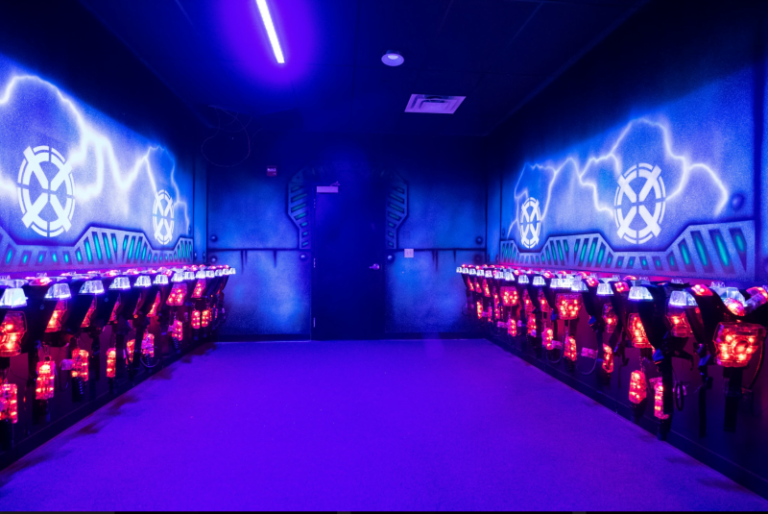
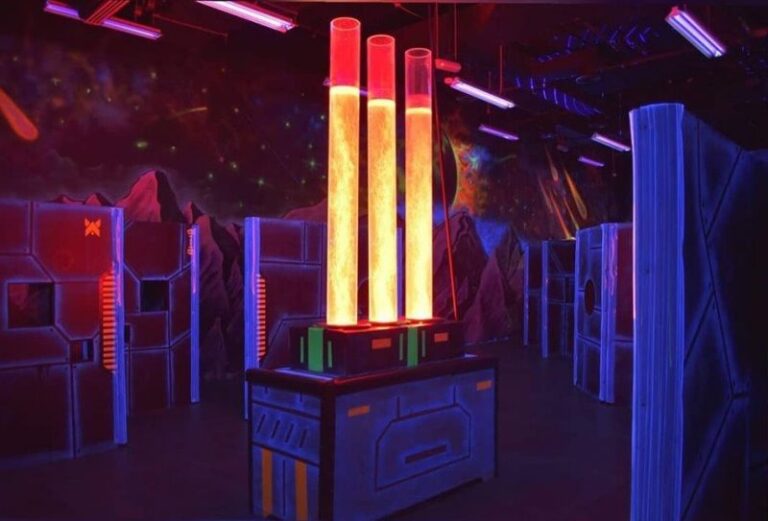
The venue is best known for its Red Planet laser tag arena — a 3,500-square-foot, two-level battleground using the Hyper Blast system with thousands of customizable game modes including solo challenges, team matches, and Zombie Outbreaks. Beyond laser tag, it features over 100 arcade and video games, motion simulators like Indy 500 and Cycraft Street Racing, hyper bowling, and virtual reality experiences such as King Kong of Skull Island VR.
Tilt Studio Indianapolis offers a range of birthday party packages with play cards, pizza, soda, cupcakes, and dedicated party hosts who handle setup and cleanup. The venue also accommodates corporate events, school field trips, fundraisers, and group gatherings in flexible event spaces. The staff is friendly and attentive, and there is a lounge area for guests to relax between activities. The modern, stylish decor creates an energetic atmosphere suitable for visitors of all ages.
 Indoors
Royal Pin Woodland is located on the northeast side of Indianapolis in the Keystone area, near the corner of Keystone Avenue and East 96th Street.
The venue offers 70 state-of-the-art bowling lanes, a two-story laser tag arena for up to 34 players, two 18-hole mini golf courses, an arcade with over 40 games, and a Hologate virtual reality arena. Birthday packages include options like the Pick Two Package (choose any two activities) and the Strike Package with or without food, all featuring a party host, decorated table, and arcade game cards. Corporate and group events are fully customizable with catering, private spaces, and a dedicated events team.
Two full-service bars (Beer30 and Beer30 Too), a café with self-serve kiosks, multiple lounges, and a private boutique area with projection screens provide spaces for relaxing, dining, or hosting semi-private gatherings. The center also offers bowling leagues for all ages, a pro shop, and a smoke-free environment, making it suitable for birthday parties, corporate outings, school events, fundraisers, and casual family visits.
IndoorsBowl 32 / 3-2-FUN! is located in Noblesville, Indiana, just off Westfield Road.
The venue offers 32 state-of-the-art bowling lanes with the immersive Neoverse system, a two-story laser tag arena with a black-lit maze, Hamilton County’s only indoor glow-in-the-dark 9-hole mini-golf course, an arcade with over 65 games using EMBED technology, and WATL-sanctioned axe throwing. Professional party planners handle everything from birthday parties to corporate team-building events and fundraisers, with packages that combine activities and food from Big Dawg Pizza & More.
The on-site Big Dawg Pizza restaurant serves appetizers, salads, sandwiches, and specialty pizzas with laneside service available. A redemption store with rotating prizes, a full bar, and a welcoming atmosphere make it easy to spend the whole day. The facility also hosts reunions, church functions, and club gatherings, with dedicated event coordinators ensuring a smooth experience for groups of all sizes.
IndoorsCombat Ops Entertainment-Indy sits on the south side of Indianapolis, just off I-65 at the Southport Road exit. The 25,000-square-foot facility is the only venue in the city that combines mission-based laser tag, a dark ride theater, Nerf-style tag, axe throwing, mini golf, an arcade, a laser maze, free-roam virtual reality, and dodgeball under one roof. Walk-ins are welcome any day of the week, and guests can choose from objective-based laser missions, foam dart battles, axe throwing on six targets with a private lounge, a nuclear-themed mini golf course, and a multi-sensory 3D dark ride. The arcade runs on a reloadable card system with credits that never expire.
Three private party rooms with dedicated captains are available for birthdays and celebrations, and corporate events can host up to 300 guests with customized team-building packages, private meeting space, and catering. The Caliber Café serves pizza, craft beer, wine slushies, and more. The facility also offers free-roam virtual reality, a laser maze, Flash Pads foot games, and dodgeball, making it a one-stop destination for groups of all ages and competitive spirits.
IndoorsXtreme Lazer Tag is located in Avon, Indiana, just west of Indianapolis.
The venue features a 4,000-square-foot multi-level laser tag arena designed as an intricate maze with obstacles, barriers, and glow-in-the-dark graffiti. Walk-in sessions are available, and the space is well-suited for birthday parties, corporate events, and group gatherings. The arcade with redemption prizes and a snack bar add to the experience.
The facility is family owned and operated, with party coaches available to guide events. Party packages include multiple games, table reservations, and refreshments. The recreation area allows guests to relax between matches, making it a solid choice for celebrations and casual outings alike.
Indoors
Laser tag, also known as laser tag combat, is a team‑or‑individual sport that blends technology, strategy, and physical activity. Players wear lightweight vests equipped with infrared sensors and carry hand‑held “phasers” that emit invisible laser beams. When a beam contacts a sensor, the vest registers a hit and records a score. Unlike paintball or airsoft, there is no projectile to clean up, and the game can be played in a wide variety of settings—darkened indoor arenas, outdoor fields, or even temporary setups in warehouses, gyms, or schools.
The core premise is simple: two or more teams compete to tag opponents while avoiding being tagged themselves. The electronic system tracks each player’s performance in real time, displaying scores, accuracy percentages, and sometimes even a live map of player movement. This immediacy of feedback makes laser tag appealing to tech‑savvy participants and to organizers who appreciate the ease of scoring and safety monitoring.
The flexibility of laser‑tag technology allows it to be adapted for countless scenarios, each with its own set of objectives, rules, and environmental themes.
| Scenario | Typical Setting | Goal | Key Features |
|---|---|---|---|
| Classic Arena Battle | Dark indoor arena with black walls, obstacles, and UV lighting | Eliminate the opposing team or achieve the highest score within a time limit | Simple “team deathmatch” rules, fast‑paced action |
| Mission‑Based Quest | Indoor or outdoor space transformed into a storyline (e.g., alien invasion, rescue operation) | Complete objectives such as capturing a flag, retrieving a “data core,” or rescuing hostages | Integrated mission briefings, checkpoints, and optional puzzles |
| Zombie Survival | Indoor “haunted house” layout or outdoor woodland area | Survivors must avoid being “infected” by laser‑tagged “zombies” while completing tasks | Asymmetrical teams (few zombies vs. many survivors), progressive difficulty |
| Corporate Team‑Building | Dedicated laser‑tag facility or converted office space | Encourage collaboration, communication, and strategic planning | Debrief sessions, leaderboards, and customized challenges linked to company goals |
| Birthday/Graduation Celebration | Portable arena set up in a community center or backyard | Provide a fun, active alternative to traditional party games | Flexible duration, customizable team colors, and “photo‑capture” zones |
| Fitness Challenge | Large outdoor field or gym | Combine cardio exercise with competitive play | Higher movement demands, timed “sprint” rounds, and interval scoring |
The scenario you choose determines everything from the layout of the arena to the rules governing respawns, ammo limits, and power‑up usage. Operators often program multiple scenarios into a single system, letting groups switch between game modes without resetting the equipment.
Beyond the obvious entertainment factor, laser tag delivers a suite of physical, mental, and social advantages that have attracted educators, health professionals, and corporate leaders alike.
Because players are constantly on the move—dodging, sprinting, ducking, and climbing—laser tag provides a moderate‑intensity workout. A 30‑minute session can burn between 250 and 400 calories, depending on the arena’s size and the intensity of play. Unlike traditional gym routines, the activity feels like play rather than exercise, which promotes adherence among children and adults who might otherwise avoid structured workouts.
Laser tag requires rapid decision‑making, spatial awareness, and strategic planning. Players must assess the positions of teammates and opponents, anticipate movements, and coordinate attacks. Research in cognitive psychology links such “fast‑thinking” environments to improved working memory and reaction time. Moreover, mission‑based scenarios that incorporate problem‑solving or riddles nurture higher‑order thinking skills.
The team‑oriented nature of laser tag encourages communication, role assignment, and mutual support. Players quickly learn to assign responsibilities—sniper, scout, defender—and to adapt when plans fail. For children, this translates into better conflict‑resolution abilities and empathy; for adults, it strengthens leadership and collaborative capabilities.
Because the “weapons” are light‑weight infrared emitters, there are no projectiles to cause bruises or injuries. The vests are made of soft, impact‑absorbing material, and the laser beams are invisible, eliminating eye‑damage concerns. Mandatory safety briefings and automatic “hit” feedback further reduce the chance of accidental harm.
Laser tag can be tailored for participants with varying physical abilities. Adjustable vest straps, low‑impact movement requirements, and the option to play seated or standing make the sport inclusive. The lack of mess (no paint or pellets) also simplifies participation for schools and venues with strict hygiene standards.
While laser tag is primarily a recreational activity, its underlying technology and psychological impact have drawn interest from researchers and industry analysts.
Engineers specializing in infrared communication note that modern laser‑tag systems are essentially compact, low‑power networking devices. Sensors can transmit data at frequencies comparable to Bluetooth, enabling real‑time score aggregation and player tracking. “The hardware advances made for laser tag have applications in indoor positioning systems, emergency responder tracking, and even wildlife monitoring,” one technologist observes, highlighting the crossover potential.
A handful of studies published in sports science journals have examined laser tag as a form of “exergaming.” Findings indicate that participants experience heart‑rate zones consistent with moderate aerobic exercise, and that the enjoyment factor leads to longer session durations compared to conventional treadmill workouts. Researchers also point out that the intermittent bursts of sprinting mirror interval training, a highly efficient cardiovascular routine.
Educational psychologists have explored laser tag’s capacity for experiential learning. In simulations where students must accomplish a mission—such as locating a “lost artifact” while navigating a map—the activity reinforces spatial reasoning and collaborative problem solving. The immersive, game‑based context has been shown to increase retention of procedural knowledge compared to lecture‑only instruction.
Industry analysts track the laser‑tag market as part of the broader “location‑based entertainment” sector. Global revenue has risen steadily, driven by the growth of portable, battery‑operated equipment that can be rented for pop‑up events. Analysts predict continued expansion, particularly in emerging markets where youth demographics favor low‑cost, technology‑rich leisure activities.
Laser tag’s appeal spans generations, but certain groups gravitate toward the activity for distinct reasons.
For younger participants, laser tag offers an adrenaline‑filled alternative to video games that also requires physical movement. Schools incorporate laser‑tag sessions into physical‑education curricula to teach teamwork, while after‑school clubs use it as a safe, supervised outlet for energy.
College campuses host regular laser‑tag leagues that function as both social gatherings and competitive sports. The combination of technology, competition, and low cost makes it a popular weekend pastime.
Family‑oriented venues market laser tag as a “generation‑bridging” activity. Parents appreciate the ability to engage in a shared experience that is both fun and physically active, while children enjoy the “cool” factor of wielding a futuristic weapon.
Team‑building consultants recommend laser tag for its ability to simulate high‑pressure situations in a controlled environment. Companies book private sessions to foster communication, test leadership dynamics, and break down hierarchical barriers.
Because the intensity can be modulated and the equipment is lightweight, some senior centers and adaptive‑sports programs have introduced laser tag as a low‑impact activity that encourages mobility and social interaction.
When parents choose laser tag for their children, they are often seeking an experience that balances excitement with developmental value. The structured nature of the game teaches rule adherence, while the need for quick reflexes hones motor coordination. Additionally, most laser‑tag facilities provide age‑segmented arenas or adjustable difficulty settings, allowing younger children to play in a simplified mode where hits count as points rather than eliminations. This reduces frustration and fosters a sense of achievement.
Safety protocols are particularly stringent for younger participants. Vests are sized appropriately, helmets or face shields are optional but available, and staff members maintain a vigilant eye on the playing field. Many venues also offer “parent‑observer” lounges where caregivers can watch the action on live feeds, ensuring peace of mind while still letting kids feel the independence of the game.
A laser‑tag birthday party transforms a traditional celebration into an immersive adventure. Packages often include a dedicated game master, customizable team colors matching party themes, and a “photo zone” where participants can pose with their phasers after the battle. The excitement of competition keeps children engaged, while the built‑in scoring system eliminates the need for a separate referee.
High school and university graduation parties benefit from laser tag’s ability to bring large groups together in a dynamic setting. Organizers can design a “graduation quest” where teams must retrieve symbolic items—diplomas, caps, or scrolls—scattered throughout the arena. The activity serves both as a celebratory outlet for released academic stress and as a memorable final gathering for classmates.
For companies, laser tag is a strategic tool for strengthening team cohesion. Customizable scenarios can mirror business challenges, such as “secure the data center” or “neutralize the competitor.” After the game, facilitators often conduct debrief sessions that translate in‑game performance into actionable insights—highlighting communication gaps, leadership styles, and decision‑making processes. Because the environment is low‑risk and non‑violent, participants can experiment with bold strategies they might avoid in a real office setting.
The location of a laser‑tag session dramatically influences the experience, and both indoor and outdoor options offer distinct advantages.
Indoor facilities dominate the laser‑tag market because they provide a controlled lighting environment, consistent sensor calibration, and the ability to create immersive themes with fog machines, strobe lights, and projection mapping. Typical indoor arenas are 5,000 to 10,000 square feet, featuring maze‑like corridors, multi‑level platforms, and modular obstacles that can be rearranged for different scenarios. The darkness enhances the visibility of infrared hits—players see a brief flash on their vest—while the enclosed space intensifies the sense of tactical maneuvering.
Advantages of indoor play include:
Outdoor laser‑tag expands the canvas to natural terrains—forests, parks, abandoned warehouses, or even urban rooftops. The larger space permits longer sightlines, encourages stealthy hide‑and‑seek tactics, and accommodates larger player counts. Portable laser‑tag kits, powered by rechargeable batteries and ruggedized sensors, enable pop‑up events in schools, summer camps, or community festivals.
Key considerations for outdoor play:
Some modern facilities blend indoor and outdoor elements, offering a “bridge” area where players transition from a dark arena into an open‑air zone. This hybrid design expands strategic possibilities: teams might defend a base inside the building before launching an assault across a meadow. Hybrid venues also attract a broader audience, catering to those who enjoy the cinematic feel of indoor combat and the freedom of outdoor maneuvering.
Whether the goal is a casual family outing, a milestone celebration, or a corporate development program, successful laser‑tag events share several planning pillars:
By addressing these components, organizers can transform a simple laser‑tag session into a memorable, purpose‑driven event.
Laser tag has evolved from a novelty arcade attraction into a versatile platform for recreation, education, and corporate development. Its core technology—infrared sensors coupled with real‑time scoring—offers a safe, low‑maintenance alternative to projectile‑based sports while delivering engaging physical activity and cognitive challenges. The breadth of scenarios—from classic arena battles to mission‑driven quests—means that anyone—from children celebrating a birthday to executives seeking innovative team‑building—can find a version that resonates.
Scientific and industry perspectives underscore laser tag’s potential beyond entertainment, pointing to applications in health‑focused exergaming, spatial tracking technologies, and experiential learning. With an ever‑expanding network of indoor arenas and portable outdoor kits, access to laser tag continues to broaden, making it an increasingly common choice for celebrations, graduations, and corporate gatherings alike.
In a world that increasingly blurs the line between digital interaction and physical experience, laser tag stands out as a bridge—inviting participants to wield virtual laser beams while moving, strategizing, and collaborating in the real world. Whether played under neon‑lit ceilings or amidst the rustle of trees, the sport delivers excitement, fitness, and social connection, confirming its status as a timeless, adaptable form of modern play.



 49 W Maryland St, Indianapolis, IN 46204, United States