
 El Monte
 Log in
Log in
Log in

Palasad South Indoor Laser Tag is located in London, ON
Nestled in the heart of London, ON, Palasad South stands out as a premier venue that seamlessly blends an upscale bar ambiance with a variety of engaging activities. The venue features an impressive 10 pin bowling alley, where you and your friends can engage in friendly competition. The lanes are equipped with modern scoring systems and atmospheric lighting, enhancing the overall bowling experience.
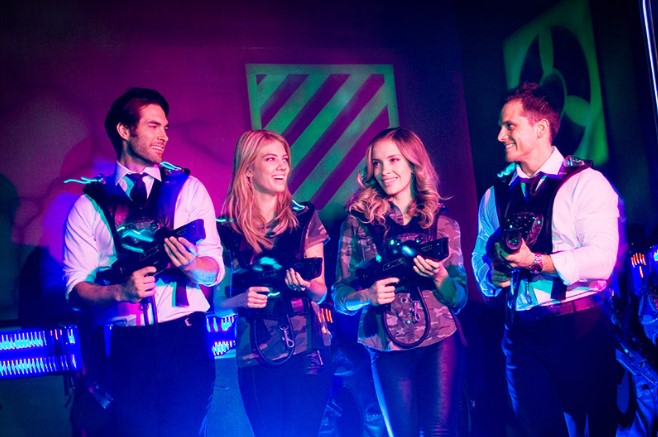
Palasad South is also home to London’s newest two-level laser tag arena, a sprawling battleground that provides an electrifying adventure for participants. Whether you’re celebrating a birthday party, engaging in team-building activities, or simply looking to compete in a Laser Tag Death Match, the arena is designed to offer an unparalleled experience. The two-level structure adds complexity and thrill, making it a top choice for laser tag enthusiasts.
Additionally, Palasad South offers a variety of other entertainment options, including pool and billiards tables, a collection of arcade games, and designated group event areas. The pool and billiards facilities provide a wonderful setting for a relaxed yet competitive game with friends or family. The arcade section is a haven for gamers, featuring a broad array of classic and contemporary games that cater to both nostalgia and modern preferences.
 Indoors
LaserTag is a fast‑paced, team‑oriented game that blends the excitement of “hide‑and‑seek” with the technology of infrared communication. Players wear lightweight sensor vests and carry hand‑held “phasers” that emit invisible infrared beams. When a beam strikes an opponent’s sensor, a hit is recorded and displayed on a personal scoreboard. The arena is usually darkened and fitted with ambient lighting, fog, and thematic props that turn a simple warehouse or outdoor field into a futuristic battlefield. Unlike paintball or airsoft, LaserTag produces no mess, requires no protective gear, and can be safely enjoyed by participants of almost any age or physical ability.
The versatility of the equipment enables a wide range of scenarios, each designed to keep the action fresh and the strategic thinking sharp.
| Scenario | Core Gameplay | Typical Setting |
|---|---|---|
| Free‑For‑All | Every player is on their own; the highest individual score wins. | Small arena, quick rounds (5‑10 minutes). |
| Team Deathmatch | Two (or more) squads compete to rack up the most collective hits. | Large, multi‑level arenas with distinct “bases.” |
| Capture The Flag | Teams must retrieve an opponent’s flag while defending their own. | Open‑field layouts with obstacles and “safe zones.” |
| Mission‑Based Ops | Players follow a storyline (e.g., infiltrate a “base,” rescue hostages). | Themed venues equipped with props, sound effects, and narrative cues. |
| Zombie Survival | One side starts as “infected” zombies; after being hit, they join the zombie team. | Dark, maze‑like arenas that emphasize suspense. |
| Training Simulations | Emphasis on tactics, communication, and decision‑making rather than pure scoring. | Indoor facilities with modular walls that can be reconfigured. |
These scenarios can be mixed or customized on the fly, allowing organizers to tailor the experience to a group’s size, skill level, or thematic preference.
Beyond the sheer thrill of dodging lasers, LaserTag offers a suite of physical, mental, and social advantages that make it more than just a pastime.
Physical Activity – Players sprint, crouch, climb, and pivot, delivering a cardio workout comparable to a brisk jog. The short, high‑intensity bursts help improve agility and stamina without the high impact of traditional sports.
Cognitive Development – Success depends on quick decision‑making, spatial awareness, and the ability to anticipate opponents’ moves. Regular play sharpens reaction time, pattern recognition, and problem‑solving skills.
Teamwork & Communication – Most scenarios demand coordinated strategies, clear voice commands, and role delegation. Participants learn to trust teammates, delegate responsibilities, and adapt plans under pressure.
Stress Relief – The immersive environment offers a healthy outlet for releasing pent‑up energy. The combination of physical exertion and playful competition triggers endorphin release, promoting mood elevation.
Inclusivity – Since there are no projectiles, wounds, or loud noises, people with limited mobility, sensory sensitivities, or younger children can join without fear of injury.
Technology Literacy – Interacting with sensors, digital scoreboards, and sometimes even augmented‑reality overlays familiarizes players with emerging tech concepts that are increasingly relevant in education and the workplace.
Research in the fields of exercise science, psychology, and human‑computer interaction has begun to recognize LaserTag’s unique position at the intersection of physical play and digital feedback.
Exercise Physiologists note that the intermittent, high‑intensity nature of LaserTag mirrors the “HIIT” (high‑intensity interval training) model, which has been shown to improve cardiovascular health and metabolic function in a shorter time than steady‑state cardio.
Cognitive Psychologists point to the game’s demand for rapid visual processing and decision‑making as a practical training ground for executive functions. Studies using eye‑tracking have demonstrated that experienced LaserTag players develop more efficient scanning patterns, a skill that translates to better situational awareness in everyday life.
Human‑Computer Interaction (HCI) Specialists appreciate LaserTag as an early example of embodied interaction—where users’ bodies become integral controllers of a digital system. The technology’s low‑latency sensor networks are often cited in academic papers exploring real‑time feedback loops for training simulations and rehabilitation.
Industry Analysts in the entertainment sector see LaserTag as a growth driver for “experience‑based” leisure. The minimal consumable costs (no paintballs or ammo) and the ability to host repeat business through scenario updates make it an attractive model for venue operators seeking sustainable revenue.
Overall, experts converge on the view that LaserTag is more than a novelty; it is a low‑risk, high‑reward activity that contributes to physical fitness, mental sharpness, and social cohesion.
LaserTag’s appeal cuts across age groups, backgrounds, and interests. While the core demographic historically comprised teenagers and young adults seeking an alternative to video gaming, the market has broadened considerably.
Children (5‑12 years) participate in supervised sessions that focus on basic rules, teamwork, and safe movement. Color‑coded vests and simplified scoring keep the experience approachable.
Teens and Young Adults are drawn to competitive leagues, themed campaigns, and e‑sports‑style tournaments that add prestige and ranking.
Families often enjoy “family night” packages where parents and kids play together in a low‑stress environment.
Corporate Teams use LaserTag for team‑building retreats, valuing the blend of physical activity and strategic collaboration.
Fitness Enthusiasts appreciate the calorie‑burning potential and the opportunity to train agility without the monotony of a gym routine.
Special‑Needs Communities benefit from the non‑contact nature of the game, which can be adapted for participants with limited mobility or sensory processing differences.
For younger children, LaserTag serves as both entertainment and an educational tool. Sessions are typically shorter (10‑15 minutes per round) and include a “training zone” where kids learn how to handle the phaser, understand hit indicators, and practice basic tactics. Some venues incorporate storylines—such as rescuing stranded space explorers—to keep imaginations engaged while subtly teaching concepts like counting (scorekeeping) and turn‑taking.
The adaptability of LaserTag makes it a compelling centerpiece for a wide array of celebrations.
Birthday Parties – A LaserTag arena can be transformed into a “space mission,” “spy academy,” or “dinosaur hunt,” allowing the birthday child to choose a theme that matches their interests. Packages often include private arena access, a dedicated game master, and customizable music playlists, ensuring a seamless party flow.
Graduations – As a rite‑of‑passage event, graduation celebrations benefit from the high‑energy, team‑oriented nature of LaserTag. Mixed‑age groups can compete in “class versus class” matches, fostering friendly rivalry and creating memorable photo‑ops.
Corporate Parties & Team‑Building – Companies leverage LaserTag to break down hierarchical barriers. By mixing departments and assigning rotating leadership roles, employees experience authentic collaboration under time pressure. Many providers offer post‑game debriefs that translate in‑game strategies into workplace communication lessons.
In each case, the venue can tailor the duration, scenario complexity, and optional add‑ons (such as catering or branded merchandise) to suit budget and event goals.
The venue choice influences the style of play, the level of immersion, and logistical considerations like weather and accessibility.
Purpose‑Built Centers – Facilities designed exclusively for LaserTag feature multi‑level platforms, black‑out lighting, fog machines, and audio systems. The controlled environment guarantees consistent lighting for sensor accuracy and enables elaborate storytelling through props and sound effects.
Multipurpose Sports Complexes – Some gyms and recreation centers allocate a portion of their floor space for LaserTag on certain nights. These venues often use portable walls and modular obstacles, allowing them to switch between basketball courts and battlefields.
Mall Entertainment Zones – Urban malls host compact LaserTag pods that cater to quick, “pay‑as‑you‑go” sessions. The smaller footprint makes them ideal for spontaneous visits during shopping trips.
Indoor venues provide year‑round operation, climate control, and the ability to integrate advanced lighting and sound cues. They are especially suitable for corporate events and birthday parties that require a predictable schedule.
Forest Courses – Natural terrain adds a layer of realism to “survival” or “post‑apocalyptic” scenarios. Trees, hills, and uneven ground force players to adapt their movement and line‑of‑sight tactics. Portable infrared sensors are weather‑sealed, and power is supplied via generators or solar panels.
Urban Battlefields – Abandoned warehouses, rooftops, or even city streets can be transformed into temporary arenas. Urban environments lend themselves to “cops‑and‑robbers” or “terror‑response” storylines, with obstacles like containers, fences, and stairwells enhancing the tactical depth.
Festival Grounds – Large outdoor festivals sometimes include LaserTag as an ancillary attraction. Temporary structures with inflatable barriers keep the action contained while drawing in crowds looking for a break from music stages.
Outdoor play adds variables such as wind, ambient light, and temperature, which can increase the challenge and the sense of adventure. However, it also requires careful planning for safety, equipment protection, and contingency plans for inclement weather.
LaserTag has evolved from a niche hobby into a mainstream activity that bridges the gap between physical sport and digital gaming. Its flexible scenarios—from simple free‑for‑all bouts to intricate mission‑based narratives—cater to a broad spectrum of participants, ranging from toddlers on their first “space adventure” to seasoned corporate teams seeking innovative ways to strengthen collaboration.
Scientific research underscores its health benefits, highlighting improvements in cardiovascular fitness, cognitive agility, and social interaction. Industry experts view the technology as a low‑maintenance, high‑engagement platform with significant growth potential in both entertainment and training sectors.
Whether housed in a high‑tech indoor arena, set against the backdrop of a forest canopy, or integrated into a birthday celebration, LaserTag offers a safe, inclusive, and exhilarating experience. Its capacity to adapt to different ages, event types, and venue constraints ensures that the glowing beams of competition will continue to attract new players for years to come.


 141 Pine Valley Blvd, London, ON N6K 3T6, Canada